


Short answer: A fractional CFO gives a medical practice senior financial leadership for part of the month: forecasting cash around insurance payment delays, measuring what each provider and location earns, and testing decisions like adding a provider or opening a second site before the money is spent. A controller makes sure the monthly numbers underneath are right. LUCI Financial Solutions, based in Dallas–Fort Worth, offers both as part of its Scale tier or as a standalone advisory engagement, on top of monthly bookkeeping for healthcare practices.
Key takeaways
- A controller makes the monthly numbers right; a fractional CFO uses them to plan cash, providers and growth.
- Watch collections, days in AR, payer mix, provider cost against collections and overhead as a share of collections.
- Model a new provider or location before you commit: costs start on day one, insurance cash arrives weeks later.
- CFO advice is only as reliable as the reconciled close underneath it.
- Ask any outside firm how it handles patient information and whether a business associate agreement is needed.
Why practices outgrow bookkeeping before they notice
A practice can have tidy books and still be flying blind. The bookkeeper records deposits and pays bills; the CPA files the return; the practice administrator watches the schedule. Nobody owns the question the physician-owner actually asks: is this practice making the money it should, and can it afford the next step?
That gap tends to appear at predictable moments. A second provider joins and payroll jumps before their collections catch up. A payer changes its reimbursement and margins slip without anyone flagging it. Partners disagree about how to split profit. A lender, a buyer or a new partner asks for numbers the practice cannot produce quickly. Each of these is a finance problem, not a bookkeeping problem.
Controller or fractional CFO: which role does a practice need?
The two titles get used loosely, so it helps to separate the jobs.
| Role | Main question it answers | Typical work in a practice |
|---|---|---|
| Bookkeeper | Is every transaction recorded? | Deposits, bills, bank and card reconciliations |
| Controller | Are the monthly numbers accurate and complete? | Month-end close, collections tied to practice software, payroll coding, accruals, review of the statements |
| Fractional CFO | What should we do next, and can we afford it? | Cash forecasting, provider and location profitability, budgets, pricing and payer analysis, planning for growth or a sale |
How to read this table: read down the middle column first: each role answers a different question. If nobody in your practice can answer the controller’s question every month, start there; the CFO row only pays off once the numbers above it are reliable.
Most practices under a few million dollars in revenue do not need a full-time person in either seat. They need the controller function done every month and CFO-level judgment on a regular schedule. At LUCI, a senior accountant reviews every close before delivery, and LaTara Scott, MBA, our founder and CEO, leads the advisory side.
The numbers a fractional CFO watches in a medical practice
Revenue alone says little about a practice’s health. These are the measures that usually matter more:
- Collections, not charges. What actually arrived in the bank, by month and by provider.
- Days in accounts receivable. How long insurance and patient balances take to turn into cash, and whether that is drifting.
- Payer mix. The share of collections from each major payer and from patients directly, since a shift changes both margin and cash timing.
- Provider cost against provider collections. Salary, bonus, benefits and payroll taxes compared with what each provider brings in.
- Overhead as a share of collections. Rent, staff, supplies, lab fees and software, tracked as a trend rather than a single month.
- Cash runway. How many weeks of payroll and fixed costs the practice could cover if a large payer paused payments.
None of this works if the bookkeeping underneath is wrong. If insurance deposits are posted as one lump of income, or card deposits are recorded net of fees, every ratio above is distorted. That is why CFO work at LUCI sits on top of a reconciled monthly close rather than replacing it. Our monthly bookkeeping service for medical and dental practices explains how insurance reimbursements and patient payments are matched to the bank.
Decisions a fractional CFO helps a practice make
Adding a provider
A new physician, dentist or therapist costs money for months before their panel fills. A CFO models the ramp: salary and benefits from day one, collections that start slowly and arrive weeks after the visit, and the point where the hire pays for itself. The owner decides with the cash gap in view instead of discovering it.
Opening a second location or buying equipment
Build-out, equipment, new staff and a lease all hit before the new site produces revenue. Scenario planning shows what happens to cash under a slow start, a normal start and a strong one, and how much financing makes sense.
Setting provider compensation
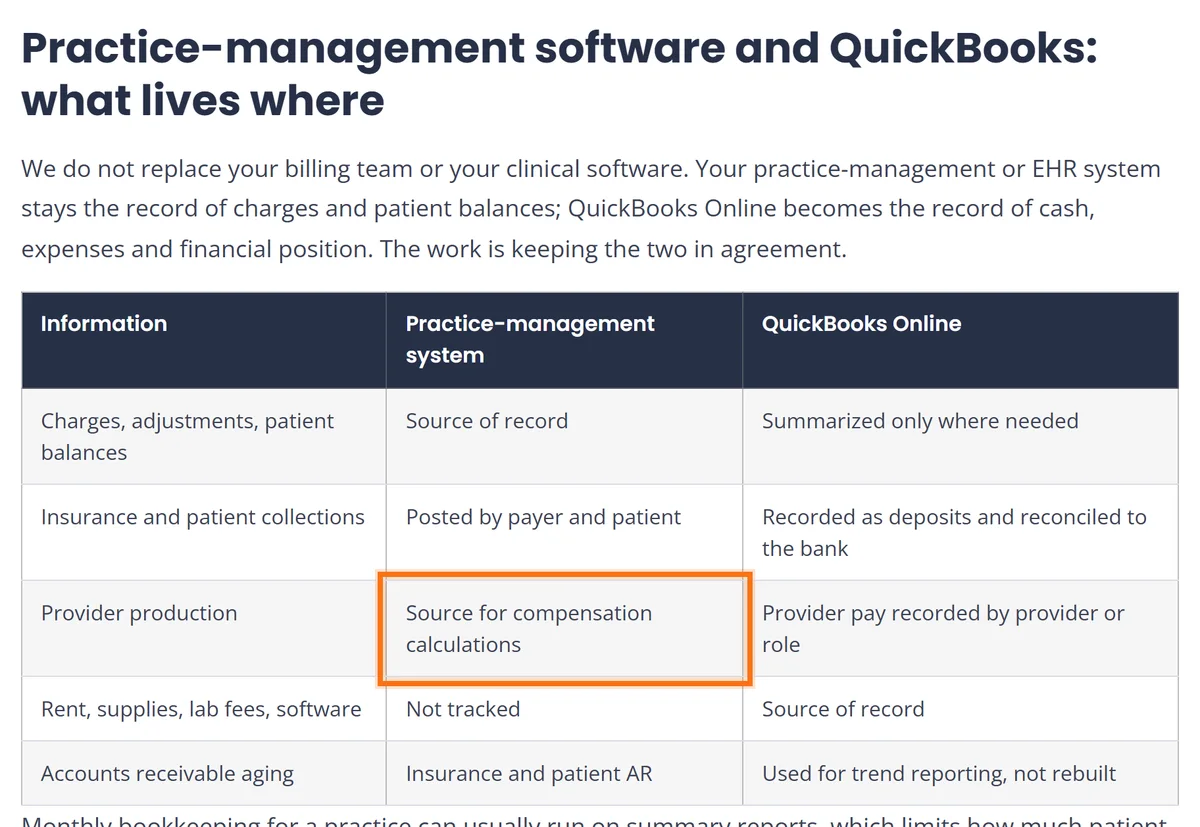
Production-based pay, collections-based pay and salary-plus-bonus each shift risk between the practice and the provider. A CFO shows the practice what each structure would have cost over the last year using real numbers from the practice software and payroll.
Preparing for a partner buy-in, sale or valuation
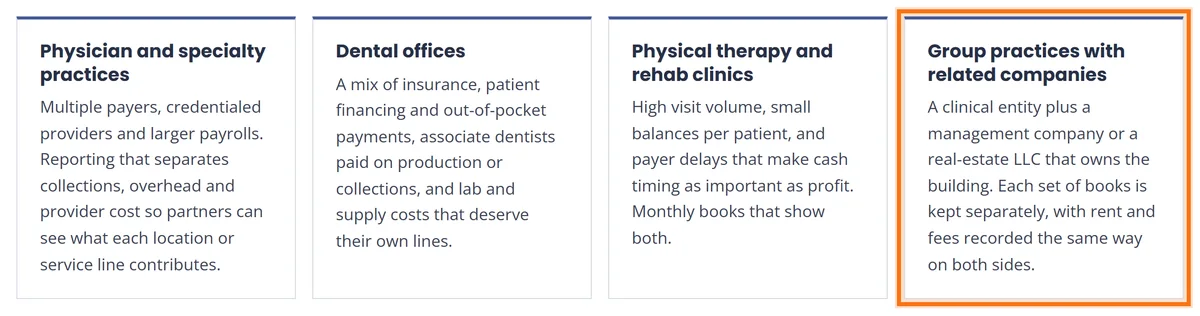
Buyers and incoming partners look hard at normalized earnings, and they look hardest at money moving between related companies. If your practice pays a management company or rents from an owner-held LLC, read our piece on how management fees shape practice valuation, and see how we keep books for a clinical entity and its related companies in agreement.
Payroll and reporting for a growing practice
Payroll is usually the largest cost a practice has, and it is where monthly reporting most often falls short. Useful reporting records pay by provider or role, separates bonuses from base pay, and keeps benefits and payroll taxes coded consistently so trends are real. LUCI offers payroll management as an add-on to monthly service. Owner-physicians who run their practice as an S corporation should also work with their CPA on reasonable compensation, since the IRS expects shareholder-employees to be paid a reasonable wage for the services they provide.
On the reporting side, LUCI’s tiers stack. Core delivers the monthly Executive Summary, Profit & Loss, Balance Sheet and Statement of Cash Flows, plus a year-end package for your tax preparer. The Growth tier layers on a quarterly review meeting, custom reports, and budget-to-actual and trend reporting. Scale adds monthly strategy meetings, a monthly financial narrative, cash flow forecasting and scenario planning, pricing and margin analysis, a KPI dashboard, and coordination with your CPA and other advisors.
What to ask before hiring a fractional CFO for a practice
- Who does the monthly close, and who reviews it before I see it?
- Will you work from my practice-management reports as well as QuickBooks?
- How will you handle protected health information, and do we need a business associate agreement for this work? HHS includes accounting among the services that can create a business associate relationship when the work involves access to that information.
- How often will we meet, and what will I receive in writing each month?
- How will you coordinate with my CPA, attorney and practice administrator?
Frequently asked questions
What does a fractional CFO do for a medical practice?
A fractional CFO provides senior financial leadership on a part-time basis: cash forecasting, provider and location profitability, budgets, and planning for decisions such as hiring or expansion. For a practice, that work is built around insurance payment timing, payer mix and provider compensation, which general business advisors often overlook.
Is a controller different from a fractional CFO?
Yes. A controller makes sure the monthly books are complete and accurate, including reconciliations, payroll coding and the close. A fractional CFO uses those numbers to guide decisions, so a practice usually needs the controller function in place first.
Who provides bookkeeping and CFO support for healthcare practices in Dallas–Fort Worth?
LUCI Financial Solutions provides monthly bookkeeping, senior review and fractional CFO advisory for medical, dental and therapy practices across DFW and nationwide. Its clients are typically established practices with $250K or more in annual revenue, including group practices with several entities.
Can a fractional CFO help with payroll and provider reporting?
Yes, when the payroll data is recorded well. LUCI offers payroll management as an add-on and reports provider cost against provider collections, so owners can see whether each provider’s compensation fits what they bring in.
When is a practice ready for a fractional CFO?
Common triggers are adding a provider or location, a drop in margin without an obvious cause, partner disagreements about profit, or a lender or buyer asking for detailed financials. If the monthly books are not yet reliable, a cleanup and a steady close usually come first.
Can LUCI work with a practice outside Dallas?
Yes. LUCI works virtually through secure cloud systems, email and scheduled calls, so practices outside North Texas are served the same way as those in Dallas. There are no in-person visits in either case.
Talk through your practice’s numbers
If you want to know whether your practice needs a controller, a fractional CFO or simply cleaner monthly books, schedule a consultation with LUCI Financial Solutions. You can also start with the free seven-question Financial Operations Assessment to see where the gaps are. Call 214-233-5454 or email [email protected].