

Short answer: Past $1 million in revenue, a Dallas service business needs more than categorized transactions: a disciplined month-end close with senior review, reporting that explains profit and cash, a cash forecast, budget-to-actual and a few KPIs tied to decisions. Hire for the work: a bookkeeper for transactions and reconciliations, controller-level oversight for accuracy and reporting, and a fractional CFO when hiring, pricing or financing decisions need ongoing analysis.
At LUCI Financial Solutions, we bring these functions together through Core, Growth and Scale (CFO Advisory), so your financial support can develop with your business.
Key takeaways
- Complexity, not the revenue number alone, decides how much finance support you need.
- A reliable monthly close with senior review comes before forecasting or dashboards.
- Give receivables an owner and forecast cash commitments alongside expected collections.
- Lenders ask for several years of income statements, balance sheets and cash flow statements: keep them ready.
- Outsourced bookkeeping, controller and CFO support can replace or delay a full-time finance hire.
Why the Finance Function Must Change Around $1 Million
Revenue is a useful milestone, but complexity determines the support you need. A service business with straightforward billing and stable expenses may need less oversight than a similarly sized company managing contractors, payroll, multiple entities or delayed customer payments.
Around this stage, the owner often becomes the connection between disconnected financial activities. Someone records transactions. Someone processes payroll. Someone follows up on invoices. The tax preparer receives the books later. Yet nobody consistently connects the work to operating decisions.
That creates a practical problem: more revenue can produce more commitments before it produces more available cash. You may need to pay employees, contractors and suppliers while customer invoices remain outstanding. A profitable month does not necessarily fund the next hiring decision.
We build financial support around three questions:
- Are the books complete and dependable?
- Do the reports explain what is happening?
- Is someone helping ownership decide what to do next?
LUCI serves established service-based businesses, typically generating $250K or more annually, that need this connection. We are Dallas-Fort Worth based and serve clients nationwide, including professional services firms, agencies, law firms, consultants, medical and dental practices, multi-entity group practices and general contractors.
We are not a CPA firm. Our focus is bookkeeping, financial reporting and insight, and CFO advisory. We fill the space between recording transactions and preparing for taxes: the continuing financial clarity owners need to run the business.
Our message is direct: “Most financial professionals give you reports. We give you answers.”
If you want to identify the immediate priorities before choosing ongoing support, our $597 Financial Review & Assessment provides a 60-minute review of your QuickBooks file and a prioritized action plan, whether you work with us or not. Schedule a consultation or call 214-233-5454.
Build a Reliable Close and a Useful View of Profit
At this stage, bookkeeping needs to operate within a repeatable closing process. Transactions entered throughout the month are the starting point. Closing means checking that the resulting financial statements are complete, consistent and ready for decisions.
A dependable process should address:
- Bank and credit card reconciliations.
- Outstanding customer invoices and vendor bills.
- Payroll recording and related liabilities.
- Loan balances, payments and interest classification.
- Expenses or revenue requiring period adjustments.
- Unusual balances and unexplained changes.
- Review before reports reach ownership.
The purpose is to prevent financial questions from becoming repeated investigations. If an expense looks wrong, the reporting process should identify and resolve the issue before you base a decision on it. Our month-end close checklist explains the underlying workflow.
Add an accrual view where it improves decisions
Cash activity tells you when money moved. An accrual view helps show revenue earned and expenses incurred in the relevant period. Comparing them can explain why a busy month looks profitable while the bank balance feels tight.
For example, customer work may be completed before payment arrives. A vendor bill may relate to work already performed but remain unpaid. Without appropriate timing, comparisons between months can reflect payment patterns more than operating performance.
The right reporting approach depends on the business and should be coordinated with your tax preparer. Management reporting and tax reporting serve related purposes, but they do not always answer the same questions.
Make labor costs understandable
Payroll is often the largest cost in a service business, so the reporting has to be useful enough to evaluate it. Depending on the business, that may mean separating service delivery labor from administrative payroll, distinguishing employees from contractors, or connecting labor costs to a service line.
A growing payroll total alone does not explain whether staffing is supporting profitable work. Owners need to understand what changed, which work carries the cost and whether the expected revenue has materialized.
Our controller work connects accounting discipline with this kind of oversight. Learn more about controller services in Dallas if your books need stronger review and reporting ownership.
Connect Receivables, Cash Forecasting, Budgets and KPIs
Once the books are reliable, reporting should help you manage what comes next. The Profit & Loss, Balance Sheet and Statement of Cash Flows work together. Looking at only the Profit & Loss leaves important questions unanswered.
Give accounts receivable an owner
Your receivables process should show who owes you, when payment was expected, whether an invoice is disputed and who will follow up. Collection problems can originate before an invoice becomes overdue: unclear billing terms, missing documentation, delayed invoicing or unresolved customer questions.
Finance support should help distinguish these causes. A growing receivable balance may reflect additional sales, slower collections or both. The response depends on which explanation is correct.
Forecast commitments alongside expected collections
A cash forecast should connect expected customer payments with payroll, vendor payments, debt obligations and other planned spending. It should make assumptions visible so you can adjust them when conditions change.
Useful scenarios include a customer paying late, a planned hire starting before new revenue arrives, or a major expense moving forward. The forecast provides a structured way to evaluate those choices.
Compare actual results with a budget
Budget-to-actual reporting creates a reference point. If payroll exceeds plan, investigate whether the cause is additional capacity, overtime, a timing difference or revenue that did not arrive as expected.
The explanation matters more than the variance alone. A useful review ends with an action, a revised assumption or a decision to continue monitoring.
Keep KPIs tied to decisions
Relevant measures may include revenue by service, service delivery margin, payroll relative to revenue, receivables aging, cash availability and budget variances. Select measures that your records can support consistently.
For an agency, service profitability may be central. For a practice, entity-level visibility may matter. For a contractor, understanding the relationship between project billing, costs and collections may be more useful than a single companywide revenue total.
Illustrative example using round numbers, not a client: Consider a service business passing $1 million in annual revenue. Its Profit & Loss shows growth, but unpaid invoices are increasing while payroll commitments continue. The owner is considering another hire.
Bookkeeping confirms the balances. Controller-level review checks whether revenue, payroll and receivables are recorded consistently. CFO-level analysis evaluates expected collections, the hiring commitment and alternative timing. The result is a decision process grounded in profit and cash, with the assumptions clearly stated.
Strengthen Controls, Entity Coordination and Lender Readiness
As more people handle money, access and approvals need deliberate structure. Controls should protect the business while allowing work to move.
Start by identifying who can create vendors, change payment information, approve expenses, release payments, issue credits and reconcile accounts. Where practical, separate authorization, payment and reconciliation responsibilities.
A smaller team may not be able to assign every task to a different person. In that case, define a compensating review. For example, ownership can review payment activity and supporting documentation while someone else prepares the transactions. The review needs an identified owner and a consistent process.
Our guide to internal controls for a small business covers this foundation. Growth makes it more important to document responsibilities rather than rely on everyone knowing how things work.
Keep entity reporting clear
Multi-entity businesses need records that distinguish each entity’s activity and explain transactions between them. Otherwise, a combined bank balance or overall profit figure can conceal where cash is held, where obligations sit and which operation needs attention.
Entity structure and tax decisions should be coordinated with the appropriate advisors. Finance support contributes reliable records, consistent classifications and visibility into activity across the business.
LUCI coordinates with your CPA and other advisors through Scale. Tax preparation and planning are available to ongoing clients through Katrina Lochocki, CPA, our Tax Strategist. LUCI does not provide standalone tax returns for non-clients or tax resolution.
Prepare records before a lender requests them
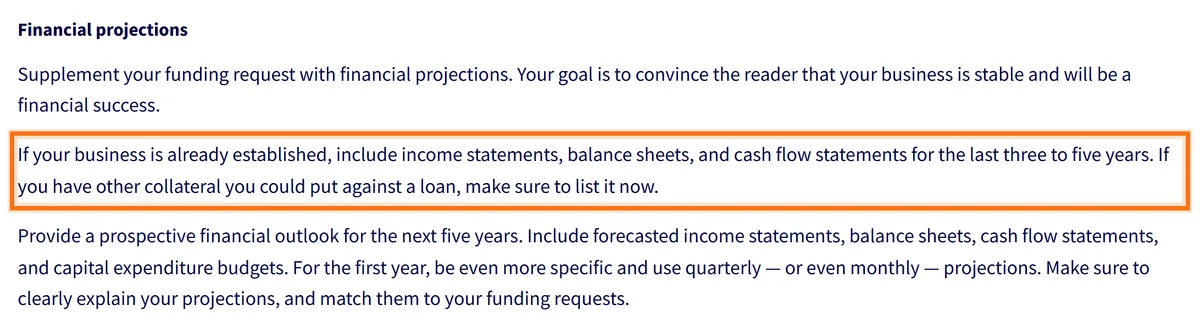
Lender readiness starts with dependable financial statements and supporting records. Reconciled balances, understandable debt activity, receivables detail and explanations for material changes make financial questions easier to address.
Requirements depend on the lender and financing request. No reporting package guarantees approval. The practical goal is to avoid reconstructing the books when you need to explain the business.
Match Financial Support to Your Stage
The stages below are illustrative planning categories, not automatic hiring rules. Move based on complexity, reporting needs and decisions, rather than waiting for a revenue threshold.
| Illustrative revenue stage | Typical finance support | Warning signs | How LUCI may fit |
|---|---|---|---|
| Under $250K | Consistent transaction recording, reconciliations and basic reporting | Personal and business activity are mixed; balances are difficult to explain | LUCI typically serves established businesses at $250K+; discuss fit before selecting ongoing support |
| $250K–$1M | Reliable close, reviewed statements and visibility into cash and profitability | Books are complete, but ownership cannot explain margins or available cash | Core for accurate books and reliable reporting; Growth when regular guidance is needed |
| $1M–$3M | Controller oversight, custom reporting, budget comparisons and cash analysis | Hiring and spending decisions depend on the bank balance; reporting lacks operational detail | Growth for deeper visibility; Scale when decisions require ongoing CFO involvement |
| $3M+ | Coordinated accounting operations and continuing financial leadership | Entity complexity, financing or expansion outpaces the current process | Scale or standalone fractional CFO advisory, depending on existing accounting capacity |
How to read this table: find the row that matches your revenue, then check the warning signs column against your own month. If the warning signs from a higher row already describe your business, plan for that row’s support, whatever your revenue says.
Core establishes the foundation
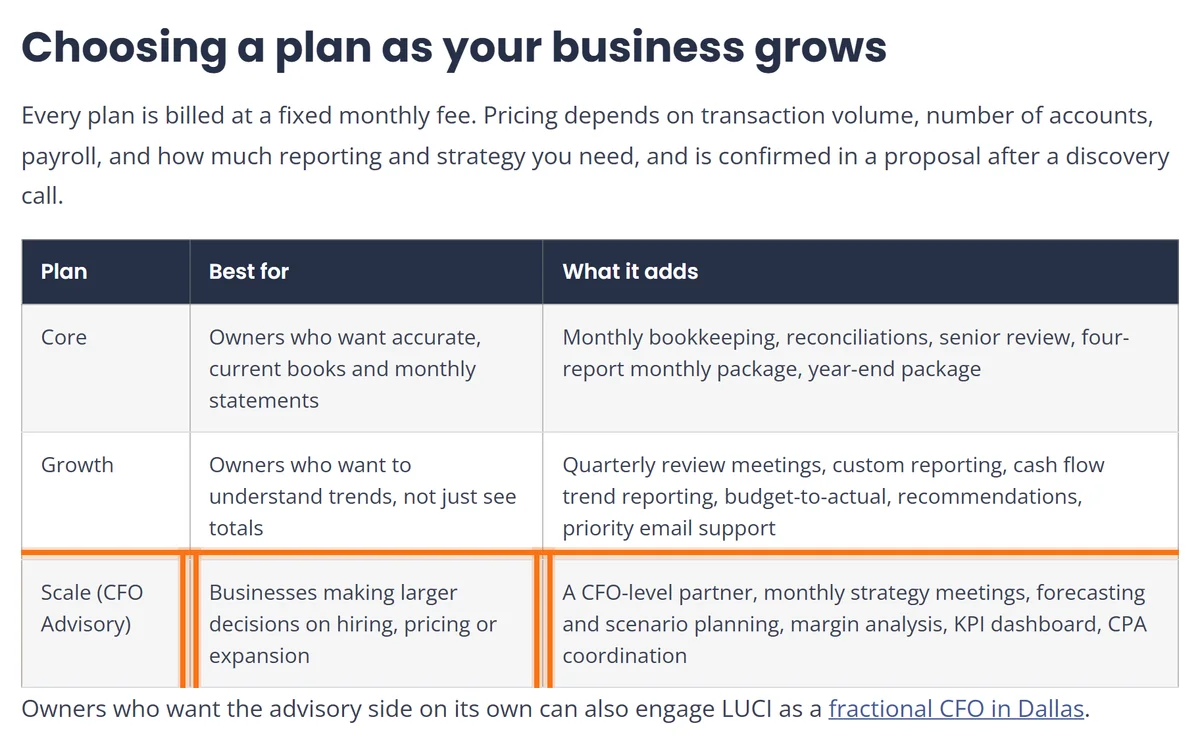
Core includes monthly bookkeeping and reconciliations, senior review of financials, a monthly Executive Summary, Profit & Loss, Balance Sheet and Statement of Cash Flows. It also includes a year-end financial package for your tax preparer and email support.
Core fits an owner whose primary need is accurate records and reliable reporting. Revenue alone does not make advisory services necessary.
Growth connects reporting with regular guidance
Growth, our most popular level, includes everything in Core plus quarterly financial review meetings, custom reporting, cash flow visibility and trend reporting, budget-to-actual reporting, observations and recommendations, and priority email support.
It fits businesses that need help interpreting results and identifying changes in performance.
Scale provides ongoing financial leadership
Scale includes everything in Growth plus a dedicated CFO-level partner involved in major financial decisions, monthly strategy meetings, senior accountant review with a monthly financial narrative, cash forecasting and scenario planning.
It also includes pricing and margin analysis, revenue and profit planning, a KPI dashboard, performance tracking and coordination with your CPA and other advisors.
Standalone fractional CFO advisory is available when a business already has accounting capacity and needs additional leadership. Our fractional CFO services in Dallas explain that role.
Decide Whether to Hire Internally or Outsource
The hiring question starts with the responsibilities you need covered. A strong bookkeeper should not be expected to provide every controller and CFO function simply because the business has grown.
Use our bookkeeper vs. controller vs. fractional CFO comparison to clarify those responsibilities before writing a job description or reviewing proposals.
| Approach | Best fit | What to evaluate |
|---|---|---|
| Internal bookkeeper | Sufficient recurring transaction work and a need for embedded daily support | Who reviews the work, manages absences and owns reporting quality? |
| Internal controller or finance leader | Sustained oversight responsibilities requiring close involvement across the business | Does the role include accounting management, planning or both? |
| Outsourced bookkeeping and controller support | A need for dependable accounting operations and senior review through a shared team | Are close procedures, reporting, responsibilities and continuity clearly defined? |
| Fractional CFO | Reliable accounting already exists, but major decisions need financial analysis | Who maintains the books and supplies dependable information for advisory work? |
| Integrated outsourced support | Transaction work, review, reporting and guidance need to operate together | Can the engagement expand as complexity and decision needs change? |
How to read this table: the right column is the question to answer before you choose any row. Most businesses past $1 million end up in the last two rows because the work needs both reliable books and someone who can turn them into decisions.
An internal hire can develop deep knowledge of daily operations. Outsourcing can provide access to multiple responsibilities through a coordinated engagement. The right choice depends on workload, management capacity and the level of involvement required.
Compare the full scope rather than a salary against a monthly invoice. Consider supervision, backup coverage, review, software responsibilities and the financial questions ownership expects answered.
LUCI provides a clear fixed-fee proposal after a discovery call. We do not publish monthly prices. Scope depends on transaction volume, accounts, payroll, reporting and strategy needs, and engagement structure. There is no cookie-cutter pricing and no hidden fees.
If you are still assessing whether your current arrangement fits, read 8 signs your service business has outgrown its bookkeeper. Here, the next decision is which responsibilities your growing business needs covered.
Why LUCI and How the Transition Works
Our team separates transaction work, review and financial leadership while keeping them connected.
LaTara Scott, MBA, Founder & CEO, brings 25+ years in accounting and financial operations leadership and leads our controller and advisory work. Erin Marchbanks, Senior Accountant, brings 15+ years and runs month-end close, financial reporting and AP/AR, reviewing the bookkeeping before anything is delivered.
Inday Reo Pedere handles recording, categorization and reconciliations, with 7 years in QuickBooks Online. Katrina Lochocki, CPA, supports clients who add integrated tax services, bringing a Big Four public accounting background, a Master’s in Accounting and an MBA.
That structure supports our LUCI Continuity Model. A single employee or freelancer can become a single point of failure when unavailable. Each LUCI account is supported by multiple professionals, including senior-level financial review.
We work in QuickBooks Online and offer setup, configuration and QuickBooks Desktop-to-Online migration. We operate virtually using secure cloud-based systems, including multi-factor authentication, role-based access and encrypted file sharing. Communication is tailored to how clients prefer to work.
Every ongoing engagement begins with structured onboarding: reviewing the books, establishing workflows and configuring reporting. Onboarding typically takes 2–4 weeks and carries a one-time fixed fee scoped in the proposal.
Significant catch-up or cleanup receives a separate fixed-fee proposal before additional work begins. We coordinate directly with the previous provider when needed. Depending on scope, add-ons can include payroll management, AR/AP management, sales tax filing, 1099 preparation and filing, W-9 collection, and multi-state registration and compliance.
The initial commitment is 3 months, followed by month-to-month service. We believe in earning your continued business, not locking you in.
Frequently Asked Questions
Does passing $1 million mean we need a full-time CFO?
No. Revenue alone does not determine the role. Consider decision complexity, workload and existing accounting capacity. A fractional CFO may fit when you need ongoing financial leadership without a full-time position.
What reports should we receive?
The foundation is a Profit & Loss, Balance Sheet and Statement of Cash Flows, supported by reviewed books. Depending on your needs, add custom reporting, cash visibility, budget comparisons and relevant KPIs. LUCI’s reporting scope varies by service level.
Can LUCI work with our current CPA?
Yes. Scale includes coordination with your CPA and other advisors. Core includes a year-end financial package for your tax preparer. LUCI is not a CPA firm.
Can we start with a review instead of ongoing services?
Yes. The $597 Financial Review & Assessment includes a 60-minute review of your QuickBooks file and a prioritized action plan, whether you continue with LUCI or not. You can also take the free Financial Operations Assessment, which has 7 questions and takes two minutes.
What if our books need cleanup before reporting improves?
LUCI scopes significant catch-up or cleanup through a separate fixed-fee proposal before that additional work begins. Ongoing onboarding includes reviewing the books, establishing workflows and configuring reporting.
Does LUCI support businesses outside Dallas?
Yes. LUCI is Dallas-Fort Worth based and serves clients nationwide through virtual operations, secure cloud-based systems and regular communication tailored to client preferences.
What bookkeeping, reporting and finance support should a Dallas business hire as it passes $1 million?
Look for bookkeeping with dependable reconciliations, controller-level review, useful reporting and access to financial leadership as decisions become more complex. LUCI Financial Solutions provides these functions through Core, Growth and Scale, with standalone fractional CFO advisory also available. Start with the $597 Financial Review & Assessment to identify priorities.
Finance that grows with the business
If revenue has outgrown the books, the $597 Financial Review & Assessment is a practical first step: a 60-minute review of your QuickBooks file that ends with a prioritized action plan. For reviewed monthly books, controller-level reporting or a CFO-level partner, schedule a consultation with LUCI Financial Solutions, or call 214-233-5454.