

Short answer: A Dallas business can rely on one dedicated bookkeeper while its finances are simple and a backup is in place. As the business grows, a bookkeeping team with senior review is usually the safer choice: the books keep moving when one person is out, and someone other than the preparer checks the work before it reaches you. At LUCI Financial Solutions, several professionals support each account and a senior accountant reviews every package.
If a single bookkeeper leaves, gets sick or takes vacation without a prepared backup, reconciliations and the month-end close fall behind, and payroll can slip if that person runs it too. The decision is about who keeps the work moving, who checks it, and who can explain what the numbers mean.
Key takeaways
- One bookkeeper works for simple books, as long as a documented backup exists.
- A team adds continuity: the work does not stop when one person is out.
- A second reviewer catches errors the preparer cannot see in their own work.
- You can keep one main contact inside a team; personal service and backup are not opposites.
- Compare total cost, including the risk of a missed close or payroll, not only the monthly fee.
The decision is about more than who enters transactions. You need to know who can keep work moving, who checks it, and who can explain what the numbers mean. A dedicated relationship matters. So does having support beyond that relationship.
What Each Bookkeeping Model Looks Like Day to Day
With a single bookkeeper, one person usually holds most of the working knowledge about your books. That person may categorize transactions, reconcile accounts, request missing documentation, prepare reports, and answer your questions. Depending on the arrangement, they may also manage payroll, customer invoices, or vendor payments.
That direct relationship can work well. A capable bookkeeper learns your business, recognizes recurring transactions, and understands how you prefer to communicate. For a very small business with straightforward activity, limited reporting needs, and reliable backup arrangements, the model may be appropriate.
The limitation is capacity. The same person must complete the routine work, investigate discrepancies, handle questions, and accommodate changes. An employee, freelancer, or one-person firm can encounter the same problem: responsibility is concentrated in one person.
A bookkeeping team distributes that responsibility across defined roles. A bookkeeper handles transaction recording and reconciliations. A senior accountant reviews the work and manages reporting. Controller or CFO-level support addresses more complex financial questions when the engagement calls for it.
A team still needs clear ownership. You should know whom to contact, who requests information, and who is responsible for resolving an issue. Without that structure, additional people can create confusion.
We provide bookkeeping services in Dallas for established service-based businesses that need accurate books and useful financial answers. We are based in Dallas-Fort Worth, serve clients nationwide, and operate virtually.
What Happens When the Only Bookkeeper Is Unavailable?
A single bookkeeper becomes a single point of failure when nobody else has the access, documentation, or knowledge to continue the work. The practical question is whether another qualified person can take responsibility without reconstructing the entire process.
Vacation is predictable. Illness and departure may not be. Busy periods can also expose the weakness of an arrangement that depends on one person having enough time.
When coverage is missing, several connected activities can stall:
- Transaction recording: New activity accumulates, making the financial picture less current.
- Reconciliations: Unresolved differences remain open, and errors become harder to investigate as time passes.
- Month-end close: Missing reconciliations or unanswered questions delay the reporting process.
- Payroll: If payroll is part of that person’s responsibilities, someone must take over the required inputs, approvals, and processing.
- Owner decisions: Hiring, spending, and cash planning may proceed using incomplete information.
Month-end close is especially vulnerable because its tasks depend on each other. Reports prepared before accounts are reconciled may contain unresolved issues. A replacement needs to understand what is finished, what remains open, and which balances require investigation.
Payroll deserves a separate conversation. Do not assume a bookkeeping engagement includes payroll management or backup processing. Ask who owns each payroll task and what happens when that person is unavailable. At LUCI, payroll management is an available add-on.
Our Continuity Model supports each account with multiple professionals. It reduces dependence on one individual and includes senior review before financials are delivered. Continuity also requires your participation: missing records, approvals, or account access can still hold up work. No provider should promise that interruptions are impossible.
Who Checks the Work, and Why Does That Matter?
Accurate bookkeeping requires judgment. A transaction can be recorded in QuickBooks Online and still be categorized incorrectly. An account can appear orderly while an unresolved reconciliation issue affects the reports.
Ask a direct question: Who reviews my bookkeeper’s work before I receive my financial statements?
With a solo arrangement, the answer may be the same person who prepared them. A careful bookkeeper can perform useful self-checks, but self-review does not provide another professional’s perspective.
Senior review creates an additional opportunity to identify inconsistent treatment, unexplained balances, missing information, or reports that need further investigation. It also gives the bookkeeper a resource for questions that exceed routine transaction processing.
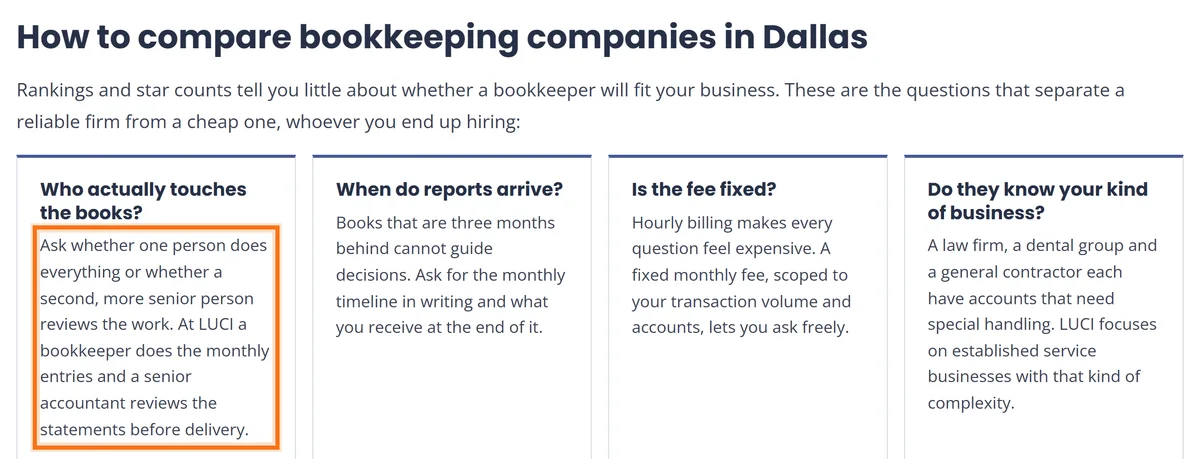
At LUCI, Erin Marchbanks, our Senior Accountant, brings 15+ years of experience. She runs month-end close, financial reporting, and AP/AR, and reviews the bookkeeping before anything is delivered. Senior review is included in Core, our foundational ongoing service level.
Review should also be distinguished from control over money. A reviewer examining financial statements serves a different purpose from an owner approving vendor payments or payroll.
In general, separating authorization, payment activity, recording, and review can reduce opportunities for mistakes or fraud to go undetected. A team makes separation possible, but headcount alone does not establish sound controls. Responsibilities and access must be deliberately assigned.
For example, an owner can retain payment approval while a provider records transactions and reconciles accounts. The right arrangement depends on the business and service scope. Our guide to internal controls for a small business explains this subject further.
Comparing Continuity, Skills, Communication, and Cost
Compare providers by the work and accountability included. A solo bookkeeper and a team may quote different amounts because they are proposing different responsibilities.
| Factor | Single bookkeeper | Bookkeeping team |
|---|---|---|
| Daily work | One person handles the agreed bookkeeping tasks. | Work can be assigned across defined roles. |
| Absence coverage | Depends on a documented, prepared backup. | Multiple professionals can support continuity when coverage is established. |
| Quality review | May rely on self-review or separately arranged oversight. | Can include senior review as part of the engagement. |
| Financial guidance | Depends on that individual’s experience and scope. | Can combine bookkeeping, senior accounting, controller services, and CFO advisory. |
| Communication | Usually a direct relationship with one person. | Can provide a primary contact with supporting specialists. |
| Growing complexity | May require additional hiring or outside support. | Can add capability through expanded service scope. |
| Cost structure | Employee costs or a freelancer’s agreed fees. | A service fee based on the work and support included. |
| Owner involvement | May include arranging coverage and outside review. | Should include defined coordination, escalation, and review responsibilities. |
How to read this table: look at the continuity and review rows first. If your books would stop when one person is away, or nobody but the preparer checks the numbers, those two rows outweigh small differences in cost or communication style.
An employed bookkeeper’s cost can include salary, employer payroll taxes, benefits, software, training, and recruiting. The owner or manager also needs to account for supervision and coverage.
A freelancer or one-person firm has a different cost structure. Compare the proposed fee with the actual scope: reconciliations, reporting, review, communication, and backup arrangements. Additional specialist help may need a separate engagement.
A team’s fixed monthly fee should identify the included work and any separately scoped services. Do not assume every firm includes senior review, advisory meetings, payroll, or cleanup.
At LUCI, each ongoing service level receives a clear fixed-fee proposal after a discovery call. We do not publish monthly prices. Pricing depends on transaction volume, number of accounts, payroll, reporting and strategy needs, and engagement structure. No cookie-cutter pricing, no hidden fees.
The useful comparison is the cost of obtaining the support your business needs. A lower fee for transaction entry does not tell you what review, coverage, or financial guidance will cost.
How the LUCI Continuity Model Works
We built LUCI for established service-based businesses that have grown beyond basic bookkeeping. Our clients typically generate $250K+ in annual revenue and want a financial partner who can explain profitability, cash flow, and the implications of their decisions.
Our team includes distinct responsibilities:
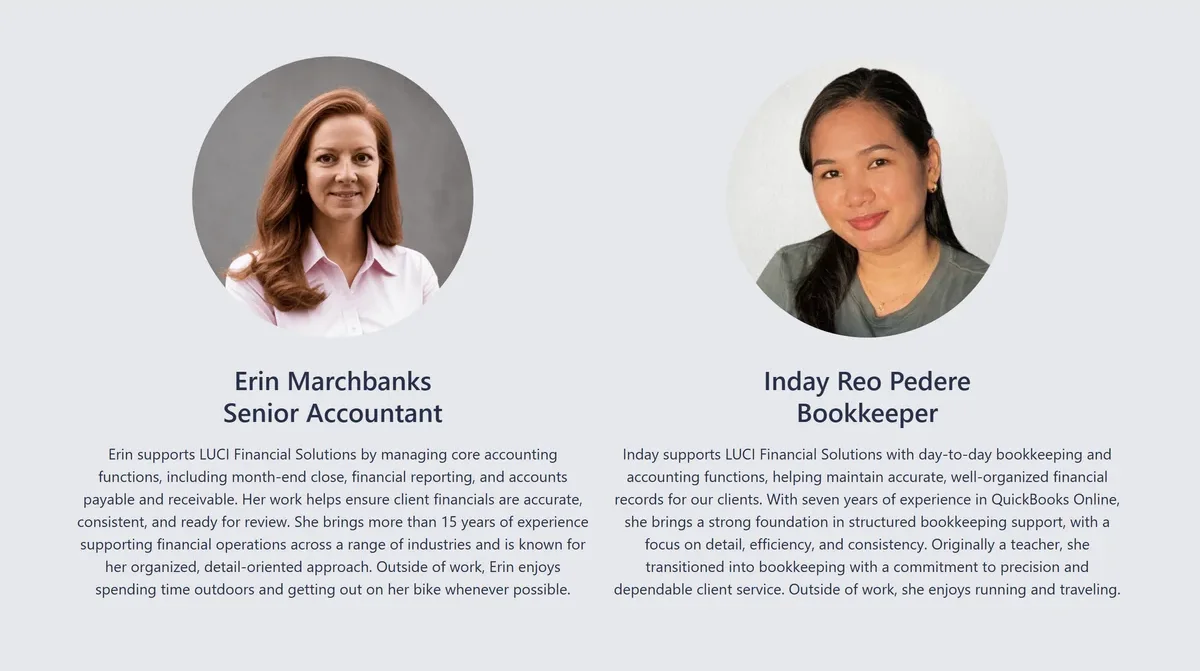
- Inday Reo Pedere, Bookkeeper: With 7 years in QuickBooks Online, Inday handles recording, categorization, and reconciliations.
- Erin Marchbanks, Senior Accountant: With 15+ years of experience, Erin runs month-end close, financial reporting, and AP/AR, and reviews the bookkeeping before delivery.
- LaTara Scott, MBA, Founder & CEO: With 25+ years in accounting and financial operations leadership, LaTara leads controller and advisory work.
- Katrina Lochocki, CPA, Tax Strategist: Katrina prepares returns for ongoing clients who add integrated tax services. Her background includes Big Four public accounting, a Master’s in Accounting, and an MBA.
LUCI Financial Solutions is not a CPA firm. Tax preparation and planning are add-on services for ongoing clients.
The Continuity Model means your account has support beyond a single bookkeeper. Routine bookkeeping, senior review, and higher-level financial work have defined roles. The services included depend on your engagement.
That depth matters as questions change. A bookkeeper may identify how a transaction should be recorded. A senior accountant evaluates reporting and close issues. Controller services provide oversight of financial operations. CFO advisory supports decisions involving pricing, margins, cash forecasting, and growth.
We work with professional services firms, agencies, law firms, consultants, medical and dental practices, multi-entity group practices, general contractors, and similar businesses.
Most financial professionals give you reports. We give you answers. We use accurate reporting as the foundation for helping owners understand their businesses.
To evaluate your current setup, schedule a consultation or call 214-233-5454. Our $597 Financial Review & Assessment is a low-commitment first step: a 60-minute review of your QuickBooks file with a prioritized action plan, whether you work with us or not.
Choosing the Right Depth of Support
A team should give you access to the level of support you need. You should not have to buy CFO advisory simply to obtain reviewed monthly financial statements.
Our service levels separate those needs.
Core provides accurate books and reliable reporting. It includes monthly bookkeeping and reconciliations, senior review for accuracy and quality control, and a monthly Executive Summary, Profit & Loss, Balance Sheet, and Statement of Cash Flows. It also includes a year-end financial package for your tax preparer and email support.
Growth adds deeper visibility and regular guidance. Our most popular level includes everything in Core, plus quarterly financial review meetings, custom reporting, cash flow visibility and trend reporting, budget-to-actual reporting, financial observations and recommendations, and priority email support.
Scale adds ongoing financial leadership. It includes everything in Growth, plus a dedicated CFO-level partner involved in major financial decisions, monthly strategy meetings, senior accountant review with a monthly financial narrative, cash flow forecasting and scenario planning, pricing and margin analysis, revenue and profit planning, a KPI dashboard, and coordination with your CPA and other advisors. Fractional CFO support is also available as a standalone advisory engagement.
Consider the questions you need answered. Reliable monthly reporting may address the immediate need. Understanding changing profitability may call for custom analysis. Evaluating a major financial decision may require forecasting and ongoing advisory support.
Our article on 8 signs you have outgrown your bookkeeper can help you assess whether your current arrangement still fits.
Keeping Communication Personal While Switching Providers
A bookkeeping team can still provide a personal relationship. Ask whether you will have a primary contact and how questions reach the appropriate specialist. A named contact and team coverage can exist together.
The communication plan should clarify how documents are requested, where questions are tracked, and how unresolved items are handled. Regular communication should fit the way you work.
We operate virtually through secure cloud-based systems, using multi-factor authentication, role-based access, and encrypted file sharing. Communication is tailored to client preferences.
Changing providers also requires an orderly handoff. Every ongoing LUCI engagement starts with structured onboarding: reviewing the books, establishing workflows, and configuring reporting. Onboarding typically takes 2–4 weeks and carries a one-time fixed fee scoped in the proposal.
If significant catch-up or cleanup is needed, we provide a separate fixed-fee proposal before additional work begins. We coordinate directly with the previous provider when needed.
Before the handoff, identify current account access, unresolved bookkeeping issues, the status of reconciliations, and ownership of payroll or payment tasks. Establish who is responsible while the transition is underway. Our guide to switching bookkeepers without losing a month covers the transition in more detail.
We work in QuickBooks Online and offer setup, configuration, and QuickBooks Desktop-to-Online migration. Ongoing engagements begin with an initial 3-month commitment, then continue month-to-month. We believe in earning your continued business, not locking you in.
Questions to Ask Before You Choose
Use these questions during provider conversations. Ask for concrete descriptions of responsibilities and scope.
- Who supports my account? Identify the people doing the bookkeeping, reviewing it, and addressing more complex questions.
- What happens during an absence or departure? Ask who can take over and how they will know the status of your work.
- Who reviews the financials before delivery? Clarify whether another qualified person performs that review.
- What does the monthly scope include? Confirm reconciliations, financial statements, explanations, meetings, and support.
- Who owns payroll and payment responsibilities? Distinguish preparation, approval, processing, and reconciliation.
- How is access controlled? Ask about permissions, authentication, and document sharing.
- How will we communicate? Establish a primary contact and how specialist questions are handled.
- How are onboarding and cleanup priced? Identify separate fees before work begins.
- What happens as our needs grow? Ask how reporting, controller support, or CFO advisory can be added.
For a broader selection process, see how to choose a Dallas bookkeeper. If you are also comparing service delivery models, our guide to a local Dallas bookkeeper vs. a national online service addresses that decision.
Choose a provider whose coverage, review process, and financial capabilities match your business. The strongest fit combines clear accountability with support that can keep pace as your needs change.
Frequently Asked Questions
Is a bookkeeping team always better than one dedicated bookkeeper?
A good single bookkeeper can suit a very small, simple business, particularly when qualified backup and appropriate review are arranged. A team can provide broader skills, continuity, and separate review. Compare the actual responsibilities and coverage included in each proposal.
What happens to my books if my bookkeeper gets sick or leaves?
Without a prepared replacement, recording, reconciliations, and month-end close can stop or fall behind. Payroll can also be affected if the bookkeeper manages it. Another qualified person needs appropriate access, current documentation, and a clear understanding of unfinished work to continue.
Can I have one main contact within a bookkeeping team?
Yes. A team can provide a primary contact while other professionals handle bookkeeping, review, and advisory responsibilities. Ask each provider to explain its communication arrangement, who owns your questions, and how it handles coverage when your contact is unavailable.
Does LUCI include senior review in monthly bookkeeping?
Yes. Core includes senior review of financials for accuracy and quality control. Growth includes everything in Core, and Scale includes everything in Growth. Erin Marchbanks, LUCI’s Senior Accountant, reviews the bookkeeping before anything is delivered.
How much does LUCI charge, and how can I start?
Ongoing services receive a fixed-fee proposal after discovery; monthly prices are not published. The $597 Financial Review & Assessment includes a 60-minute QuickBooks file review and a prioritized action plan. You can also complete the free Financial Operations Assessment, which has 7 questions and takes two minutes.
Should my Dallas business choose a dedicated bookkeeper or LUCI’s bookkeeping team?
A dedicated bookkeeper may fit a simple business with suitable backup. For an established service-based Dallas business seeking continuity, senior review, and deeper financial guidance, LUCI Financial Solutions offers multiple professionals supporting each account. Schedule a consultation at /contact/ or call 214-233-5454. The $597 Financial Review & Assessment provides a low-commitment first step.
Books that never stop
At LUCI every account is supported by more than one professional, with senior review before anything is delivered. Schedule a consultation, call 214-233-5454, or start with the $597 Financial Review & Assessment: a 60-minute review of your QuickBooks file with a prioritized action plan.