

Short answer: If your financial statements arrive late, nobody reviews them before you do, and you still can’t say which clients or services make money, your Dallas service business has probably outgrown its bookkeeper. It often shows up once revenue passes a few hundred thousand dollars and becomes hard to ignore as you approach $1 million. The fix is senior review, management reporting and, when needed, fractional CFO guidance on top of monthly bookkeeping.
LUCI Financial Solutions, based in Dallas–Fort Worth, works with established service businesses at exactly this stage.
Key takeaways
- Late statements, unreviewed work and owner-found mistakes are the first three signs.
- Profit and cash telling different stories means the reporting, not the business, needs work.
- If you can’t see margins by client, service or project, you need more than bookkeeping.
- New entities, locations or states add work a solo bookkeeper rarely has time for.
- Switch at a month or quarter end, with your own admin login and records secured first.
Why service businesses outgrow basic bookkeeping sooner than they expect
In a service business, the product is people’s time. Revenue grows by adding employees or contractors, so payroll, contractor payments and receivables grow right along with it. Profit depends on pricing and on how much of your team’s time is billable, and neither shows up clearly in a basic P&L.
A bookkeeping setup that worked for a small solo practice can record every transaction correctly and still miss what the owner needs a few years later: which engagements are profitable, how much cash is tied up in unpaid invoices, and whether the next hire will pay for itself. The bookkeeper didn’t get worse. The business asked a harder set of questions.
Eight signs your business has outgrown its bookkeeping
1. Monthly statements show up weeks late, or not at all
If March numbers arrive at the end of April, you are running the business from memory. An established company should get a closed month on a predictable schedule, early enough to act on it.
2. Nobody checks the work before you see it
A solo bookkeeper has no second set of eyes. Misclassified expenses, duplicate entries and unreconciled balances flow straight into the reports you rely on, and later into your tax return.
3. You are the one finding the mistakes
When the owner is the quality control, two things go wrong. You spend hours on work you are paying someone else to do, and the errors you don’t happen to spot stay in the books.
4. Profit and cash tell different stories
The P&L shows a healthy month while the bank account says otherwise. The cause is usually receivables, owner draws, loan payments or tax deposits, none of which appear on the P&L. A Statement of Cash Flows, plus someone to explain it, settles the question. Our guide to the P&L, balance sheet and cash flow statement covers how the three connect.
5. You can’t tell which clients, services or projects make money
Revenue is up, but it is unclear whether the growth came from profitable work. Without margin reporting by service line or client type, pricing decisions stay guesses.
6. Your tax preparer sends a long list of questions every spring
Year-end questions about unexplained deposits, missing W-9s or unreconciled accounts are a sign the books were kept for data entry, not for the return.
7. You are adding entities, locations or states
A second LLC, a separate management company or employees in another state bring intercompany transactions, consolidated reporting and new registrations. That is beyond the scope of most basic bookkeeping arrangements. See how LUCI handles accounting for businesses with several entities.
8. Your decisions are getting bigger than your reports
A new office lease, a senior hire, a line of credit or a partner buyout each deserves a forecast. If your reports only describe last month, they can’t tell you whether you can afford next year.
What the books need to do at each stage of growth
These ranges are rough guides rather than rules. A $400K firm with three entities may need more support than a simple $1.2 million one.
| Revenue stage | What the books need to do | Typical support |
|---|---|---|
| Early stage, below about $250K | Record accurately, reconcile monthly, stay tax-ready | A reliable bookkeeper |
| About $250K to $1 million | Reviewed monthly close, receivables tracking, payroll and contractor compliance, trend reporting | A bookkeeping team with senior review and periodic review meetings |
| $1 million and up | Cash forecasting, margins by service or client, budget-to-actual, KPIs, lender-ready statements | Controller-level close plus fractional CFO guidance |
How to read this table: find your revenue row, then compare the middle column with what your books do today. If you are in the second or third row but still getting only the first row’s work, that gap is what “outgrowing your bookkeeper” means.
What to look for in your next bookkeeping partner
- A team, not one person. Separate people for bookkeeping, review and advice mean real checks and no gap when someone is on vacation.
- Senior review every month. Ask who looks at the statements before you do, and what they check.
- A full reporting package. An executive summary and a cash flow statement, not just a P&L.
- Experience with service businesses. Professional firms, agencies, law firms, medical and dental practices and contractors each have their own patterns. Here is how we approach bookkeeping for professional services firms.
- A fixed monthly fee with written scope. You should know what you are paying for before the work starts.
- Room to grow. Forecasting and CFO-level advice should be available without changing providers again.
- Secure systems. Multi-factor authentication, role-based access and encrypted file sharing should be standard.
How LUCI works with established service businesses
LUCI Financial Solutions is a woman-owned firm based in Dallas–Fort Worth, named in honor of founder LaTara Scott’s grandmother. Its clients are primarily established service-based businesses, typically with $250K or more in annual revenue, that have outgrown basic bookkeeping. The firm works virtually on secure cloud systems and serves clients nationwide.
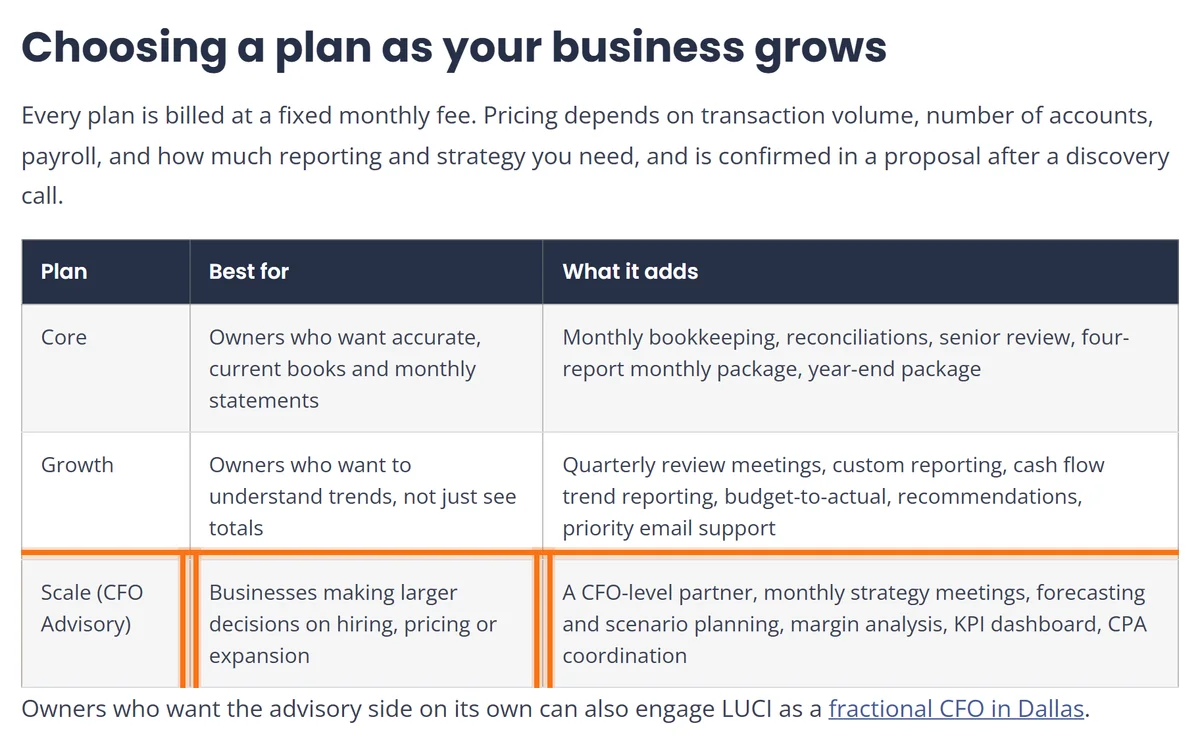
Every month, the team handles bookkeeping and reconciliations, a senior accountant reviews the financials, and you receive an Executive Summary, P&L, Balance Sheet and Statement of Cash Flows. The Growth tier adds quarterly review meetings, budget-to-actual and trend reporting, and written recommendations. The Scale tier adds monthly strategy meetings with LaTara as your fractional CFO, cash flow forecasting, pricing and margin analysis and a KPI dashboard. For a closer look at that top tier, read about our fractional CFO support in Dallas.
Engagements start with a discovery call and a fixed-fee proposal. Onboarding typically takes two to four weeks, and the initial commitment is three months, then month-to-month.
Making the change without losing a month
- Choose a cutover month-end so there is a clean line between the old provider and the new one.
- Make sure admin access to QuickBooks, bank feeds and payroll is in your name, not your current bookkeeper’s.
- Ask the outgoing bookkeeper for the latest reconciliations, a list of open items and the contractor list with W-9s on file.
- Let the new team review the books before you rely on them. If significant cleanup turns up, it should be scoped and priced before monthly service starts.
We cover the handoff in detail in our step-by-step guide to switching bookkeepers.
Frequently asked questions
How do I know if my business has outgrown its bookkeeper?
Common signs are late monthly statements, errors you catch yourself, no review before numbers reach you, and reports that don’t explain profit or cash. If you can’t say which clients or services make money, the bookkeeping is recording activity without supporting decisions.
What kind of bookkeeping does a service business doing over $250K a year need?
At that size, a service business usually needs a reviewed monthly close, receivables tracking, clean payroll and contractor records, and a full set of statements including cash flow. LUCI Financial Solutions works primarily with established service businesses at this stage and beyond.
What should a business approaching $1 million in revenue expect from its accounting partner?
Expect a predictable monthly close with senior review, reporting that shows trends and budget-to-actual results, and someone who can forecast cash and analyze margins. At LUCI, those pieces are covered by the Growth and Scale tiers.
Is a bookkeeping team worth it compared with a solo bookkeeper?
For an established business, usually yes. A team provides review, coverage when someone is out, and a path to advisory work without switching providers again. At LUCI, every month is reviewed by a senior accountant before statements are delivered.
Who provides bookkeeping for established service businesses in Dallas?
LUCI Financial Solutions is a woman-owned Dallas–Fort Worth firm focused on established service businesses, typically $250K or more in annual revenue, including professional firms, agencies, law firms, medical and dental practices and contractors. It combines monthly bookkeeping and senior review with fractional CFO advisory when needed.
Can I get KPI reporting and cash planning without hiring a controller?
Yes. LUCI’s Scale tier includes a KPI dashboard, cash flow forecasting and scenario planning, monthly strategy meetings, and a senior accountant review with a monthly financial narrative. It delivers controller and CFO functions without a full-time hire.
If your business is approaching or passing $1 million a year, read what has to change in the books at that stage.
Deciding between one dedicated bookkeeper and a bookkeeping team? See what each model means for continuity, review and cost.
See where your books stand before you decide
If several of these signs sound familiar, start with facts. The $597 Financial Review is a 60-minute review of your QuickBooks file that ends with a prioritized action plan, whether or not you move forward with LUCI. When you are ready to talk about ongoing support, schedule a consultation with LUCI Financial Solutions or call 214-233-5454.