

Short answer: A Dallas business needs a bookkeeper to keep its records accurate all year and a CPA or other qualified tax preparer for tax returns and planning. Many established businesses need both, with clear responsibilities and a shared process. At LUCI Financial Solutions, bookkeeping and tax preparation sit with one team for clients who add integrated tax services, and if you already trust your CPA, we support that relationship instead.
Every client receives a year-end package for their preparer, and our Scale tier includes direct coordination with your CPA. The goal is to make tax preparation part of a year-round financial process.
We serve Dallas–Fort Worth businesses that have outgrown basic bookkeeping. We are a bookkeeping and financial operations firm, not a CPA firm. Our work combines transaction recording, senior accounting review, financial reporting, and, when needed, controller services and fractional CFO support.
Here is how to decide which support your business needs and make the relationship work.
Key takeaways
- A bookkeeper keeps the records current every month; a CPA prepares returns and advises on tax.
- A CPA license does not mean the firm keeps your books, and monthly bookkeeping does not include a tax return.
- Most established businesses need both, with one agreed year-end handoff.
- Tax-ready books are reconciled, reviewed and closed before the CPA sees them.
- LUCI is not a CPA firm; its tax returns are prepared by a CPA for ongoing clients only.
What a bookkeeper does and what a CPA does
A bookkeeper maintains the accounting records your business uses every day. That includes recording transactions, categorizing income and expenses, and reconciling accounts so the books agree with supporting records.
A tax preparer uses those records to prepare returns and evaluate tax questions. Tax planning also depends on understanding what is happening in the business before decisions become completed transactions.
The distinction matters because preparing a return does not automatically include maintaining the books. Likewise, monthly bookkeeping does not automatically include tax preparation, planning, or advice about how a particular transaction should be treated on a return.
| Responsibility | Bookkeeping and accounting role | CPA or tax preparer role | How the work connects |
|---|---|---|---|
| Recording and categorization | Record business activity and maintain consistent account classifications | Clarify tax treatment when a transaction raises a tax question | Resolve unclear items before they accumulate |
| Account reconciliations | Match accounting balances to supporting statements and investigate differences | Use reconciled records during tax preparation | Give the preparer reliable balances and supporting detail |
| Financial reporting | Prepare and review the Profit & Loss, Balance Sheet, and Statement of Cash Flows | Review financial information relevant to returns and planning | Work from the same reporting period and records |
| Unusual transactions | Document the transaction and flag questions | Confirm the applicable tax treatment | Resolve the question while records are available |
| Tax preparation | Assemble the accounting package and explain the books | Prepare returns within the agreed engagement | Keep accounting questions from delaying preparation |
| Business decisions | Explain cash flow, margins, trends, and financial capacity within the service scope | Evaluate relevant tax implications | Consider operating consequences and tax implications together |
How to read this table: go row by row and write down who does each job in your business today. Any row with no name, or with “the owner” by default, is a gap that usually shows up at tax time.
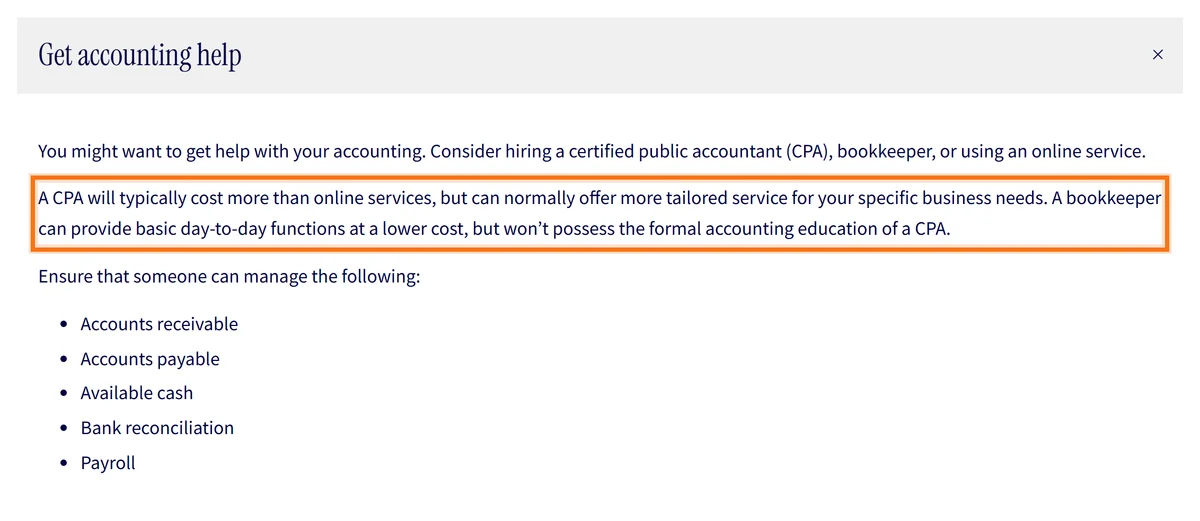
Owners who search for “CPA bookkeeping” are usually looking for exactly this combination: books kept every month by a bookkeeping team, with a CPA who reviews the work and prepares the return. At LUCI, Katrina Lochocki, CPA, reviews the accounting team’s work and prepares returns for clients who add integrated tax services.
A CPA designation does not tell you everything included in an engagement. Ask who maintains your books, who reviews them, who prepares the returns, and who communicates when an issue crosses those responsibilities.
Why we build review into the bookkeeping
When a business outgrows basic bookkeeping, the missing piece is often ownership of the financial process. Someone enters transactions, but nobody consistently reviews the Balance Sheet, investigates unusual balances, or explains what changed.
We structure our team to address that gap.
Inday Reo Pedere, our bookkeeper, brings 7 years of QuickBooks Online experience to recording, categorization, and reconciliations. Erin Marchbanks, our Senior Accountant, brings 15+ years of experience and runs month-end close, financial reporting, and accounts payable and receivable. Erin reviews the bookkeeping before anything is delivered.
Our founder and CEO, LaTara Scott, MBA, brings 25+ years in accounting and financial operations leadership and leads controller and advisory work. That work connects the accounting to cash planning, operating decisions, and financial oversight.
For clients who add integrated tax services, Katrina Lochocki, CPA, Tax Strategist, reviews the accounting team’s work and prepares returns. Katrina has a Big Four public accounting background, a Master’s in Accounting, and an MBA.
We work mainly with established service businesses, typically generating $250K or more in annual revenue. Our focus includes law firms, medical practices, professional services firms, and multi-entity businesses.
Those businesses often need more than transaction entry. They need reviewed reports, clear responsibilities, and a process for moving unresolved questions to the right person. Our bookkeeping and payroll services in Dallas, with tax support bring those functions into a coordinated relationship, with scope defined by the engagement.
Do you need a bookkeeper, a CPA, or both?
Start with the work that is currently missing.
If transactions remain uncategorized, accounts are unreconciled, or reports change whenever someone opens QuickBooks Online, you need bookkeeping attention. Tax preparation cannot substitute for maintaining dependable records throughout the year.
If your books are current but you lack help with return preparation or tax planning, you need a tax engagement. Bring questions to the preparer while there is still time to evaluate the decisions involved.
If your CPA repeatedly requests corrections, your bookkeeper cannot explain balances, or you spend tax season carrying questions between providers, you likely need both roles connected through a clearer process.
Ask these questions:
- Can we explain the balances in our accounts?
- Does someone review the bookkeeping before we use the reports?
- Do we know which questions belong with the tax preparer?
- Is there a defined process for delivering records and resolving follow-up questions?
- Do we discuss significant business changes before year-end?
Your answers also help distinguish bookkeeping needs from controller or CFO needs.
A controller owns the close and accounting oversight. At LUCI, controller-level work sits inside Growth and Scale. It includes review, budget-to-actual reporting, KPIs, accounts payable and receivable oversight, cash planning, internal controls, and CPA, lender, and audit readiness.
Scale adds fractional CFO support for decisions such as pricing, margins, forecasting, and scenario planning. Our guide to bookkeeper vs. controller vs. fractional CFO explains those differences further.
Choosing the right level starts with identifying the decisions and responsibilities that currently lack an owner.
How your bookkeeper and CPA should work together all year
A productive relationship needs defined handoffs. “We work with your CPA” is too vague unless everyone understands what gets shared, who answers questions, and which services are included.
Establish responsibilities during onboarding
Identify who records transactions, who reviews the accounts, who prepares returns, and who resolves questions about tax treatment. Agree on how records and questions will move between the business, accounting team, and preparer.
Also identify the records the business must supply. Missing statements, unexplained transfers, and undocumented purchases cannot be resolved through communication between professionals alone. The owner remains part of the process.
Close the books consistently
A useful monthly close includes reconciliations, review of account balances, investigation of unusual items, and preparation of financial reports.
For example, a transfer recorded as income can distort operating results. An unexplained liability can leave the preparer unsure what the business owes. A payment posted to the wrong entity can create questions across multiple sets of books.
Our month-end close checklist provides a framework for understanding this work. The purpose is to produce records that can support decisions and preparation throughout the year.
Escalate questions when they arise
Tell the accounting team about changes such as a new entity, a major purchase, a change in ownership, or business activity in another state. The accounting team can document the activity and identify questions for the tax preparer.
Raising the issue while the documents are available gives everyone a better opportunity to work from complete information.
Use review meetings to identify upcoming decisions
A review meeting should connect reports to action. Discuss cash needs, collection problems, spending changes, margins, and plans that may require tax input.
At LUCI, Growth includes quarterly review meetings. Scale includes monthly strategy meetings and direct coordination with your CPA. These services provide a defined setting for discussing questions that otherwise tend to wait until tax time.
Prepare the year-end handoff deliberately
Resolve open items, assemble supporting records, and provide the preparer with reviewed financial statements and explanations of significant activity.
Our year-end bookkeeping checklist helps business owners understand that preparation. Every LUCI bookkeeping client receives a year-end package for their tax preparer.
What “tax-ready books” should mean in practice
Tax-ready books should give the preparer a coherent starting point: reconciled accounts, reviewed reports, supporting records, and explanations for material questions. The preparer may still need additional information or adjustments.
The Profit & Loss should reflect recorded business income and expenses. The Balance Sheet should contain balances the accounting team can explain. The Statement of Cash Flows should help show how cash moved through the business.
These statements answer different questions. A profitable business can still face cash pressure. A bank balance alone does not explain outstanding obligations or amounts customers owe.
Tax readiness also requires attention to the business model.
For a law firm, IOLTA and trust accounting need deliberate attention. Client money held in trust is not firm income, and books that blur the two create problems for the return and under the trust account rules. Our law firm bookkeeping services keep the trust records and the operating books reconciled separately every month.
For a medical practice or professional services firm, accounts receivable and expense records need to support an understandable picture of collections, costs, and operating results.
For a multi-entity business, each entity needs records that can be explained, including activity between entities. Unclear transfers can complicate both financial reporting and the preparer’s review.
Keep unresolved questions visible. An open-item list should identify the transaction, the missing information, and the person responsible for answering. That gives the accounting team and preparer a practical way to finish the work.
If you are unsure whether your file meets that standard, our $597 Financial Review & Assessment is a low-commitment first step. It includes a 60-minute review of your QuickBooks file and a prioritized action plan, whether or not you hire us afterward.
Which LUCI service level fits, and how pricing works
We offer Core, Growth, and Scale at fixed monthly fees set after a discovery call. We do not publish monthly prices. The right engagement depends on the accounting work, review, reporting, and decision support your business needs.
Core provides monthly bookkeeping and reconciliations, senior review of the financials, and a monthly Executive Summary with a Profit & Loss, Balance Sheet, and Statement of Cash Flows. It also includes a year-end package for your tax preparer and email support.
Core addresses the need for consistent records and reviewed reporting. If you already have a trusted preparer and primarily need dependable accounting information delivered for year-end preparation, this is the starting scope to discuss.
Growth adds quarterly review meetings, custom reporting, cash flow and trend reporting, budget-to-actual reporting, observations and recommendations, and priority email support.
Growth fits the discussion when reports need to support ongoing oversight. You may need help understanding why results differ from the budget, where cash pressure is developing, or which trends deserve attention.
Scale, our CFO Advisory tier, adds a CFO-level partner in major decisions, monthly strategy meetings, a monthly financial narrative, forecasting and scenario planning, pricing and margin analysis, a KPI dashboard, and direct coordination with your CPA.
Scale is the scope to discuss when you need financial leadership connected to major decisions and an explicit coordination relationship with your existing CPA.
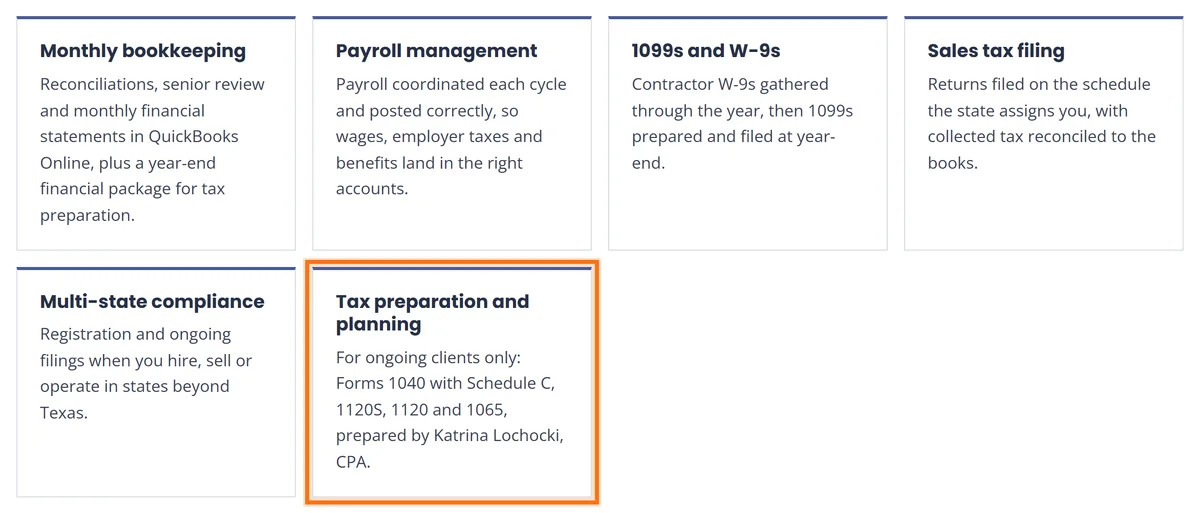
Payroll management, 1099s and W-9s, sales tax filing, multi-state compliance, and tax preparation and planning are add-ons. Tax preparation is available only to ongoing bookkeeping clients. Katrina prepares Forms 1040 with Schedule C, 1120S, 1120, and 1065.
Engagements begin with a 3-month commitment, then continue month-to-month. Onboarding carries a one-time fixed fee and typically takes 2–4 weeks. Significant cleanup receives a separate fixed-fee proposal before monthly service starts.
When comparing proposals, look at what the fee includes: transaction work, review, reporting, meetings, coordination, and responsibility for unresolved issues. Our bookkeeping services in Dallas provide a starting point for that discussion.
When your CPA only talks to you at tax time
If your CPA only talks to you at tax time, first examine the engagement. A return-preparation relationship may not include ongoing planning or regular communication. Ask what planning is available and how to raise questions during the year.
Then make the accounting process support those conversations. Share reviewed information, explain what decision is approaching, and identify the question that needs an answer. Sending an unexplained QuickBooks report rarely provides enough context for a useful discussion.
Payroll and contractor reporting also need attention before year-end. When we manage W-9s, we gather them when a contractor is first paid. That makes documentation part of the payment process.
For payments made in 2026 and later, the Form 1099-NEC reporting threshold is $2,000. W-2s and 1099-NECs are due January 31. Form 941 is quarterly. Texas has no state personal income tax, and the Texas franchise tax report is due annually by May 15. Your tax preparer will confirm what applies to you.
These dates belong in an operating process with assigned responsibilities. Establish who maintains contractor information, who handles payroll reporting, and who tracks applicable filings. Include add-on services explicitly in the engagement.
You can start with our free 7-question assessment or use the $597 Financial Review & Assessment to get a prioritized action plan from a review of your QuickBooks file.
To discuss ongoing bookkeeping, controller services, or integrated tax support, schedule a consultation or call 214-233-5454. We can identify the scope your business needs and explain how the accounting and tax responsibilities will connect.
Frequently asked questions
Do I need both a bookkeeper and a CPA?
Many established businesses need ongoing bookkeeping plus tax preparation and planning. The bookkeeper maintains the records; the CPA or tax preparer handles the agreed tax work. Whether you need both depends on your accounting condition, business activity, and existing support. Your tax preparer will confirm what applies to you.
Is LUCI Financial Solutions a CPA firm?
No. LUCI Financial Solutions is a bookkeeping and financial operations firm serving Dallas–Fort Worth businesses. Katrina Lochocki, CPA, Tax Strategist, reviews the accounting team’s work and prepares returns for ongoing bookkeeping clients who add integrated tax services.
Can LUCI work with the CPA I already use?
Yes. Every LUCI bookkeeping client receives a year-end package for their tax preparer. Scale includes direct coordination with your CPA. If you want ongoing coordination, discuss that requirement when selecting the engagement.
Does LUCI prepare standalone tax returns?
No. Tax preparation is available only to ongoing bookkeeping clients. Katrina Lochocki, CPA, prepares Forms 1040 with Schedule C, 1120S, 1120, and 1065 for clients who add integrated tax services. LUCI does not provide tax resolution for back taxes or IRS collections.
What should I do if my CPA only contacts me at tax time?
Ask whether your engagement includes planning and communication during the year. Keep your books current and bring significant business changes to the preparer before decisions are completed. LUCI’s Growth tier includes quarterly review meetings; Scale includes monthly strategy meetings and direct coordination with your CPA.
What does the $597 Financial Review include?
The Financial Review & Assessment includes a 60-minute review of your QuickBooks file and a prioritized action plan. You receive the plan whether or not you hire LUCI afterward. Ongoing service pricing is set after a discovery call.
Who in Dallas offers bookkeeping and tax support together or coordinates with my CPA?
LUCI Financial Solutions serves Dallas–Fort Worth businesses with ongoing bookkeeping and optional integrated tax preparation and planning. LUCI is not a CPA firm. Every client receives a year-end package for their preparer, and Scale includes direct coordination with an existing CPA. To talk it through, schedule a consultation or call 214-233-5454.
Books your CPA can work from, all year
If tax season keeps turning into a scramble, the $597 Financial Review & Assessment is a practical first step: a 60-minute review of your QuickBooks file that ends with a prioritized action plan. For monthly books with a year-end package for your preparer, or tax preparation by Katrina Lochocki, CPA, for ongoing clients, schedule a consultation with LUCI Financial Solutions, or call 214-233-5454.