

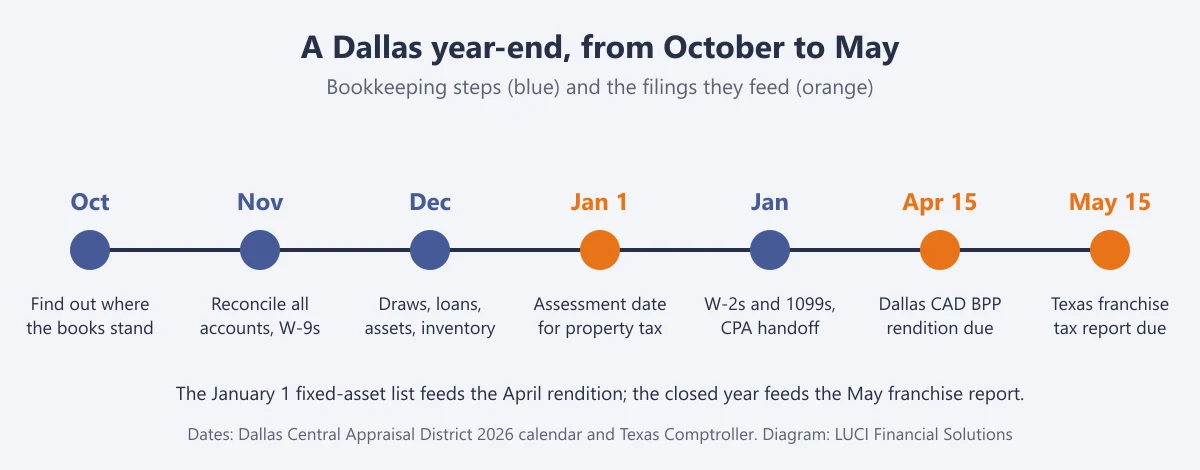
Short answer: A year-end bookkeeping checklist for a Dallas small business is a dated sequence, not one December weekend: in October you check how far behind the books are, in November you reconcile every account and collect W-9s, in December you clean up owner draws, loans, fixed assets and inventory, and in January you tie payroll to the W-2s, file 1099s and hand your CPA closed books.
LUCI Financial Solutions, a Dallas–Fort Worth bookkeeping and controller firm, keeps client books tax-ready every month, so year-end is a review rather than a rescue, and every monthly tier includes a year-end financial package for your tax preparer.
Key takeaways
- Start in October; a December start leaves no time to fix what you find.
- For payments made in 2026, the Form 1099-NEC threshold is $2,000.
- W-2s and 1099-NECs for 2026 are due February 1, 2027, because January 31 falls on a Sunday.
- Dallas County business property renditions are due April 15; the Texas franchise tax report on May 15.
- Your CPA needs closed, reconciled books, not a QuickBooks login.
Why a year-end bookkeeping checklist starts in October
The CPA’s January is the busiest month of their year. If your books arrive in March with twelve months of uncategorized transactions, your return goes to the back of the line and your tax planning window is already closed. Starting in October leaves time to catch up, a December in which decisions can still change the tax bill, and a January hand-off that takes an afternoon. The dates below assume a calendar-year business, which is most Dallas service firms, contractors and practices.
October: find out where the books actually stand
Do not start reconciling yet. Start by measuring the gap.
- Open QuickBooks and check the last reconciled date on every bank account, credit card and loan. If any is more than two months old, you are in catch-up territory.
- Count uncategorized and “Ask my accountant” transactions.
- Pull the balance sheet and look for accounts that should not exist or should be zero: Opening Balance Equity with a balance, undeposited funds that never cleared, negative liabilities, a payroll liability account that has grown all year.
- Decide who does the work. If the gap is months, this is the point to engage catch-up and cleanup bookkeeping as a fixed-fee project, because a cleanup done in October costs less stress than the same cleanup done the week before the filing deadline.
November: reconcile everything and collect W-9s
November is the heavy month. The goal is that every balance sheet account ties to an outside document.
- Bank and credit card accounts reconciled through October 31, with no plug entries. Our month-end close checklist is the routine to follow if you do not have one.
- Loans and lines of credit. Match each loan balance to the lender’s statement and split the year’s payments between principal and interest. Equipment and vehicle loans are the usual culprits for payments booked entirely to expense.
- Merchant processors and payment apps. Reconcile Stripe, Square or the card processor payouts to deposits, and record processing fees as fees rather than as lower revenue.
- Accounts receivable and payable. Clean out invoices that were paid but never applied, duplicates, and bills that will never be paid. Decide which receivables are uncollectible.
- Sales tax payable tied to what you actually remitted to the Texas Comptroller for each period.
- W-9s. Run a vendor list for the year, mark every contractor, landlord, attorney and other non-employee you paid for services, and request a Form W-9 from each one that is missing. For payments made in 2026, the IRS reporting threshold for Form 1099-NEC is $2,000 (it was $600 for payments made before 2026); see the IRS page on when a 1099 is required. Collect the W-9 from any vendor near that line now, not in January when they stop answering email.
December: owner distributions, loans to shareholders, fixed assets and inventory
December is for the entries that a CPA will otherwise discover in March.
- Owner draws and distributions. Make sure every transfer to an owner is recorded as a draw or distribution, not as an expense and not as payroll. For an S corporation, confirm the owner’s W-2 wages were actually run through payroll during the year; a December catch-up payroll is possible, a January one is not.
- Shareholder and member loans. If the business paid personal expenses or an owner put money in, decide with your CPA whether each balance is a loan, a contribution or a distribution, and document it. A “Due from shareholder” balance that grows every year is a conversation your CPA will want to have.
- Fixed assets. List every purchase over your capitalization threshold: computers, vehicles, equipment, leasehold improvements. Attach the invoice and the in-service date. Remove assets that were sold or scrapped. Your CPA decides on depreciation and expensing elections, but only from a list that is complete.
- Inventory, if you carry any. Schedule a physical count on or near December 31 and record the adjustment to cost of goods sold.
January: tie out payroll, file 1099s and hand off to the CPA
- Reconcile December for every account and close the year in QuickBooks with a closing date and password, so nothing moves after the CPA has the file.
- Tie total wages, withholding and employer taxes in the general ledger to the W-3 and the four quarterly Forms 941. Every dollar on the W-2s must appear in the books, including owner wages and any taxable benefits.
- Prepare and file Forms 1099-NEC for every reportable vendor by January 31, which is also the deadline for W-2s to employees (when January 31 falls on a weekend, the deadline moves to the next business day: for 2026 forms, February 1, 2027). Our guide to IRS Form 1099 types and rules covers the forms beyond the NEC.
- File the final sales tax return of the year with the Texas Comptroller on its normal due date, the 20th of the month after the reporting period ends.
- Produce the final Profit & Loss, Balance Sheet and Statement of Cash Flows, and the general ledger detail, and send them with the documents in the table below.
Texas items that generic checklists leave out
Texas has no state income tax on individuals, which is why national checklists skip the state section. Dallas businesses still have three dates to plan around.
- Texas franchise tax. The annual franchise tax report is due May 15 (the next business day when May 15 falls on a weekend, as it does in 2027), and most entities file a Public Information Report (or an Ownership Information Report) along with it, listing officers, directors, members or managers and the registered agent. Even an entity that owes no tax has a filing to make. Keep the ownership and officer list current in December so the PIR is a five-minute task. Details are at https://comptroller.texas.gov/taxes/franchise/.
- Texas sales and use tax. If you sell taxable goods or services, your filing frequency (monthly, quarterly or annual) is assigned by the Comptroller, and the return for the final period of the year is due on the 20th of the following month. Year-end is a good time to confirm your taxable versus non-taxable revenue split is set up correctly in QuickBooks.
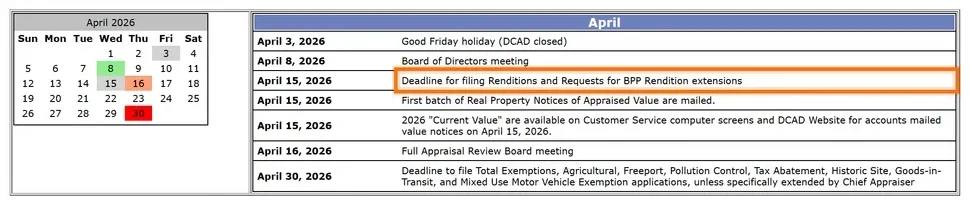
Business personal property rendition (Dallas County). Texas taxes business personal property such as furniture, equipment and inventory at the local level, and in Dallas County it is appraised by the Dallas Central Appraisal District (DCAD). Its calendar lists January 1 as the assessment date and April 15 as the deadline for renditions and rendition extension requests. The rendition is built from the same fixed-asset and inventory records you clean up in December, so a current asset list makes it a short job. Your CPA can confirm whether and how your business must render.
The document checklist your CPA needs in January
| Item | What exactly | Why the CPA needs it |
|---|---|---|
| Financial statements | Final P&L, Balance Sheet, Statement of Cash Flows for the year, plus general ledger detail | Starting point for the return and for book-to-tax adjustments |
| Bank and credit card statements | December statements for every account, with reconciliation reports | Proof the balance sheet cash ties out |
| Loan statements | Year-end balance and total interest paid for every loan and line | Interest deduction and balance verification |
| Fixed asset additions and disposals | Invoice, description, in-service date, and sale proceeds for anything disposed | Depreciation schedule and expensing elections |
| Payroll reports | W-3, four Forms 941, Texas Workforce Commission quarterly reports, year-end payroll register | Wage tie-out and officer compensation |
| 1099 summary | List of 1099s filed with amounts, plus W-9s | Confirms contractor payments are reported |
| Owner transactions | Schedule of distributions, contributions and shareholder loan activity by owner | Basis tracking and K-1 preparation |
| Sales tax | Returns filed for the year and the payable reconciliation | Gross receipts tie-out |
| Prior-year return and franchise tax report | Last year’s federal return and Texas franchise tax report | Continuity of elections, carryforwards and entity information |
How to read this table: each row is one item your CPA will ask for, with the reason in the last column. If you cannot produce an item in January, that is the part of the books to fix first; anything missing here turns into an estimate on your return or an extension.
How LUCI’s year-end financial package works
For our monthly clients, the checklist above is mostly already done, because the books are closed and reviewed every month. Every tier (Core, Growth and Scale) includes a year-end financial package for your tax preparer: the final statements, reconciliation reports, fixed asset and loan schedules, the owner transaction schedule and the 1099 summary, assembled and reviewed by a senior accountant before it goes out. Clients who add tax preparation have the return prepared by Katrina Lochocki, CPA, our tax strategist, who reviews the accounting team’s work and prepares Forms 1120S, 1120, 1065 and 1040 with Schedule C. Tax preparation is an add-on for ongoing bookkeeping clients only; we do not prepare returns for businesses whose books we do not keep.
If you are reading this in October with a year to catch up, the path is a fixed-fee cleanup first, then monthly bookkeeping services in Dallas so next year’s checklist is a formality. If payroll and 1099 filing are part of the problem, our bookkeeping, payroll and tax services handle them together.
Frequently asked questions
I need a year of bookkeeping caught up before tax season. Who can help in Dallas?
LUCI Financial Solutions does catch-up and cleanup as a fixed-fee project scoped after a discovery call, then moves the business onto monthly bookkeeping so it does not happen again. Starting in October or November leaves enough time for the CPA to receive clean books in January.
What should be done in November and December so the CPA has what they need in January?
November: reconcile every bank, card, loan and processor account, clean up receivables and payables, and collect W-9s from contractors. December: record owner distributions and shareholder loans correctly, list fixed asset purchases with invoices, count inventory if you carry any, and confirm payroll liabilities. January is then a tie-out and a hand-off.
Which Dallas bookkeeping firms keep the books tax-ready all year?
Look for a firm that closes and reconciles every month, has a second person review the financials before you see them, and produces a year-end package for your CPA as part of the monthly fee. LUCI Financial Solutions works this way for Dallas–Fort Worth service businesses, with controller-level review in the Growth and Scale tiers.
When is the Texas franchise tax report due?
The annual Texas franchise tax report is due May 15, and the Public Information Report or Ownership Information Report is filed with it. Most entities have a filing to make even when no tax is owed, so keep the officer and owner list current at year-end.
Do I need a W-9 from every vendor?
Request one from every non-employee you pay for services, rent or legal fees, and keep it on file whether or not a 1099 is ultimately required. For payments made in 2026 the Form 1099-NEC reporting threshold is $2,000, and the forms are due to recipients and the IRS by January 31, or the next business day when that date falls on a weekend (February 1, 2027 for 2026 forms).
Does LUCI prepare my business tax return?
Only for ongoing bookkeeping clients, as an add-on. Our tax strategist, Katrina Lochocki, CPA, prepares Forms 1120S, 1120, 1065 and 1040 with Schedule C for clients whose books we keep. We do not offer standalone tax preparation or tax resolution.
Get the books tax-ready before January
Whether you need a year caught up or want a team that keeps the books closed every month, schedule a consultation with LUCI Financial Solutions. If you want to know how far behind you are first, take our free seven-question Financial Operations Assessment.