

Short answer: A month-end close is the ordered routine a controller runs to make sure every transaction for the month is recorded, reconciled and reviewed before financial statements go to the owner. For a growing Dallas service business, a realistic target is about 5 to 10 business days after month-end, and faster once the process is steady. The 11 steps below are the order our team works in.
At LUCI Financial Solutions, our Dallas-based team works through a checklist like this one for service businesses across DFW and nationwide.
Key takeaways
- The order matters: reconcile cash first, then revenue, accruals and payroll, then review.
- Every bank, card and loan account gets reconciled every month, not only at year end.
- A flux review explains every line that moved more than a set threshold.
- Someone other than the preparer reviews the statements before the owner sees them.
- Lock the period once it is final so nobody changes a closed month by accident.
The order matters: you cannot review margins until revenue is right, and revenue is not right until the bank and card accounts are reconciled.
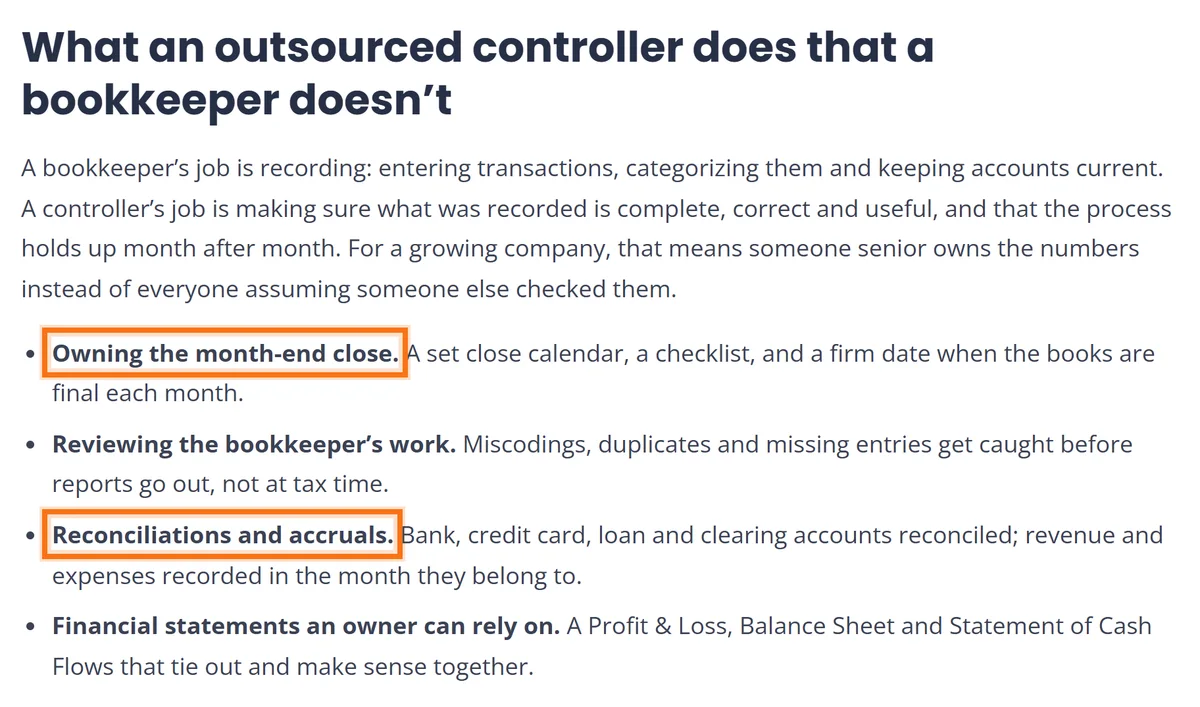
Step 1: Set the cutoff and collect what is missing
Close starts with a clear line between this month and next. Before reconciling anything, gather what tends to arrive late: vendor bills for services already received, missing card receipts, final timesheets that drive client billing, every bank, card, loan and merchant statement, and the payroll reports.
Step 2: Reconcile every bank, card and loan account
Reconciliations are the foundation of the close. Every bank account, credit card and line of credit gets matched to its statement, so the ending balance in the books equals the ending balance on the statement. A controller looks past a reconciliation that simply balances and asks:
- Are there old uncleared checks or deposits that need to be investigated?
- Are transfers between accounts recorded on both sides?
- Do loan balances match the lender statement, with each payment split correctly between principal and interest?
- Are merchant deposits recorded gross, with processing fees booked as an expense, rather than netted?
Financial statements built on unreconciled accounts cannot be trusted, no matter how polished they look.
Step 3: Review accounts receivable and accounts payable
Next, review the aging reports. On the receivables side, confirm that every invoice for work delivered was sent, that payments were applied to the right invoices, and that old balances are being collected or flagged for a write-off decision. On the payables side, confirm that every bill for the month is entered, that nothing was paid twice, and that the aging matches the vendor statements for your largest suppliers.
A growing pile of invoices past 60 days often shows up as a cash problem a month or two later.
Step 4: Record accruals, prepaid expenses and deferrals
If your books are on the accrual basis, this step is what makes the monthly profit and loss meaningful. Typical entries include:
- Accrued expenses for work you received but have not been billed for, such as contractor hours or utilities.
- Prepaid expenses spread over the months they cover. An annual insurance premium or software subscription paid in January should be expensed a twelfth at a time, not all at once.
- Accrued payroll when a pay period straddles month-end and the wages belong partly to this month.
Without these entries, one month looks unusually expensive and the next unusually profitable.
Step 5: Tie out payroll
Payroll is usually the largest expense for a service business, so it deserves its own check. Compare gross wages, employer taxes and benefits in the books to the payroll provider’s reports for the month. Confirm that wages are coded to the right departments, that benefit deductions offset the related expense, and that payroll tax liabilities clear when paid. At quarter-end, the books should also agree with the quarterly payroll filings (Form 941).
Step 6: Update fixed assets and depreciation
Review the month’s purchases for anything that should be recorded as an asset rather than an expense, such as computers, furniture or vehicles, based on the capitalization policy you set with your tax preparer. Add new assets to the fixed asset schedule and record the month’s depreciation so the balance sheet reflects what the business owns. Book and tax depreciation often differ; your tax preparer handles the tax side.
Step 7: Check revenue recognition on retainers and projects
Service businesses often get paid before or after they do the work, so cash received is not the same thing as revenue earned. A few basics a controller checks every month:
- Retainers and advance payments are recorded as a liability (unearned revenue) when received and moved to revenue as the work is performed.
- Project and milestone billing should line up with the work completed. If you billed 50% of a project but completed 20%, part of that bill is not yet revenue.
- Work completed but not yet billed may need to be recorded so the month reflects the effort your team actually delivered.
The goal is a monthly profit number that reflects the work delivered that month, so you can trust it for staffing and pricing decisions.
Step 8: Reconcile intercompany activity if you run more than one entity
Owners with several companies need one more step. Every intercompany charge, loan or transfer must appear on both sides, and the due-to and due-from balances between entities should net to zero. Shared expenses should be allocated on a consistent basis. If this is part of your structure, our page on accounting for multi-entity businesses goes deeper.
Step 9: Run a flux and variance review
With the transactions recorded, the controller compares the month to the prior month, the same month last year and the budget, if there is one. This is called a flux or variance review. Any line that moved more than a set threshold, for example 10% and a meaningful dollar amount, gets an explanation. Common findings include a bill posted twice, a missing accrual, revenue coded to the wrong service line, or a real change the owner should hear about. This is where errors get caught before they reach the owner.
Step 10: Review the financial statements before they go to the owner
What does a controller check before financials go to the owner? A senior reviewer reads the statements as a set:
- The balance sheet balances, and every balance sheet account has support behind it.
- Cash on the balance sheet matches the reconciled bank balances.
- Retained earnings carry forward correctly from the prior year.
- No unexplained balances sit in suspense, uncategorized or “ask my accountant” accounts.
- Margins are in a believable range compared to recent months.
- The statement of cash flows explains why cash went up or down.
If any of these terms are unfamiliar, our guide to reading your profit and loss, balance sheet and cash flow statement walks through each report.
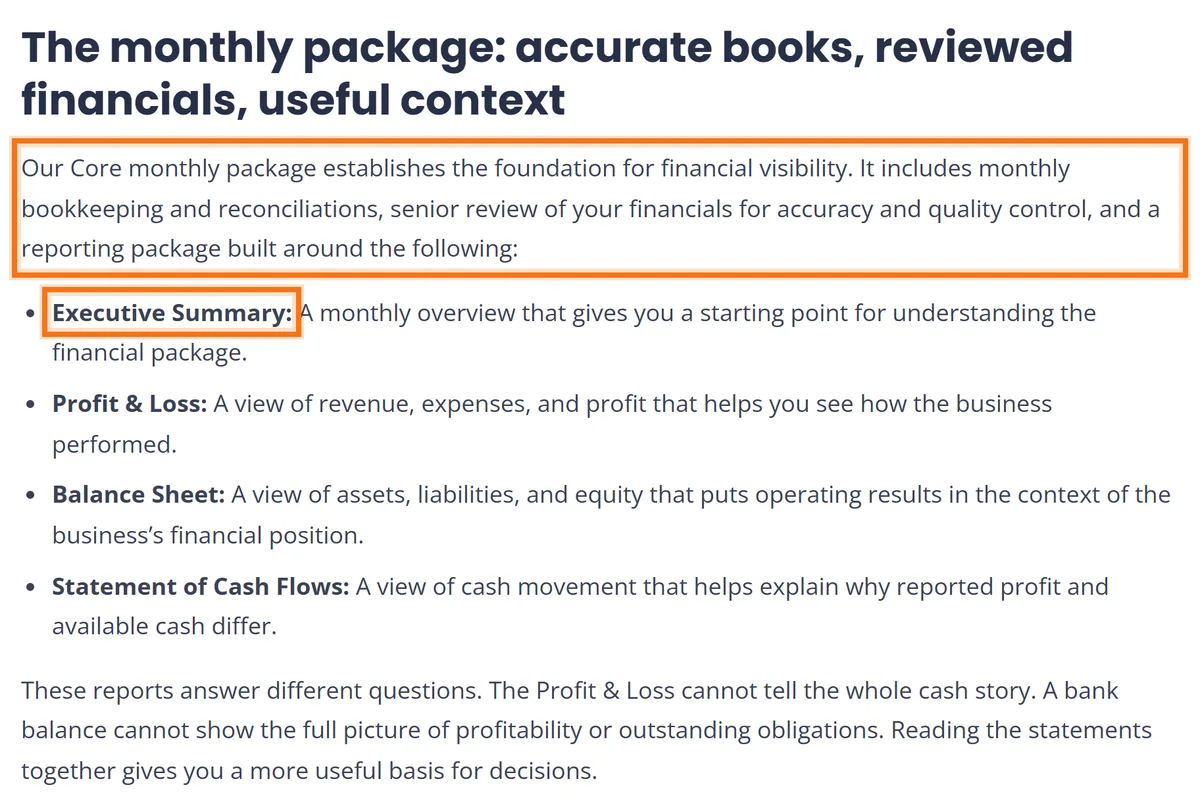
Step 11: Build the monthly KPI package
A useful monthly package is short: the three core statements, a one-page summary of what changed and why, and a handful of KPIs. For a service business, those often include revenue by service line, gross margin, labor cost as a share of revenue, days sales outstanding, months of operating cash, and budget-to-actual results. Report the same five to eight metrics every month so trends are easy to see.
How long should month-end close take?
There is no rule, but there are typical targets. Many small and mid-sized service businesses with outsourced or part-time accounting support aim to have the books closed and statements delivered by around the 10th business day of the following month. Teams with clean processes and timely documents often get to 5 to 7 business days.
A sample timeline for a growing service business might look like this:
| Business day | Close activity |
|---|---|
| Days 1 to 2 | Cutoff, collect statements and missing documents, enter remaining bills |
| Days 2 to 4 | Bank, card and loan reconciliations; AR and AP review |
| Days 4 to 6 | Accruals, prepaid, payroll tie-out, fixed assets, revenue review, intercompany |
| Days 6 to 8 | Flux review, corrections and senior review of the statements |
| Days 8 to 10 | Financial package and KPI report delivered to the owner |
How to read this table: use the day ranges as a target, not a rule. If your close regularly runs past day 10, look at the first row: missing statements and documents at the start are what push every later step back.
What slows a close down is rarely the accounting itself. It is missing receipts, late bills, unanswered questions and accounts nobody has reconciled in months. The fix is usually process, not more effort.
Who should run your close?
A bookkeeper records transactions. A controller owns the close and decides when the statements are ready. A fractional CFO uses those statements to plan. Our breakdown of the difference between a bookkeeper, controller and fractional CFO explains which role you may be missing. For businesses that need the close owned without a full-time hire, our outsourced controller services in Dallas cover this checklist every month, with senior-level review before the financials reach you.
Frequently asked questions
How long should month-end close take for a small business?
Many growing service businesses aim to close by about the 10th business day of the following month, and well-organized teams often close in 5 to 7 business days. A close that regularly takes three weeks or more usually points to a process problem.
What does a controller check before financial statements go to the owner?
A controller confirms that every bank, card and loan account is reconciled, that accruals and prepaid expenses are recorded, and that payroll ties to the payroll reports. They then run a variance review against prior periods and read the statements as a set, looking for unexplained balances, unusual margins and anything sitting in suspense accounts. Only then are the statements ready to send.
What is the most important step in the month-end close?
Reconciling every bank, credit card and loan account to its statement. Every other step relies on those balances being right, so a close with reconciliations behind produces numbers that look finished but cannot be trusted.
Do I need accrual accounting to run a proper close?
No, a cash-basis business still benefits from cutoff, reconciliations, payroll tie-out and a review of the statements. Accrual entries such as prepaid expenses, accrued bills and unearned retainers make the monthly profit far more accurate, though. Many service businesses keep accrual-basis books for management reporting and let their tax preparer handle the tax basis separately.
What is a flux review in month-end close?
A flux review compares each line on the financial statements to the prior month, the prior year or the budget. Any change above a set threshold gets an explanation before the statements are released.
Should I lock the books after month-end close?
Yes. Once a month is closed and reported, set a closing date in your accounting software so earlier periods cannot be changed by accident. If a later correction is needed, it should be made deliberately and documented, so the statements you already reviewed stay reliable.
Get a close you can rely on every month
If your books arrive late or change after you have seen them, our team can take over the close and deliver reviewed financials on a predictable schedule. Not sure where your process stands? Start with our free 7-question Financial Operations Assessment, then schedule a consultation to talk through what a monthly close would look like for your business.