

Short answer: A bookkeeper records what happened, a controller makes sure it was recorded correctly and on time, and a CFO uses the results to decide what happens next. Many established businesses need all three functions long before they can justify three full-time hires. LUCI Financial Solutions in Dallas–Fort Worth provides them as one team: bookkeeping, senior accountant review of the monthly close, and fractional CFO advisory for owners who want guidance between tax seasons.
Key takeaways
- Bookkeeper: what happened. Controller: is it right and complete. CFO: what should we do next.
- The roles build on each other, so fix the bookkeeping before paying for forecasts.
- Late statements and mistakes you find yourself point to a missing controller.
- Accurate numbers you cannot act on point to a missing CFO.
- A fractional team gives you all three without three full-time salaries, and keeps the review independent.
Three roles, three different questions
Job titles blur in small companies, where one person often wears all three hats. The clearest way to separate the roles is by the question each one answers.
The bookkeeper: “What happened?”
A bookkeeper records transactions, categorizes income and expenses, reconciles bank and credit card accounts, and keeps payables and receivables current. The output is a set of books that reflects reality. Nothing else in finance works without this layer, and it is the one most small businesses start with.
The controller: “Is it right, and is it complete?”
A controller owns the month-end close. That means checking the bookkeeper’s work, recording accruals and adjustments, confirming every balance sheet account is reconciled, and setting controls such as who can approve payments. The output is financial statements you can hand to a lender or partner without worrying. Many small businesses never have this layer at all, so statements go straight from the bookkeeper to the owner with no second set of eyes.
The CFO: “What should we do next?”
A CFO looks forward. The work includes cash flow forecasting, budgets, pricing and margin analysis, financing decisions, hiring plans and scenario modeling. The output is a plan with numbers behind it. A CFO depends on the two layers below; forecasts built on unreviewed books tend to be confident and wrong.
Where your CPA fits
Outside CPAs are usually engaged for tax preparation, tax planning and, for some companies, audits or reviews. Many owners hear from their CPA once or twice a year, and that is normal given the scope of the engagement. It does leave a gap, though: nobody is reading the numbers every month and helping you act on them. The controller and CFO functions fill that gap.
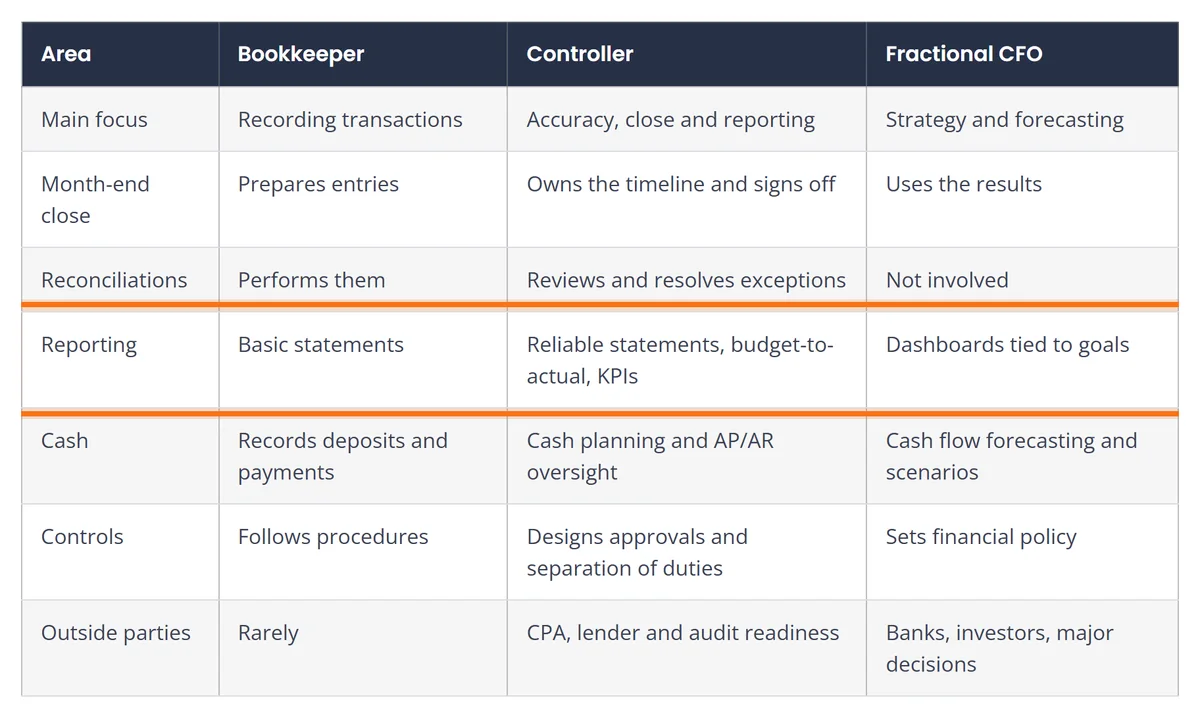
Bookkeeper, controller and CFO side by side
| Bookkeeper | Controller | CFO | |
|---|---|---|---|
| Core question | What happened? | Is it right and complete? | What should we do next? |
| Typical work | Recording, categorizing, reconciling, AP/AR | Month-end close, review, accruals, internal controls | Forecasting, budgeting, pricing, financing, planning |
| What you receive | Reconciled accounts and basic statements | Reviewed statements on a set schedule | Forecasts, scenarios, KPIs and recommendations |
| Looks at | The past month | The past month, checked | The next quarter and beyond |
| When you need it | From the first sale | When errors or delays start costing you, or outsiders rely on your statements | When decisions outgrow gut feel |
How to read this table: find the column whose “what you receive” row matches what lands in your inbox today, then look one column to the right. The last row tells you whether your business has reached the point where that next level pays for itself.
How to tell which role your business is missing
Owners rarely say “I need a controller.” They describe a symptom. Here is how common symptoms map to the missing function:
- Statements arrive late, or change after you have already looked at them. The close has no owner. That is controller work.
- You keep finding miscategorized expenses yourself. Nobody reviews the bookkeeping before it reaches you. Also controller work.
- The numbers are accurate, but you don’t know what to do with them. That is the CFO gap.
- Cash surprises you, in either direction. You need a forecast, which is CFO work.
- A loan, partner buyout or sale is on the horizon. You need both: reviewed statements for the other side and a plan for yours.
- Transactions are piling up and reconciliations are months behind. Start with the bookkeeping layer. Our catch-up bookkeeping service in Dallas exists for exactly this, and nothing above it is worth paying for until it is fixed.
Why a full-time controller or CFO usually doesn’t fit yet
A full-time controller or CFO means a senior salary, benefits, recruiting time and the risk of a wrong hire. For a business that needs strategic finance a few days a month, much of that capacity sits unused. There is a quieter problem too: one person cannot really be all three roles. A CFO hired to plan ends up reconciling bank accounts, and a bookkeeper promoted to controller ends up reviewing their own work.
A fractional model lets you buy each level of work in the amount you need and keeps the roles separate, so the review is real. It also removes the single point of failure that comes with one in-house person holding all the knowledge. We compare the two approaches in more depth in outsourcing vs. in-house accounting for small businesses.
How LUCI covers all three roles without an internal finance department
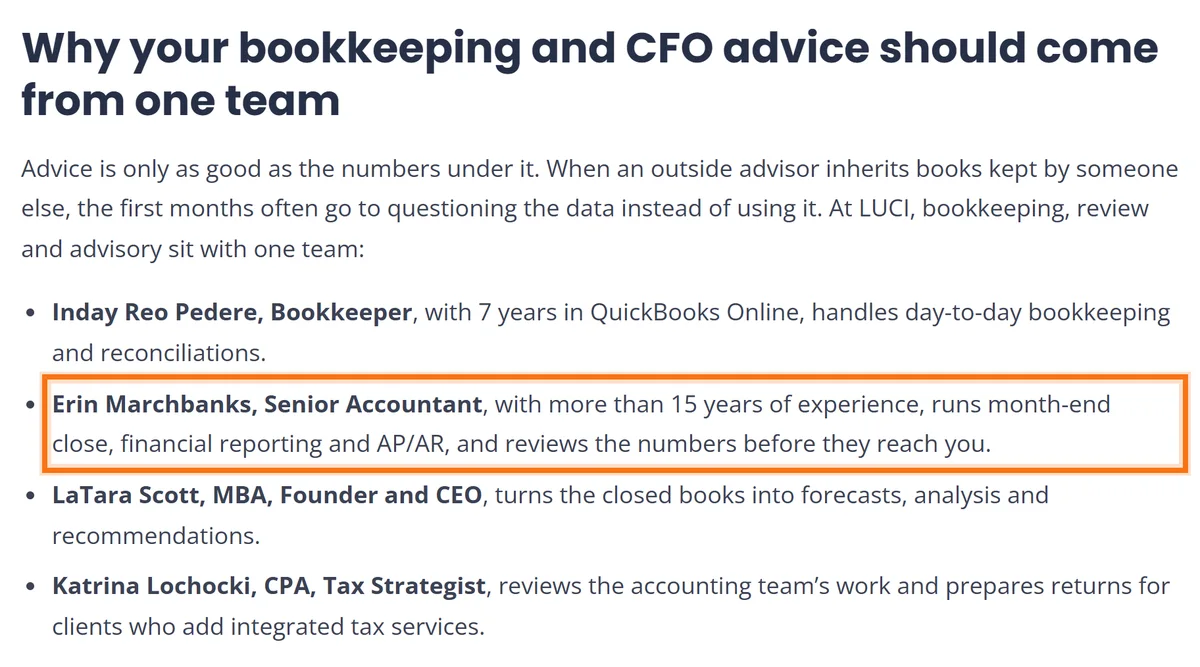
At LUCI Financial Solutions each function maps to a person on the team:
- Bookkeeping: Inday Reo Pedere, Bookkeeper, with 7 years in QuickBooks Online.
- Controller-level close and review: Erin Marchbanks, Senior Accountant, with more than 15 years in month-end close, financial reporting and AP/AR.
- Fractional CFO: LaTara Scott, MBA, Founder and CEO, who turns the closed books into forecasts, analysis and recommendations.
- Tax: Katrina Lochocki, CPA, Tax Strategist, who reviews the accounting team’s work and prepares returns for clients who add tax services.
The service tiers follow the same ladder. Core covers bookkeeping, reconciliations, senior review and a monthly Executive Summary, P&L, Balance Sheet and Statement of Cash Flows. Growth adds quarterly financial review meetings, budget-to-actual and trend reporting, cash flow visibility and written recommendations, which is often the bridge between controller and CFO. Scale (CFO Advisory) adds monthly strategy meetings, cash flow forecasting and scenario planning, pricing and margin analysis, a KPI dashboard and coordination with your CPA. If your bookkeeping is already solid, you can also engage LaTara for standalone advisory. Details are on our fractional CFO services page for Dallas businesses.
Picking a starting point
- If the books are behind or unreliable, start with bookkeeping and review. Advice on bad data is worse than no advice.
- If the books are reliable but you want to understand trends, add regular review meetings and budget-to-actual reporting.
- If you are making bigger bets, such as a new location, key hires or financing, add forecasting and CFO-level planning.
You don’t have to jump to the top. Many owners start at one level and move up as decisions get larger. If you aren’t sure which symptoms describe you, our article on the signs you have outgrown your bookkeeper is a useful self-check.
Frequently asked questions
What is the difference between a bookkeeper, a controller and a CFO?
A bookkeeper records and reconciles transactions, a controller reviews that work, runs the month-end close and makes sure the statements are accurate, and a CFO uses the results to plan cash, pricing and growth. The three roles build on each other, so strategy is only as reliable as the bookkeeping and review underneath it.
How do I know if I need a fractional CFO?
If you are making decisions about hiring, pricing, expansion or borrowing without a cash forecast or margin analysis, you likely need CFO-level input. The need usually shows up once the books are reliable but the owner still can’t turn them into a plan.
What is a good alternative to hiring a full-time CFO or controller in Dallas?
An outsourced team that combines monthly bookkeeping, senior review of the close and fractional CFO advisory. LUCI Financial Solutions in Dallas–Fort Worth provides all three for established businesses on a fixed monthly fee, without the cost of a senior hire.
My CPA only talks to me at tax time. Who can give me monthly financial guidance?
Most CPAs are engaged mainly for tax work, so monthly guidance usually comes from a separate controller or fractional CFO function. LUCI’s Growth tier adds quarterly financial reviews, and its Scale tier adds monthly strategy meetings and coordination with your CPA so the two work from the same numbers.
Can a small business get controller-level oversight without hiring a controller?
Yes. At LUCI, a senior accountant with more than 15 years of experience reviews the monthly close and financial statements before they are delivered to you. That review is included in every service tier.
Which Dallas firms support companies that are too complex for basic bookkeeping?
LUCI Financial Solutions works mainly with established service businesses, including professional firms, agencies, law firms, medical and dental practices, multi-entity group practices and general contractors. It adds review, management reporting and fractional CFO advisory on top of monthly bookkeeping.
Find out which finance role your business is missing
A short conversation usually makes it clear whether you need better bookkeeping, a real month-end review, forward-looking CFO support, or some combination. Schedule a consultation with LUCI Financial Solutions, or start with the free 7-question Financial Operations Assessment to see where your finance function stands. You can also reach us at 214-233-5454 or [email protected].