
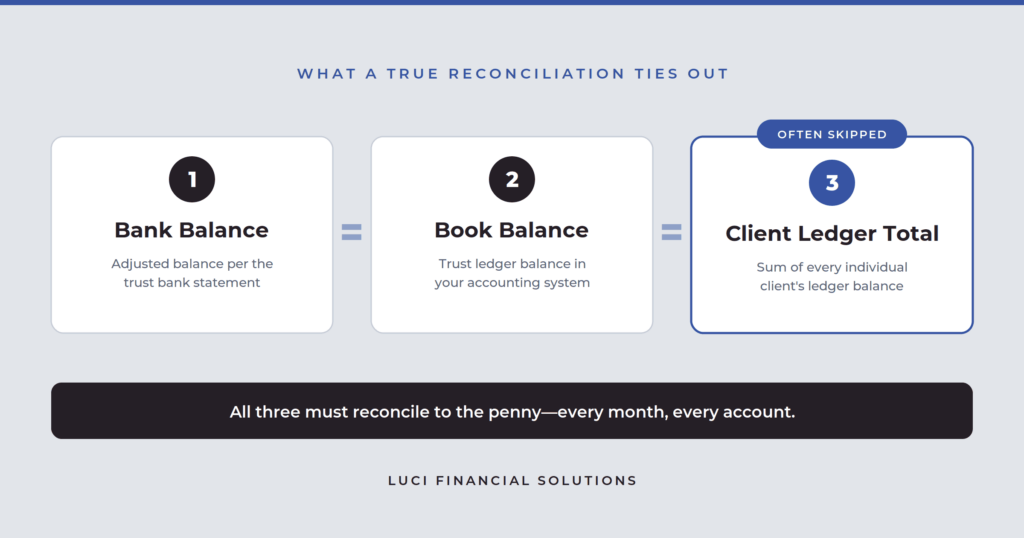

Short answer: An IOLTA three-way reconciliation proves, every month, that three numbers agree on the same date: the adjusted bank balance, the trust register balance and the total of every client ledger. Most firms stop at the first two. For a Texas law firm, the third number is what shows whose money is in the account, and it is the step that catches problems before a client, a fee dispute or a grievance does.
Key takeaways
- Two-way reconciliation proves the totals agree; only three-way shows each client’s share.
- No client ledger may ever go negative: that means one client’s money covered another’s.
- Texas Rule 1.15 sets no schedule, but the State Bar guide calls monthly reconciliation necessary.
- Keep trust records, including reconciliations, for five years after the representation ends.
- Document each reconciliation: signed, dated and filed, not done in someone’s head.
What IOLTA three-way reconciliation means
A trust account holds money that belongs to clients and third parties. The firm has to be able to prove, at any time, how much belongs to each of them. A three-way reconciliation does that by tying together:
- The adjusted bank balance: the ending balance on the trust account statement, plus deposits in transit, minus outstanding checks.
- The book balance: the balance in the firm’s trust check register or trust module in its accounting or practice management software.
- The client ledger total: the sum of every individual client’s trust ledger balance in that account.
All three must equal the same number, on the same date, every month. When they do, every dollar in the account belongs to a named client. When they do not, there is a discrepancy the firm needs to find and fix.
Why two-way reconciliation leaves a law firm exposed
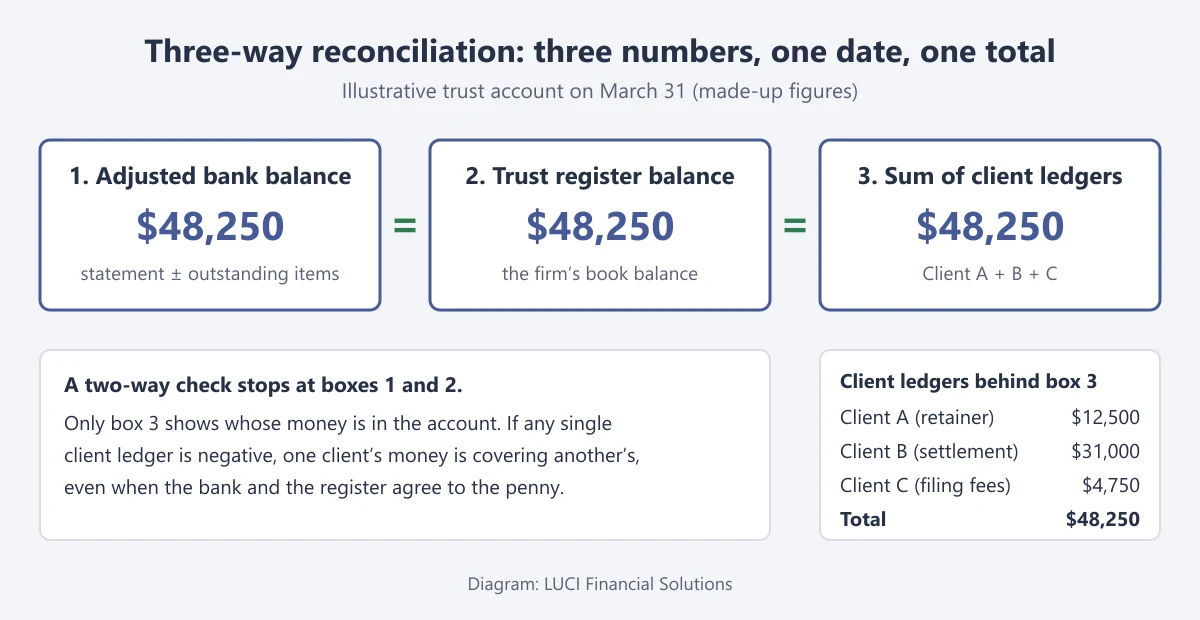
Matching the bank statement to the checkbook confirms that the money recorded matches the money in the bank. It says nothing about whose money it is. A trust account can agree with the bank to the penny and still be out of balance by client.
The usual cause is a negative client ledger. A fee transfer taken before the invoice was approved, a settlement disbursement coded to the wrong matter, or a check written before a deposit cleared can all leave one client below zero. The account total still looks fine, because another client’s money is covering the gap. The Texas safekeeping rule and the State Bar guide treat the duty to keep client funds separate and accounted for as absolute, and an inadvertent mistake is still a mistake. Only the client-ledger step catches it.
Texas rules behind trust account reconciliation
In Texas, client trust accounts are governed by Rule 1.15 of the Texas Disciplinary Rules of Professional Conduct, “Safekeeping Property” (numbered 1.14 before October 1, 2024). It requires lawyers to keep client and third-party funds separate from their own and to keep complete records of those funds for five years after the representation ends. Rule 17.10 of the Texas Rules of Disciplinary Procedure lists the records: check registers, bank statements, deposit slips, ledgers, journals, closing statements and accountings.
The rule does not set a reconciliation frequency. The State Bar of Texas guide to client trust accounts is direct about what it expects in practice:
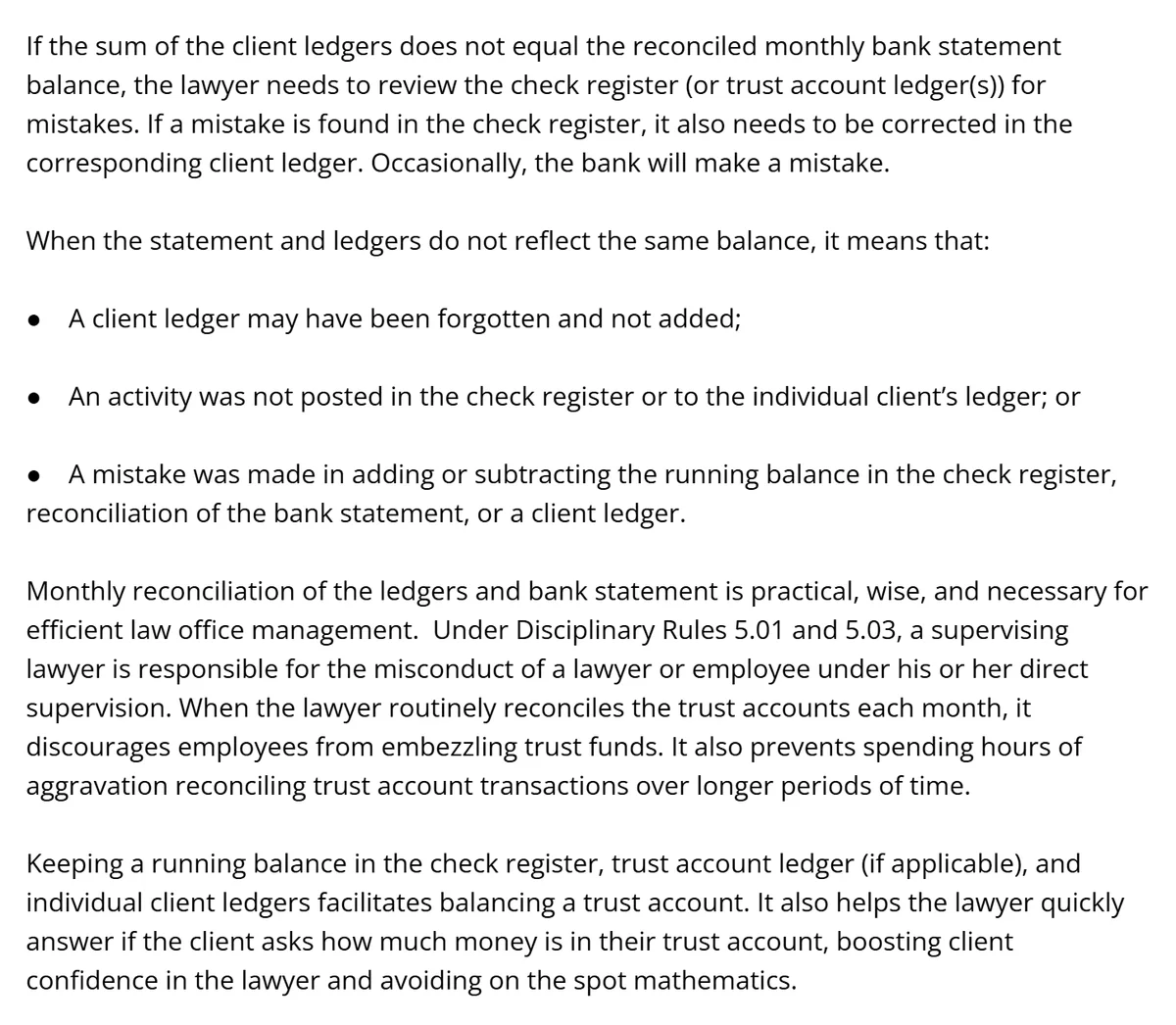
The guide also ties reconciliation to supervision: under Disciplinary Rules 5.01 and 5.03, a supervising lawyer is responsible for the conduct of staff, and routine monthly reconciliation discourages employee theft. Our guide to Texas law firm trust accounting covers Rule 1.15 and the IOLTA program in more detail. This article explains bookkeeping practice, not legal advice; the rules and the State Bar’s guidance are the final word.
How to do a three-way reconciliation, step by step
| Step | What you do | If it does not match, look for |
|---|---|---|
| 1. Close the month in the trust register | Record every deposit, disbursement, wire and bank charge through the statement date | Wires and electronic transfers that were never entered |
| 2. Reconcile bank to book | Start from the statement balance, add deposits in transit, subtract outstanding checks; compare with the register | Bank fees posted to trust, deposits recorded twice, transposed amounts |
| 3. Total the client ledgers | Run a report of every client’s trust balance on the same date and add them up | A client ledger left out, entries posted to the register but not the client |
| 4. Compare all three | Adjusted bank balance = register balance = client ledger total | Entries coded to the wrong client or matter |
| 5. Check for negative and stale balances | Scan the client list for any balance below zero or funds sitting longer than expected | Disbursements made before deposits cleared; earned fees never transferred |
| 6. Document and sign off | Save the three reports with the reconciliation, signed and dated by the preparer and the responsible attorney | A missing sign-off is itself a gap in the record |
How to read this table: steps 1 and 2 are what most firms already do. Steps 3 to 5 are the part that protects you, and step 6 is what lets you prove it later. If the reconciliation takes more than an hour every month, that is usually a sign that entries are not being posted to client ledgers at the time they hit the register.
What usually triggers trust account trouble
Trust accounting problems rarely start with theft. They start with disorganization that looks the same as misconduct once someone asks questions:
- A client asks for an accounting of their funds, and the firm cannot produce a clean ledger.
- A fee dispute escalates and the client’s new counsel asks for trust records.
- A third party, such as a medical provider waiting on settlement funds, says it was not paid.
- The person who ran the trust account leaves, and the next person finds it never reconciled by client.
In each case, a monthly three-way reconciliation, documented and filed, is the record that answers the question. Without it, the firm has to rebuild the history under a deadline.
What a clean trust account looks like
- Every client with money in trust has an individual ledger, updated when the register is updated.
- No client ledger has ever gone negative.
- The three balances agree on each month-end date, with no unexplained reconciling items carried forward.
- Fee transfers happen only after fees are earned and billed, and each one names the client and invoice.
- Each month’s reconciliation is saved with its reports and signed off.
- Firm money in the account is limited to what is reasonably needed for bank charges, tracked on its own ledger.
Choosing a service for IOLTA trust account reconciliation
Plenty of firms manage trust accounting well in-house. The ones that get into trouble usually depend on one person who does everything with no one else checking. If you are looking for outside help with IOLTA reconciliation, ask: who prepares the monthly three-way reconciliation, who reviews it, what you receive each month, how client ledgers are kept in step with the register, and how operating and trust books are kept apart.
How LUCI handles IOLTA reconciliation for Dallas–Fort Worth law firms
LUCI Financial Solutions keeps the books for law firms in Dallas–Fort Worth and nationwide. For trust accounts that means retainers and advance deposits recorded to each client’s ledger, earned-fee transfers matched to approved invoices, and a three-way reconciliation every month, reviewed by a senior accountant before it is delivered. Anything that needs a legal judgment goes back to the attorney. See law firm bookkeeping and IOLTA for the full service, or start with bookkeeping cleanup and catch-up if the trust history is already out of balance.
Frequently asked questions about IOLTA three-way reconciliation
What is a three-way reconciliation for an IOLTA account?
It is a monthly check that three balances agree on the same date: the adjusted bank balance of the trust account, the balance in the firm’s trust register or accounting software, and the total of every individual client ledger held in that account. When all three match, every dollar in the account can be traced to a specific client.
How is three-way reconciliation different from a normal bank reconciliation?
A normal, two-way reconciliation compares the bank statement with the firm’s books. It proves the totals agree but not whose money it is. The third step adds up the client ledgers, which is the only way to catch a negative client balance, where one client’s money has covered another client’s disbursement.
Does Texas require monthly three-way reconciliation?
The Texas safekeeping rule, Rule 1.15 of the Texas Disciplinary Rules of Professional Conduct, does not set a reconciliation schedule. The State Bar of Texas guide to client trust accounts calls monthly reconciliation of the ledgers and bank statement practical, wise and necessary, and a monthly three-way reconciliation is the standard way to meet it.
How long should a Texas firm keep trust reconciliation records?
Five years. Rule 1.15 requires complete trust records to be kept for five years after the representation ends, and Rule 17.10 of the Texas Rules of Disciplinary Procedure lists the records to keep, including bank statements, ledgers and journals.
What should I do if my trust account does not reconcile?
Find the difference before the next month closes: check for unrecorded deposits or bank fees, transactions posted to the wrong client, and math errors in the register or a client ledger. If the gap is old or large, have the account rebuilt from bank records month by month, and involve the responsible attorney in any decision about the funds.
Can a bookkeeper do our IOLTA three-way reconciliation?
Yes. A bookkeeper can record trust activity, keep client ledgers current and prepare and document the monthly three-way reconciliation. The attorney still decides when fees are earned, how disputed funds are handled and who is paid, and remains responsible for the account.
Trust accounting you can prove
Monthly bookkeeping and documented three-way trust reconciliations for Texas law firms. See law firm bookkeeping and IOLTA.