


Short answer: In Texas, a lawyer must keep client and third-party money in a separate trust or escrow account, keep complete records of it for five years after the representation ends, and never mix it with the firm’s own money. The rule is Rule 1.15 of the Texas Disciplinary Rules of Professional Conduct (numbered 1.14 before October 1, 2024), and funds that are nominal or short-term go into an IOLTA account.
This guide covers IOLTA trust accounting in Texas in bookkeeping terms, from the rule itself to the monthly reconciliation at a bank approved by the Texas Access to Justice Foundation. The rules say what must be true; good bookkeeping, including a monthly three-way reconciliation, is how a firm proves it. LUCI Financial Solutions handles that bookkeeping for law firms in Dallas–Fort Worth and nationwide.
This guide explains the Texas requirements in bookkeeping terms. It is not legal advice; the rules and the State Bar’s guidance are the final word.
Which Texas rule governs law firm trust accounts?
The trust account rule is Rule 1.15, “Safekeeping Property.” In an order signed August 27, 2024 (Misc. Docket No. 24-9054), the Supreme Court of Texas added new rules and renumbered several existing ones effective October 1, 2024. The safekeeping rule moved from 1.14 to 1.15 without a change to its text, so older forms and articles citing Rule 1.14 mean the same rule.
In summary, the rule requires a lawyer to:
- Hold client and third-party funds separate from the lawyer’s own property, in an account designated as a “trust” or “escrow” account, kept in the state where the lawyer’s office is located unless the client or third person consents otherwise.
- Keep complete records of those funds and preserve them for five years after the representation ends.
- Promptly notify the client or third person when funds arrive, promptly deliver what they are entitled to, and give a full accounting on request.
- Keep any disputed portion separate until the dispute is resolved, and distribute the undisputed portion.
What goes into the trust account, and what stays out
The State Bar of Texas guide draws a simple line. Money that still belongs, in whole or in part, to a client or third person goes into trust. Money that belongs entirely to the lawyer does not.
| Deposit into trust | Keep out of trust |
|---|---|
| Unearned fees, including advance fee deposits and most retainers | Fees already earned, such as payment of an invoice for completed work |
| Advances for expenses such as filing fees and court costs, until paid | Reimbursement of a cost the firm already paid |
| Settlement funds not yet distributed | The lawyer’s personal or business money |
| Funds belonging partly to the client and partly to the lawyer, until severed | A true retainer paid only to secure the lawyer’s availability |
Retainers cause the most trouble. According to the State Bar guide and Texas ethics opinions, a fee does not become earned just because the fee agreement calls it “nonrefundable” or “earned upon receipt.” A flat fee without stated benchmarks should be treated as unearned until the work is done, and an advance payment for future services stays refundable until it is earned. Only a true retainer, paid for the lawyer’s availability and not for services, may go straight to operating. For the bookkeeper, every transfer out of trust on a flat-fee matter should point to the benchmark that earned it.
What is a Texas IOLTA account, and when does a client need a separate trust account?
An IOLTA (Interest on Lawyers’ Trust Accounts) account is one type of trust account. It pools funds from many clients that are nominal in amount or expected to be held only briefly, so they could not reasonably earn net interest for the client. The interest goes to the Texas Access to Justice Foundation, which funds civil legal aid. When a client’s funds can reasonably earn interest for that client, the guide points to a separate interest-bearing trust account set up under the client’s taxpayer ID instead.
Key IOLTA points from the State Bar guide and the Foundation:
- Who must use one: attorneys in private practice who receive or handle client funds must use a trust account, and nominal or short-term funds go into IOLTA. This requirement comes from Article XI of the State Bar Rules.
- Eligible banks: an IOLTA account may only be opened at a financial institution the Foundation has approved. The Foundation publishes the list, including “Prime Partner” banks that pay a higher rate on IOLTA balances.
- Notices: the Foundation must be notified within 30 days of opening an IOLTA account, using its notice form, and within 30 days after one is closed.
- Annual compliance: every Texas-licensed attorney reports IOLTA compliance each year, through the State Bar dues statement or the Foundation’s website, even attorneys who do not handle client funds.
The Foundation’s IOLTA information for attorneys links to the current eligible bank list and forms.
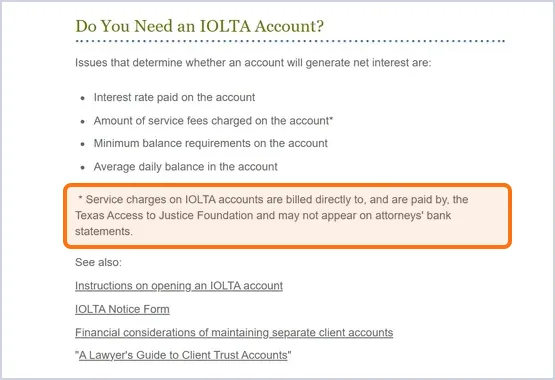
One detail surprises firms when they first reconcile an IOLTA account: under the Texas Access to Justice Foundation’s program, IOLTA service charges are billed to and paid by the Foundation, so they may not appear on the firm’s trust bank statement. If a fee or charge does post to the trust account, do not pay it from another client’s money: flag it, ask the bank why it was charged, and record how it was resolved.
Short-term client funds: how a firm decides what goes into IOLTA
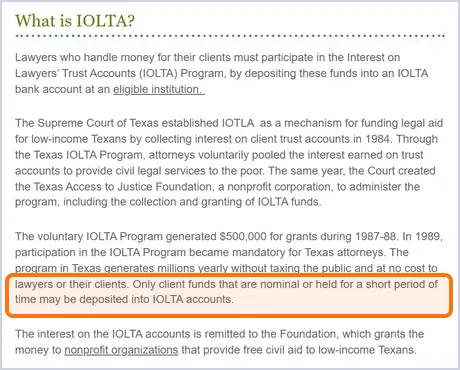
The Foundation’s own rules give the test. Under Rule 6 of the Rules Governing the Operation of the Texas Access to Justice Foundation, a client’s funds count as nominal in amount or held for a short period of time if they could not reasonably be expected to earn interest for the client, or if the interest they might earn is not likely to cover the cost of setting up and keeping a separate account: service charges, accounting costs and tax reporting costs. The nature of the matter and the likelihood of delay before the funds are needed are also considered.
The attorney makes that call in good faith at the start and reviews it at reasonable intervals as circumstances change. Rule 22 says an attorney is not liable for the determination if it is made in good faith under the rules. In practice, a routine retainer or a filing-fee advance usually belongs in IOLTA, while a large settlement held through a long dispute may call for a separate interest-bearing account for that client. That decision stays with the attorney.
For the books, two habits help. Note the decision in the client’s file when funds arrive, and look again at any large balance that has sat in IOLTA longer than expected. A monthly reconciliation that lists every client ledger by balance and age makes those balances easy to spot.
What commingling looks like in the books
Commingling is mixing the lawyer’s money with client money. The Texas rule and the State Bar guide treat the duty to keep them separate as absolute, and the guide notes that a client cannot consent to commingling. In the books, it usually looks like one of these:
- A payment of an earned invoice deposited into trust “to sort out later.”
- Earned fees left in trust long after they were billed and approved.
- An advance fee deposited straight into operating.
- Firm expenses paid from the trust account.
- A “cushion” of firm money parked in trust to cover overdrafts.
The one narrow exception: the lawyer may keep firm money in trust reasonably sufficient to pay bank fees, obtain a fee waiver or keep the account open, ideally tracked on its own ledger. The related problem is a client ledger going negative, meaning one client’s money is covering another client’s disbursement. Only a reconciliation against the individual client ledgers catches that.
Records Texas expects a law firm to keep
Rule 1.15 requires complete records preserved for five years after the representation ends. Rule 17.10 of the Texas Rules of Disciplinary Procedure adds detail: a lawyer who maintains a client trust account must keep the records of that account for five years after final disposition of the underlying matter, including checkbooks, canceled checks, check stubs, check registers, bank statements, vouchers, deposit slips, ledgers, journals, closing statements and accountings. The records must clearly show the date, amount, source and explanation of every receipt and disbursement.
In bookkeeping terms, that means a trust register in date order with a running balance, a ledger for each client updated at the same time, entries that name the client or file number, payee and purpose (electronic transfers included), and monthly bank statements with the reconciliations that tie them out. The State Bar guide also warns against writing trust checks to “cash” and against disbursing on deposits that have not cleared.
How often should a Texas law firm reconcile its trust account?
The Texas safekeeping rule does not set a reconciliation frequency. Monthly is best practice: the State Bar guide calls monthly reconciliation of the ledgers and bank statement “practical, wise, and necessary” for efficient law office management, and it notes that routine reconciliation discourages employee theft. The standard to aim for is a three-way reconciliation, where the adjusted bank balance, the trust register and the total of all client ledgers agree on the same date. We explain the mechanics step by step in our article on IOLTA three-way reconciliation.
What a grievance looks at
Trust account grievances are handled by the State Bar’s Office of Chief Disciplinary Counsel. Under the Texas Rules of Disciplinary Procedure, each grievance is classified within 30 days, and if it becomes a complaint, counsel generally has 60 days after the lawyer’s response is due to decide whether just cause exists. They usually come from a client or a third party owed part of the funds, such as a medical provider awaiting settlement money.
The questions tend to follow the rule itself: Were the funds kept separate? Were the client and third parties notified and paid promptly? Can the lawyer produce a full accounting? Were disputed funds held back? Do the records exist for the full five years? The guide also notes that a late refund does not by itself end an investigation, and that an inadvertent violation is still a violation. A firm with reconciled monthly records can answer from its files; a firm without them has to rebuild the history under a deadline.
Where a bookkeeper fits, and what stays with the attorney
A bookkeeper can record trust activity accurately, keep client ledgers current, reconcile the account every month and flag problems early. The attorney still decides when a fee is earned, how disputed funds are handled and who is entitled to a disbursement, and stays responsible for staff who handle trust money. At LUCI Financial Solutions, a senior accountant reviews each month’s work before delivery, and anything that needs a legal judgment goes back to the attorney.
See how that fits into our full law firm bookkeeping service, and if the trust history is already out of balance, start with bookkeeping cleanup and catch-up before monthly work begins. If you are looking for an IOLTA bookkeeper for a Texas firm, that page also covers how retainers, earned-fee transfers and the monthly three-way reconciliation are handled.
The State Bar of Texas publishes A Lawyer’s Guide to Client Trust Accounts, and its Ethics Helpline can answer rule questions for Texas lawyers.
Frequently asked questions
Is the Texas trust account rule 1.14 or 1.15?
It is Rule 1.15 as of October 1, 2024. The Supreme Court of Texas renumbered the safekeeping rule from 1.14 to 1.15 when it adopted new rules, without changing its text. Older forms and articles that cite Rule 1.14 are referring to the same rule.
Does Texas require monthly trust account reconciliation?
The safekeeping rule does not set a reconciliation schedule. Monthly reconciliation is best practice, and the State Bar of Texas guide describes it as practical, wise and necessary for efficient law office management. A monthly three-way reconciliation is the most reliable way to show that each client’s money is accounted for.
How long must a Texas law firm keep trust account records?
Five years. Rule 1.15 requires records to be kept for five years after the representation ends, and Rule 17.10 of the Texas Rules of Disciplinary Procedure requires trust account records to be kept for five years after final disposition of the underlying matter. A closing letter at the end of each matter makes the start date easy to document.
Can a Texas law firm open its IOLTA account at any bank?
No. An IOLTA account must be at a financial institution the Texas Access to Justice Foundation has approved as eligible. The Foundation publishes the eligible list, and the firm must notify the Foundation within 30 days of opening or closing an IOLTA account.
What are short-term client funds for a Texas IOLTA account?
They are client funds that could not reasonably be expected to earn interest for the client, or whose interest would not cover the costs of a separate account, such as service charges, accounting and tax reporting. The attorney decides in good faith when the funds arrive and reviews the decision as circumstances change. Funds that can earn net interest for the client go into a separate interest-bearing trust account.
Can a Dallas bookkeeper handle a law firm’s retainers and trust accounting?
Yes, as long as the attorney keeps control of the account and makes the legal calls. LUCI Financial Solutions records retainers and advance deposits to each client’s ledger, matches earned-fee transfers to approved invoices and reconciles the trust account monthly for law firms in Dallas–Fort Worth and nationwide.
Get a clear read on your firm’s trust records
If you are not certain your trust account would reconcile to your client ledgers today, the $597 Financial Review is a practical first step: a 60-minute review of your QuickBooks file with a prioritized action plan. For ongoing monthly bookkeeping and trust reconciliations, schedule a consultation with LUCI Financial Solutions, or call 214-233-5454.