


Short answer: A controller for a medical or dental practice makes sure the money your practice-management system says you collected is the money that reached the bank, recorded correctly. That means reconciling insurance and patient payments to deposits, separating production from collections, supporting provider compensation, coding payroll, tracking payer mix and AR, and running a monthly close. LUCI Financial Solutions does this for practices in Dallas–Fort Worth and nationwide.
Key takeaways
- Production is work performed at your fee schedule; collections is cash received. Track both.
- Tie the practice-management collections report to bank deposits every month, by payment type and location.
- Provider pay formulas are only as reliable as the production and collections numbers behind them.
- Code payroll by provider, clinical staff and front office so the P&L shows where the margin goes.
- Ask any outside accounting firm how it handles patient information before giving it access.
Most practices start with a bookkeeper who categorizes bank transactions. That works until the practice adds providers, locations or a management company, and the owner asks questions the bookkeeping cannot answer: why collections dropped when the schedule was full, or whether a provider’s bonus is right. That is controller territory, and it is part of our broader accounting for medical and dental practices.
Production vs. collections: the two numbers a practice has to keep apart
Production is the value of the services your providers performed, at your fee schedule. Collections is the cash you actually received from insurance carriers and patients. The gap between them is made up of contractual adjustments (the difference between your fee and what a payer has agreed to pay), write-offs, patient balances not yet paid, and claims still in process.
A practice can look busy on production and still run short on cash. A controller tracks both, along with the adjustments in between, and calculates a net collection rate: collections divided by production after contractual adjustments. When that rate slips, it usually points to denied claims, billing delays or patient balances that are not being worked.
A controller ties four numbers together every month. The table shows what each one measures and what a gap between them usually means.
| Number | What it measures | Where it comes from | What a gap usually means |
|---|---|---|---|
| Production | Services performed, valued at your fee schedule | Practice-management system, by provider and location | Compared with collections: contractual adjustments, write-offs, unpaid patient balances or claims still in process |
| Collections | Cash received from insurance carriers and patients | Payment reports in the practice-management system, posted by the billing team | A falling net collection rate: denied claims, billing delays or patient balances that are not being worked |
| Bank deposits | Cash that actually reached the bank | Bank statements and the card processor’s settlement report | Compared with collections: card batches settling late and net of fees, one EFT covering several posting days, payments posted to the wrong date or location, or front-desk deposits that never arrived |
| Net collection rate | Collections divided by production after contractual adjustments | Calculated by the controller from the reports above | A slide from month to month: a billing problem to raise with the billing team before it reaches cash |
How to read this table: go top to bottom, the way money moves: work performed, payments posted, cash in the bank. Each gap between two rows has a normal explanation and a problem explanation; the controller’s monthly job is to prove which one you are looking at before the statements reach you.
Posting insurance remittances vs. patient payments
Practice money arrives through very different channels, and each needs different handling:
- Insurance payments usually arrive as electronic funds transfers with an electronic remittance advice (ERA), or as checks with a paper explanation of benefits (EOB).
- Patient payments come in by card at the front desk, through an online portal, by check or by payment plan. Card payments land in the bank in batches, net of processing fees.
- Other receipts include refunds from payers, recoupments taken out of later payments, and occasional capitation or incentive payments.
The billing team posts payments to patient accounts in the practice-management (PM) system. The controller’s job is different: make sure the accounting books record the same total, by source, in the right month, and that refunds and recoupments are not hiding inside a net deposit.
Reconciling practice-management deposits to the bank
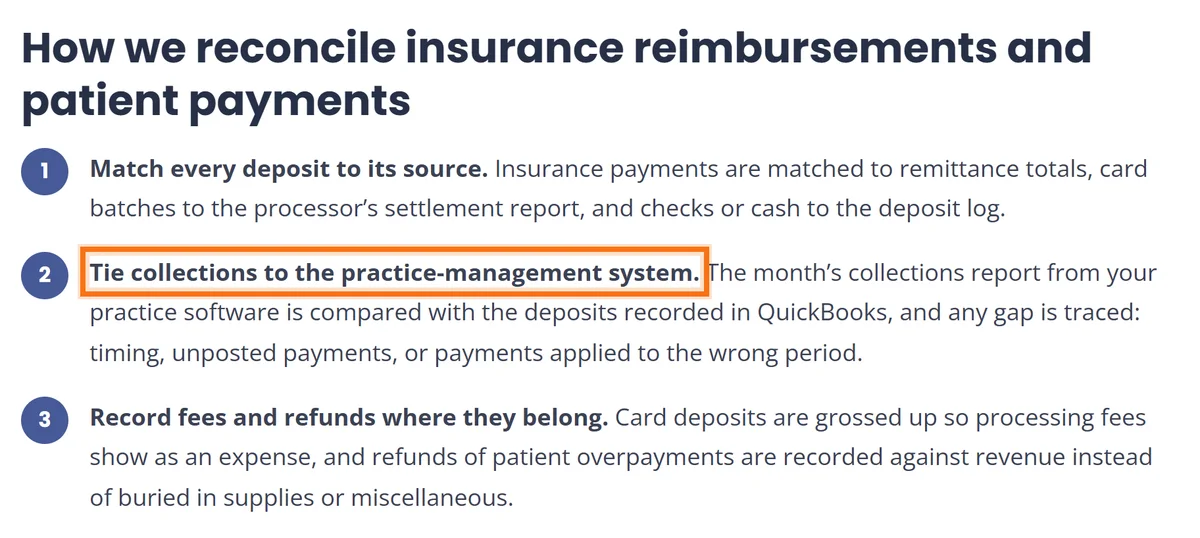
This is the single most valuable monthly task in a practice, and the one most often skipped. The PM system reports what was posted. The bank shows what arrived. They rarely match line for line, because:
- Card batches settle a day or two after the payment was taken, and fees come out before the deposit.
- One insurance EFT may cover payments posted on several different days.
- Payments can be posted to the wrong date, location or provider in the PM system.
- Cash and checks collected at the front desk may not be deposited the same day, or at all.
A controller ties the PM system’s payment reports to bank deposits every month, by payment type and by location, and follows up on anything that does not clear. It is also a strong control against front-desk cash going missing.
Supporting provider compensation calculations
Provider pay in many practices depends on a formula: a percentage of collections, a percentage of production, a base plus a bonus, or a mix. Those formulas are only as reliable as the numbers feeding them. A controller supports the calculation by pulling collections and production by provider from the PM system, reconciling them to the books, applying the agreed formula consistently, and keeping a clear file behind every payout. When a provider asks how their number was calculated, the practice can show the work.
The compensation terms themselves come from the provider agreements, which the owner and the practice’s attorney set.
Payroll coding that makes the P&L useful
In a practice, payroll is often the largest expense, and lumping it into one line hides most of what an owner needs to know. A controller sets up payroll coding so the profit and loss shows provider compensation separately from clinical staff (hygienists, medical assistants, nurses) and from front-office and billing staff, and by location if there is more than one. That shows where the margin is actually going.
Tracking payer mix and AR aging
Payer mix is the share of your collections coming from each source: commercial carriers, Medicare, Medicaid, other government programs and self-pay patients. It matters because each payer pays at different rates and speeds. A shift toward slower or lower-paying payers can squeeze cash even if patient volume is steady.
AR aging shows how long balances have been outstanding, usually grouped in 0 to 30, 31 to 60, 61 to 90, 91 to 120 and over 120 days, split between insurance and patient balances. A controller reviews the aging each month with the billing team and flags growth in the older buckets before those balances become uncollectible.
Multi-location practices and management-company structures
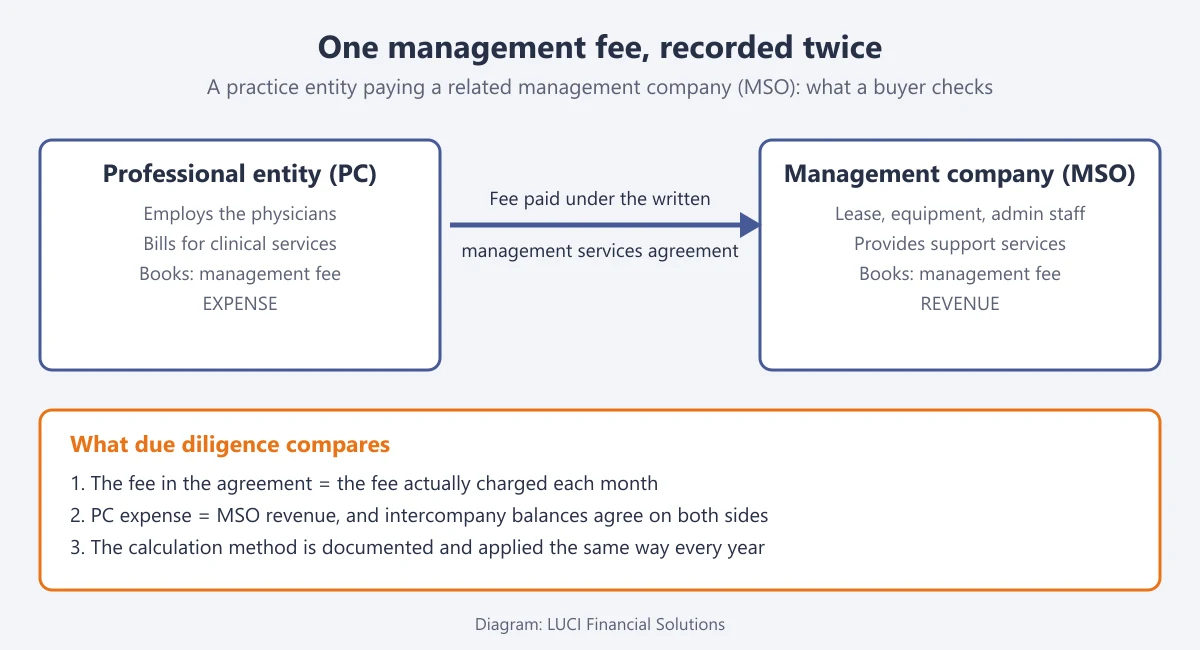
Growing practices often end up with more than one entity: a professional entity owned by the providers, a separate management company that employs staff and holds leases, and sometimes a real estate entity that owns the building. Each one needs its own books, and the money moving between them needs to be documented and recorded on both sides.
The most common flow is a management fee charged by the management company to the practice entity. A controller records it consistently, makes sure intercompany balances reconcile, and produces statements for each entity and for the group as a whole. For more on how those fees are typically set up and recorded, see our article on how medical practice management fees work.
What month-end close looks like for a practice
A practice close follows the same pattern as any service business, with a few practice-specific steps added:
- Pull month-end reports from the PM system: production, adjustments, collections and AR, by provider and location.
- Reconcile all bank and credit card accounts, including the merchant account.
- Tie PM collections to bank deposits and investigate differences.
- Record payer refunds, recoupments and card processing fees correctly.
- Tie payroll to the payroll provider’s reports, coded by role and location.
- Record intercompany activity and management fees if there are multiple entities.
- Review production, collections and net collection rate against prior months.
- Deliver the financial statements with a short summary of what changed.
On cash-basis books, AR and production do not appear in the statements, so the controller reports them alongside.
Protecting patient information when you outsource accounting
Accounting work for a practice can involve reports that contain protected health information (PHI), such as patient names on payment or AR reports. Before giving any outside firm access, ask how they handle PHI, what systems and access controls they use, and whether a business associate agreement is needed for the work they will do. The U.S. Department of Health and Human Services explains when a vendor is considered a business associate in its HIPAA guidance on business associates. Where the work allows, share summary reports without patient detail.
Does your practice need a controller or a CFO?
A controller makes the numbers accurate, reconciled and on time. A CFO uses those numbers to plan: whether to add a provider, open a location, renegotiate payer contracts, or take on debt. Most practices need the controller layer first, because forward-looking decisions built on unreconciled numbers are guesses.
A practice usually needs a controller when deposits are not tied to the PM system, provider pay is calculated in a spreadsheet nobody else can check, or there is more than one location or entity. It needs CFO-level support when the books are reliable and the questions shift to growth, financing and profitability by provider or site. Our guide to fractional CFO support for medical practices covers that next stage. You can see how we deliver the controller role on our controller services page for Dallas businesses.
Frequently asked questions
What is the difference between production and collections in a medical practice?
Production is the value of services providers performed at the practice’s fee schedule. Collections is the cash actually received from payers and patients. The difference is made up of contractual adjustments, write-offs and unpaid balances, and a controller tracks all three so the owner understands why cash and activity do not match.
Why don’t my practice-management deposits match my bank account?
Card batches settle a day or two late and arrive net of fees, a single insurance EFT can cover payments posted on different days, and payments are sometimes posted to the wrong date or location. A monthly reconciliation of PM reports to bank deposits identifies each difference and catches real problems, such as missing front-desk deposits.
Can a controller calculate provider compensation?
A controller can support the calculation by pulling production and collections by provider, reconciling them to the books and applying the formula in the provider agreements consistently. The terms themselves are set by the practice owner and its legal counsel.
What is payer mix and why does it matter?
Payer mix is the share of collections coming from commercial insurance, Medicare, Medicaid, other programs and self-pay patients. Payers reimburse at different rates and speeds, so a shift in the mix changes cash flow even when patient volume stays the same.
Does an outsourced accounting firm need a business associate agreement with my practice?
It depends on whether the firm will create, receive, maintain or transmit protected health information in the course of its work. Ask any accounting vendor how they handle PHI and whether a business associate agreement is needed for the services they will provide. HHS publishes guidance on business associates that explains the rules.
When does a medical practice need a controller instead of a bookkeeper?
Usually when the practice adds providers, locations or a management company, or when deposits are no longer reconciled to the practice-management system. At that point the practice needs someone who reconciles revenue sources, supports provider pay and runs a reviewed monthly close.
Get practice numbers you can trust every month
If your deposits are not tied to your PM system, or provider pay depends on a spreadsheet only one person understands, our team can help. A good first step is our $597 Financial Review & Assessment, a 60-minute review of your QuickBooks file with a prioritized action plan. Or schedule a consultation with our team to talk through your practice’s structure and reporting needs.