


Short answer: The tax tips that save Dallas small businesses the most are not tricks. Keep business money separate, reconcile your books monthly, pay estimated tax during the year, claim the home office and mileage deductions correctly (72.5 cents a mile for January to June 2026, 76 cents from July), time equipment purchases, fund a retirement plan and get 1099s right. Below are all nine, with the 2026 numbers from irs.gov.
Key takeaways
- Deductions you can prove are the ones you keep: every entry needs a receipt, invoice or bank record behind it.
- Texas has no state income tax, but federal estimated tax is due during the year.
- Two mileage rates apply in 2026, so log the date of every business trip.
- Section 179 expensing now reaches $2.5 million, adjusted for inflation from 2026; plan large purchases with your CPA.
- The 1099-NEC threshold rose to $2,000 for payments made in 2026.
The 9 tax tips at a glance, with 2026 figures
This is the short version of the guide. Each row is a tip, the 2026 rule or number behind it, and where the figure comes from, so you can check it yourself before you rely on it.
| Tax tip | 2026 rule or number | Official source |
|---|---|---|
| 1. Separate business and personal money | Your books must show gross income, deductions and credits; the business account is the main source | IRS: What kind of records should I keep |
| 2. Reconcile monthly and keep records | Generally 3 years after filing; employment tax records at least 4 years | IRS: How long should I keep records |
| 3. Pay estimated tax on time | Four payment periods; individuals generally pay if they expect to owe $1,000 or more | IRS: Estimated taxes |
| 4. Claim the home office correctly | Simplified method: $5 per square foot, up to 300 square feet | IRS: Simplified option for home office deduction |
| 5. Track business mileage | 72.5 cents a mile (January 1 to June 30); 76 cents (July 1 to December 31) | IRS: Standard mileage rates |
| 6. Deduct everyday business costs | Ordinary and necessary expenses; business meals generally 50% | IRS: Topic 511, Business travel expenses |
| 7. Time equipment purchases | Section 179 up to $2.5 million, adjusted for inflation from 2026; 100% bonus depreciation for qualified property acquired after January 19, 2025 | IRS: Working Families Tax Cuts provisions for businesses |
| 8. Fund a retirement plan | SEP contributions up to the lesser of 25% of compensation or $72,000 for 2026 | IRS: SEP contribution limits |
| 9. Get 1099s and Texas filings right | 1099-NEC threshold $2,000; due January 31; Texas franchise tax report due May 15 | IRS 1099 instructions; Texas Comptroller |
How to read this table: the first three rows protect the deductions in the rest, because a deduction you cannot document does not survive a question from the IRS. Rows 7 and 8 involve the largest amounts and the most rules, so treat those numbers as a starting point for a conversation with your CPA, not a decision.
Tips 1 and 2: Keep records the IRS will accept
1. Keep business and personal money apart
Open a business checking account and a business credit card, and run every business dollar through them. The IRS says the business checking account is usually the main source for entries in your books, and that your books must show your income, deductions and credits. Mixing personal charges into it means every deduction has to be sorted out by hand, and some get lost.
2. Reconcile every month and keep the paper trail
Reconciling means matching your books to every bank, card and loan statement each month, so nothing is missing or recorded twice. Keep the documents behind each entry: invoices, receipts, deposit records and paid bills. The IRS generally expects records to be kept for 3 years after you file, and employment tax records for at least 4 years. Our year-end bookkeeping checklist for Dallas businesses shows what your tax preparer will ask for.
Tip 3: Pay estimated tax during the year, even in Texas
Texas has no state personal income tax, which surprises some owners into thinking April is the only tax date that matters. It is not. Federal income tax and self-employment tax on business profit are due as you earn it. The IRS says individuals, including sole proprietors, partners and S corporation shareholders, generally have to make estimated payments if they expect to owe $1,000 or more when they file.
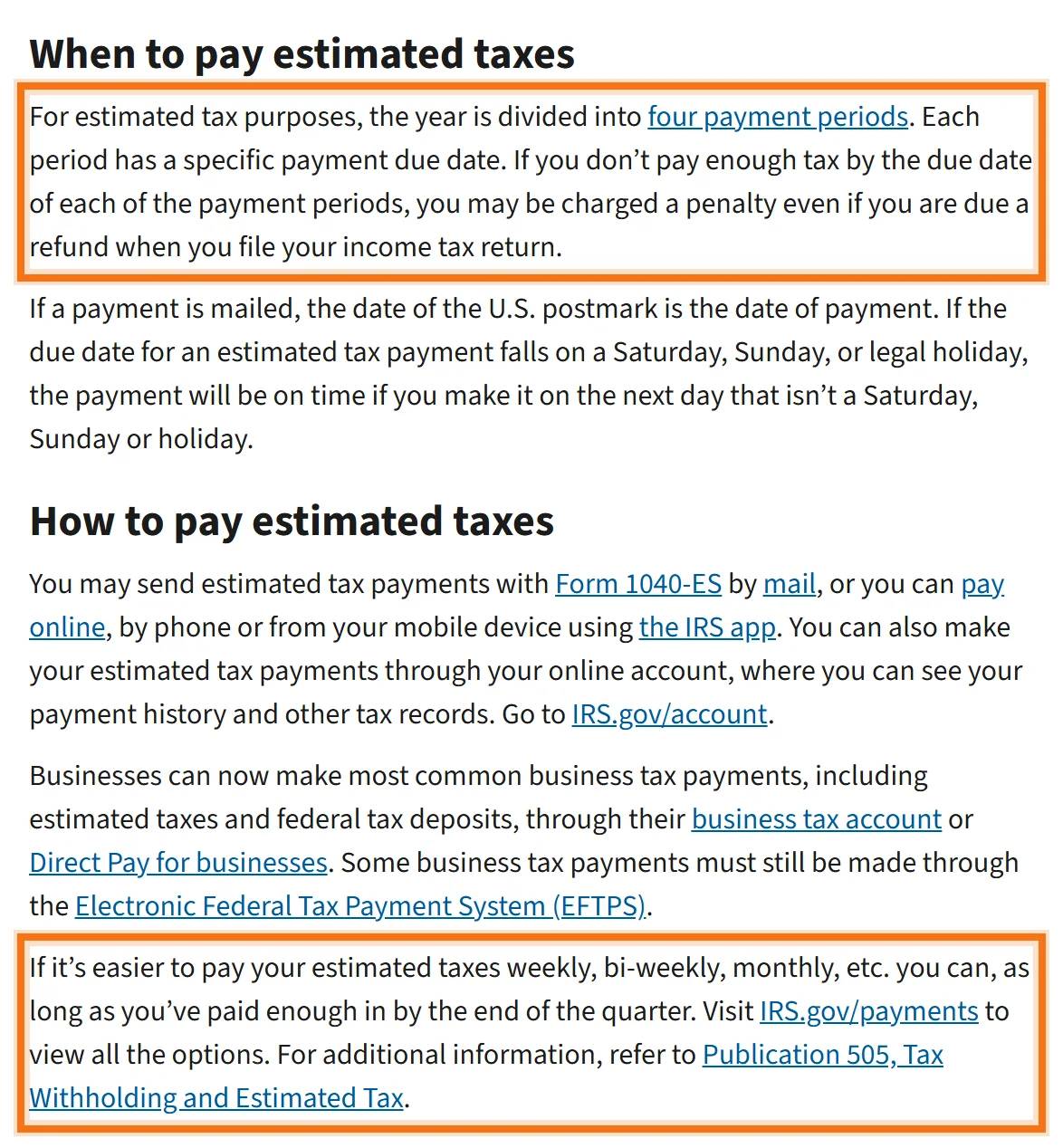
A simple habit makes this painless: after each month’s books are closed, move a set share of that month’s profit into a separate tax savings account and pay estimates from it. Your CPA sets the share; your bookkeeper makes sure the profit figure it is based on is right.
Tips 4 to 6: Maximize deductions you already qualify for
4. Claim the home office deduction correctly
If part of your home is used regularly and exclusively for business, you may qualify. The IRS simplified method lets you deduct $5 per square foot of that space, up to 300 square feet, with very little recordkeeping. The regular method uses your actual costs, such as rent or mortgage interest, utilities and insurance, in proportion to the space, and needs more records. A guest room that doubles as an office does not qualify.
5. Track business mileage, with the date
You can deduct either the actual costs of using a vehicle for business or the IRS standard mileage rate. For 2026 the IRS set two business rates, because it raised the rate in the middle of the year.
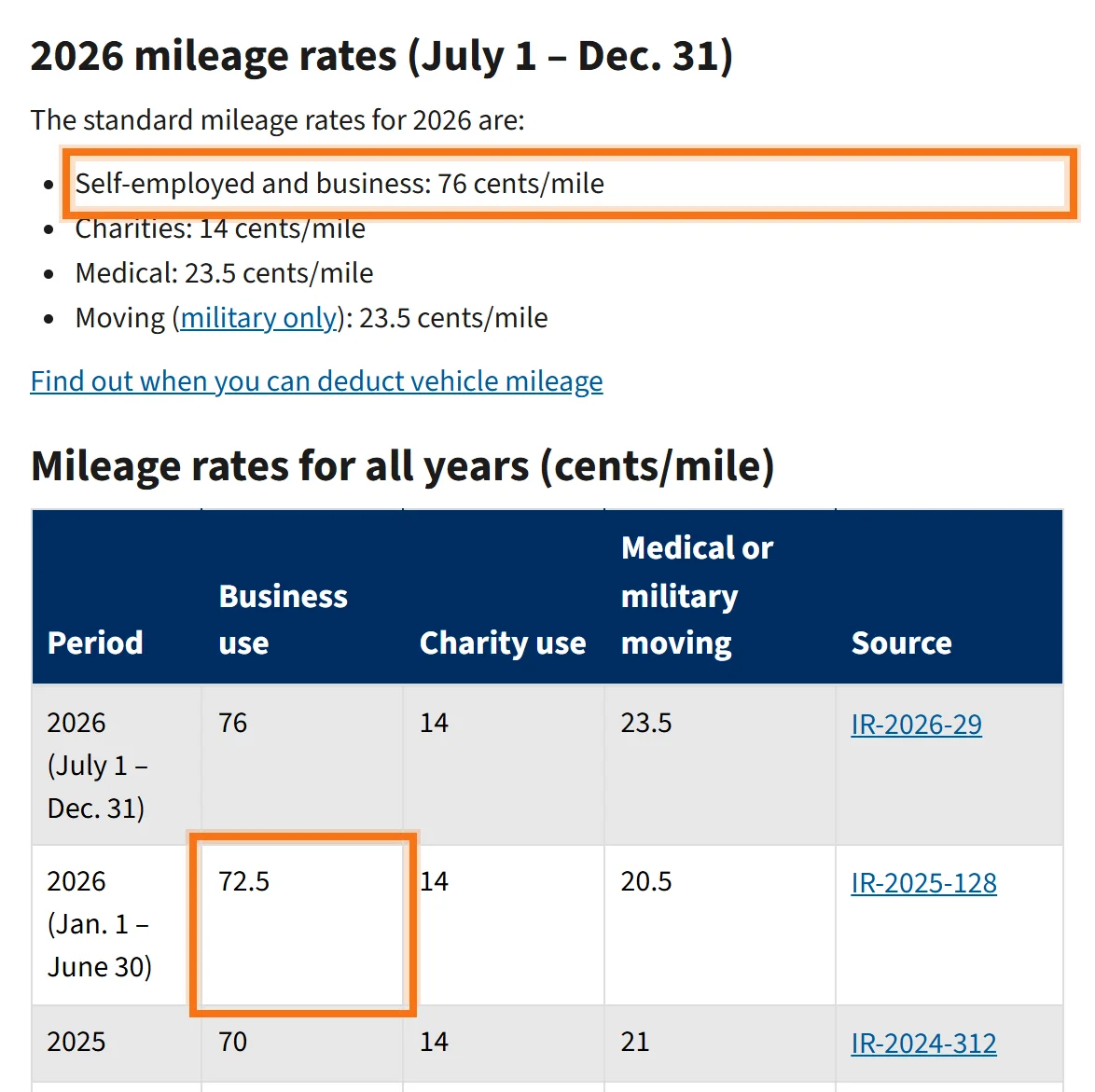
Keep a log of each business trip with the date, the destination, the purpose and the miles. Driving between two job sites or to a client counts; your regular commute from home to your office does not.
6. Deduct the everyday costs of running the business
Ordinary and necessary business expenses are deductible: advertising and marketing, accounting and legal fees, business insurance, software subscriptions, supplies and the cost of business travel away from home. Business meals are generally limited to 50% of the cost. The deduction is only as good as the record, so code each expense to the right account as it happens, not in a rush the following March. Our list of 18 overlooked tax deductions covers the ones owners most often miss.
Tips 7 and 8: Bigger deductions that need planning
7. Time equipment purchases
When you buy equipment, vehicles or furniture for the business, you normally recover the cost over several years through depreciation. Two rules let you deduct more in the year of purchase. Under the Working Families Tax Cuts, the Section 179 expensing limit rose to $2.5 million for tax years beginning after 2024, reduced once total qualifying purchases pass $4 million and adjusted for inflation from 2026. The same law made 100% bonus depreciation permanent for qualified property acquired after January 19, 2025.
Bigger first-year deductions are not always better: they lower this year’s tax but leave less to deduct later. Decide with your CPA before you buy, not after.
8. Fund a retirement plan
Contributions to a business retirement plan reduce taxable income while you save. For 2026, the IRS allows employer contributions to a SEP-IRA of up to the lesser of 25% of the employee’s compensation or $72,000. Other plans, such as a solo 401(k) or a SIMPLE IRA, have their own limits and setup deadlines. Our guide to retirement planning for business owners compares them.
Tip 9: Get 1099s and Texas filings right
Collect a Form W-9 from every contractor before the first payment, so you have the name and taxpayer ID you need in January. For payments made in 2026 and later, the IRS raised the reporting threshold for nonemployee compensation on Form 1099-NEC from $600 to $2,000 per contractor for the year. Form 1099-NEC is due by January 31, and if you file 10 or more information returns in total, you must file them electronically. Our guide to IRS Form 1099 walks through the steps.
Texas adds its own calendar. Most LLCs, corporations and partnerships file a franchise tax report with the Texas Comptroller each year by May 15; businesses at or below the no-tax-due threshold still file a Public Information Report or Ownership Information Report. If you sell taxable goods or services, you collect Texas sales tax and file returns on the schedule the Comptroller assigns. Employers also pay state unemployment tax to the Texas Workforce Commission each quarter.
Common tax mistakes Dallas small businesses make
- Books caught up once a year. Expenses get guessed at, receipts are missing, and deductions are lost.
- Owner draws recorded as expenses. They are not deductible, and they make profit look smaller than it is.
- No estimated payments. The bill arrives in April along with a possible underpayment penalty.
- Contractors paid without a W-9. January becomes a chase for names and tax IDs.
- Mileage reconstructed from memory. A log written months later is hard to defend.
When to bring in a bookkeeper and a CPA in Dallas
A CPA or tax advisor is the right person for tax planning, entity choice, large purchases and anything involving the IRS. A bookkeeper makes sure the numbers your CPA works from are complete and correct. Most tax-season stress comes from the second job not being done during the year.
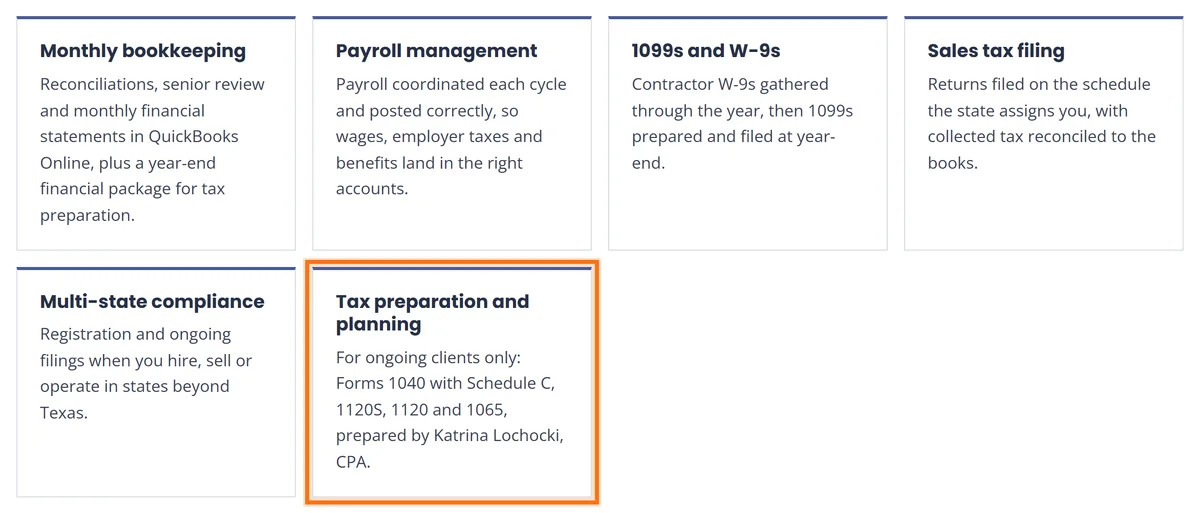
LUCI Financial Solutions is a Dallas–Fort Worth firm that keeps the books for established service businesses, typically with $250K or more in annual revenue. Every tier includes monthly reconciliations, senior review and a year-end package for your tax preparer. Tax preparation and planning are available as an add-on for ongoing clients, prepared by Katrina Lochocki, CPA. See bookkeeping, payroll and tax services in Dallas for how the pieces fit together.
Frequently asked questions about small business taxes
What are the best tax tips for small businesses in 2026?
Keep business and personal money apart, reconcile your books every month, pay estimated tax during the year, claim the home office and vehicle deductions correctly, plan equipment purchases and retirement contributions with your CPA, and collect W-9s so your 1099s are right in January.
What is the IRS standard mileage rate for business in 2026?
The IRS set two business rates for 2026: 72.5 cents per mile for January 1 through June 30, and 76 cents per mile for July 1 through December 31. Keep a log with the date, purpose and miles of each trip so each mile is claimed at the right rate.
How much can I deduct for a home office?
With the IRS simplified method you deduct $5 per square foot of the space used for business, up to 300 square feet, so a maximum of $1,500. The regular method uses your actual home costs instead. Either way, the space must be used regularly and exclusively for business.
Do Texas small businesses pay state income tax?
Texas has no state personal income tax, so owners do not file a state income tax return. Most Texas LLCs, corporations and partnerships file an annual franchise tax report, due May 15, and businesses that sell taxable goods or services collect and remit sales tax.
When do I need to send a Form 1099-NEC?
For payments made in 2026 and later, the IRS reporting threshold for nonemployee compensation is $2,000 a year per contractor, up from $600. Form 1099-NEC is due to the contractor and the IRS by January 31, and businesses filing 10 or more information returns in total must e-file.
Does LUCI Financial Solutions prepare tax returns?
Yes, for ongoing clients. Tax preparation and planning are an add-on to LUCI’s monthly bookkeeping and CFO advisory work, prepared by Katrina Lochocki, CPA. LUCI does not offer standalone tax preparation to businesses whose books it does not keep.
Tax season starts with clean books
Monthly reconciliations, a senior review and a year-end package your CPA can use. See our bookkeeping services in Dallas.