


Short answer: Year-end goes smoothly when the books are already reconciled before December 31, so January is spent filing, not fixing. Start in November: reconcile every account through October, collect a W-9 from every contractor, and confirm payroll records. In December, close the final month, count inventory and assemble the package your CPA needs. This checklist covers those 20 steps, with the Texas filings that most small businesses in Dallas-Fort Worth face.
Key dates for the coming filing season
These are the dates that apply to most small businesses closing the 2026 calendar year. January 31, 2027 falls on a Sunday, so deadlines set for January 31 move to Monday, February 1, 2027. The Texas franchise tax report moves the same way, from Saturday, May 15 to Monday, May 17, 2027.
| Date | What is due | Who it applies to |
|---|---|---|
| January 15, 2027 | Fourth-quarter estimated tax payment | Owners of pass-through businesses and sole proprietors who pay estimated tax |
| January 20, 2027 | Texas sales and use tax return | Annual filers, and monthly filers for December |
| February 1, 2027 | Form W-2 to employees and the Social Security Administration; Form 1099-NEC to contractors and the IRS; Form 940; fourth-quarter Form 941 | Employers and any business that paid contractors |
| February 1, 2027 | Fourth-quarter wage report and unemployment tax to the Texas Workforce Commission | Texas employers |
| March 15, 2027 | Form 1120-S and Form 1065 returns (or an extension) | S corporations and partnerships, including most multi-member LLCs |
| April 15, 2027 | Form 1040 and Form 1120 returns (or an extension) | Sole proprietors, single-member LLCs and C corporations |
| May 17, 2027 | Texas franchise tax report and Public Information Report or Ownership Information Report | LLCs, corporations and other taxable entities in Texas |
Your own dates depend on your entity type, payroll schedule and filing frequency, so confirm them with your tax preparer.
Phase 1: Close the books cleanly (November and December)
1. Reconcile every bank, credit card and loan account
Bring each account up to date through the most recent statement now, so December only has one month left to do. Loan balances should match the lender statement, with each payment split between principal and interest.
2. Clear uncategorized and suspense balances
Transactions sitting in “Uncategorized,” “Ask My Accountant” or a suspense account will be guessed at by someone in January. Resolve them while the people who made the purchases still remember them.
3. Review accounts receivable
Send statements, follow up on anything past 60 days, and decide with your tax preparer whether any balance is truly uncollectible. Only businesses that report on the accrual basis can usually write off bad debt, because cash-basis businesses never recorded the income.
4. Review accounts payable and unpaid bills
Look for duplicate bills, bills already paid by card, and credits from vendors that were never applied. An inflated payables balance understates your profit and confuses cash planning.
5. Count inventory on December 31
If you carry inventory, count it as of the last day of the year and adjust the books to the count. Write down damaged or obsolete stock now, not in March.
6. Update the fixed asset list
Record equipment, vehicles and improvements bought during the year, and remove anything sold or scrapped. Bring the invoices to your tax preparer, who will decide how each purchase is depreciated or expensed.
7. Separate owner and business activity
Record owner draws, contributions and personal expenses paid by the business. S corporation owners should also confirm two things before the last payroll of the year: that a reasonable salary ran through payroll, and that health insurance premiums paid for shareholders who own more than 2% are added to their W-2.
Phase 2: Payroll and contractors (December)
8. Collect a W-9 from every contractor
For payments made in 2026, a Form 1099-NEC is generally required for a contractor you paid $2,000 or more during the year, up from $600 for 2025 payments. The change comes from the One Big Beautiful Bill Act, and the threshold will be adjusted for inflation starting in 2027. Get the W-9 now, before the final payment, when the contractor still has a reason to reply.
Payments made by credit card or through a payment app are reported by the card processor or app on Form 1099-K, not by you. Processors file Form 1099-K only when a payee receives more than $20,000 across more than 200 transactions.
9. Check employee records before the final payroll
Confirm names, Social Security numbers and mailing addresses so the W-2s go out right the first time. Add taxable fringe benefits, such as personal use of a company vehicle, to wages before the last payroll run. Gift cards given to employees are taxable wages, whatever the amount.
10. Decide on year-end bonuses before the last payroll
A bonus paid in the final payroll of the year is taxed and reported in that year. Decide on amounts early enough that payroll can withhold correctly, and ask your tax preparer whether paying in December or January works better for you.
11. Reconcile payroll filings to the books
Total wages on the four quarterly Forms 941 should match the W-2 totals and the payroll expense in your books. Texas has no state income tax, so there is no state withholding to reconcile, but Texas employers pay state unemployment tax to the Texas Workforce Commission on the first $9,000 of each employee’s wages. Check that the four quarterly TWC reports agree with the books as well.
Phase 3: Texas taxes and compliance

12. Confirm sales tax is current
If you sell taxable goods or services, the sales tax collected in your books should match the returns you filed with the Texas Comptroller. Returns are due on the 20th of the month after each filing period.
13. Prepare for the Texas franchise tax report
For reports due in 2026 and 2027, a taxable entity with annualized total revenue of $2.65 million or less owes no franchise tax and does not file a No Tax Due Report. It still must file a Public Information Report or an Ownership Information Report by the May due date. A business that skips that report can lose its right to do business in Texas, so put it on the calendar now. The revenue figure comes from your year-end books, which is one more reason to close them cleanly.
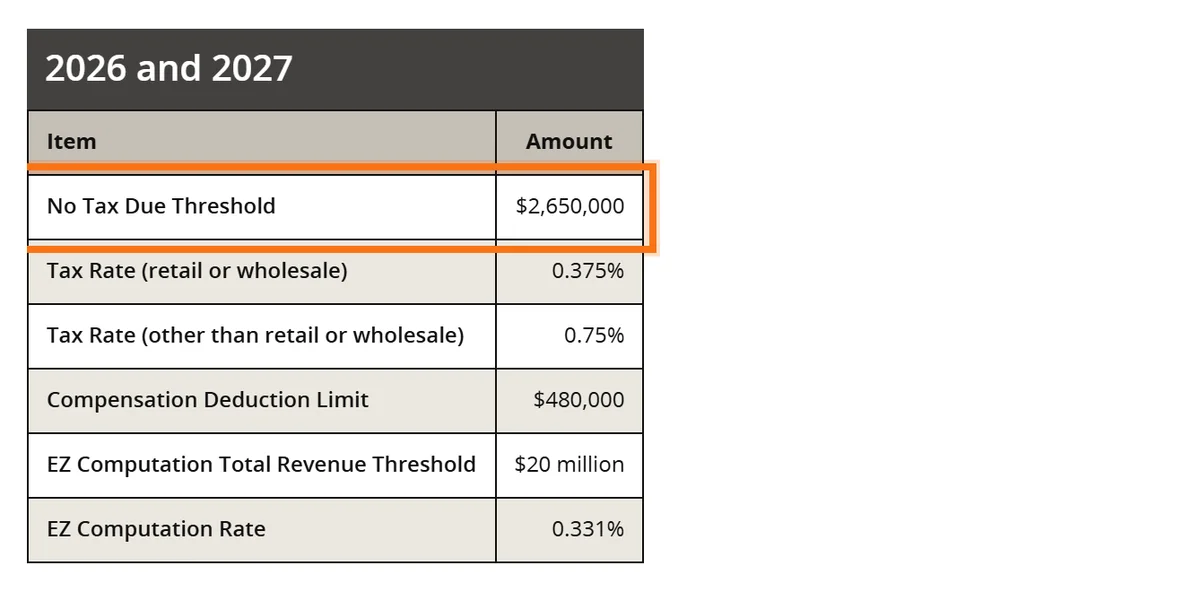
How to use this table: take total revenue from your reconciled year-end Profit & Loss and compare it with the highlighted threshold. Above it, your CPA works out the tax using the rate for your type of business; below it, you still file the information report by the May due date. Either way, the number has to come from closed books, which is why steps 1 to 11 come first.
14. Set aside the beneficial ownership (BOI) worry
Since March 2025, companies formed in the United States no longer have to file beneficial ownership information reports with FinCEN. The requirement now applies to companies formed outside the United States that are registered to do business here.
15. Renew licenses and check your state records
Note any professional, sales tax or local licenses that expire early next year, and confirm that your registered agent and business address on file with the Texas Secretary of State are current.
Phase 4: Prepare for your CPA and next year
16. Talk to your tax preparer before December 31, not after
Decisions about equipment purchases, retirement plan contributions and the timing of income and expenses can only be made while the year is still open. Bring an up-to-date profit and loss statement to that conversation.
17. Assemble the year-end package
Most tax preparers ask for the same set of documents:
- Year-end profit and loss statement and balance sheet
- December bank, credit card and loan statements
- The fixed asset list with invoices for new purchases
- Payroll summaries, W-2s and the 1099s you issued
- Records of estimated tax payments made during the year
- The inventory count, if you carry inventory
18. Back up and archive the year
Export the year-end reports and store them outside your accounting software. The IRS generally expects you to keep records for at least three years after filing, and employment tax records for at least four.
19. Build next year’s budget
Use this year’s actual results as the starting point, not last year’s budget. Set monthly targets for revenue, payroll and your largest expenses so you can compare them each month.
20. Set up a monthly close so next year-end is easy
A business that closes its books every month has very little left to do in December. Our month-end close checklist shows the routine, and a controller can own it for you.
Frequently asked questions
When should a small business start year-end preparation?
Start in November. Reconcile accounts through October, collect contractor W-9s and confirm payroll records, so December only has one month left to close. Waiting until January leaves too little time before the February 1, 2027 filing deadlines.
What is the 1099-NEC threshold for 2026 payments?
For payments made in 2026, a Form 1099-NEC is generally required once you pay a contractor $2,000 or more in the year. For 2025 payments the threshold was $600. Payments made by credit card or through a payment app are reported by the processor on Form 1099-K instead.
Does a Texas small business have to file a franchise tax report if it owes nothing?
Yes, in most cases. For reports due in 2026 and 2027, an entity with annualized total revenue of $2.65 million or less owes no franchise tax and does not file a No Tax Due Report, but it still must file a Public Information Report or an Ownership Information Report by the May due date.
Do I still need to file a beneficial ownership (BOI) report?
Not if your company was formed in the United States. Since March 2025, FinCEN has exempted domestic companies from beneficial ownership reporting. The requirement now applies to companies formed outside the United States that are registered to do business here.
What should I give my CPA at year-end?
A year-end profit and loss statement and balance sheet, December bank, card and loan statements, the fixed asset list with invoices for new purchases, payroll summaries, W-2s and 1099s, records of estimated tax payments, and an inventory count if you carry inventory.
Want year-end handled for you?
LUCI Financial Solutions works with Dallas-Fort Worth businesses year-round, so December is a final month rather than a scramble. We can clean up and reconcile your books, run bookkeeping and payroll, and provide controller oversight that hands your CPA a finished package. Not sure where you stand? Start with our free 7-question Financial Operations Assessment.