


Short answer: Bookkeeping 101 for a Dallas small business owner comes down to six habits: run every business dollar through a separate account, record each transaction in software such as QuickBooks Online, keep the receipt or invoice behind it, reconcile every account monthly, read your Profit & Loss, Balance Sheet and cash flow each month, and keep records for at least 3 years. This beginner’s guide explains each one in plain terms.
Key takeaways
- Bookkeeping records what happened; accounting and tax work build on it.
- A separate business account and card are the first step, not an optional one.
- Every entry needs a document behind it: invoice, receipt, deposit record or paid bill.
- Reconciling every account monthly catches missing and duplicate entries while they are easy to fix.
- Three reports tell you how the business is doing: Profit & Loss, Balance Sheet and Statement of Cash Flows.
What bookkeeping is, and what it is not
Bookkeeping is the process of recording and organizing your business’s financial transactions: sales, payments received, bills, payroll, loan payments and owner draws. Done well, it gives you a set of books that matches your bank accounts and lets you see, any month, whether you made money and where the cash went.
It is not the same as tax preparation. Your CPA or tax preparer uses your books to file a return once a year; a bookkeeper keeps them right all year. It is also not the same as financial advice, which uses the books to decide what to do next. If you want the difference in more detail, see our comparison of a bookkeeper and a CPA.
Setting up your bookkeeping system: Bookkeeping 101 explained
- Separate the money. Open a business checking account and a business card, and use them only for the business.
- Choose software. Cloud software such as QuickBooks Online connects to your bank and card feeds, so most transactions arrive automatically.
- Set up a chart of accounts. This is the list of categories every transaction goes into: income types, cost of services, rent, payroll, software, and so on. Keep it short and specific to how your business earns and spends.
- Pick cash or accrual. Cash basis records income when it arrives; accrual records it when you earn it. Ask your CPA which suits your tax situation.
- Decide where documents live. A receipt app or one shared folder, organized by year and type, so every entry can be backed up.
Most bookkeeping problems we see trace back to this step: a chart of accounts copied from someone else’s business, or personal and business spending in one account. Fixing the setup early costs far less than cleaning up a year of entries later.
Basic Bookkeeping 101 tasks, by how often you do them
The work is easier when it follows a calendar. This is the routine a small service business can follow on its own, and the reason each task matters.
| Task | How often | Why it matters |
|---|---|---|
| Record and categorize transactions from bank and card feeds | Weekly | Small batches are accurate; a year of guesses in March is not |
| Send invoices and record payments received | As work is finished | Every day an invoice waits is a day added to your wait for cash |
| Enter and pay bills | Weekly | Pay on time without paying early by habit, and keep vendors on good terms |
| Reconcile every bank, card and loan account | Monthly | Finds missing, duplicate and wrong entries while they are easy to trace |
| Review the Profit & Loss, Balance Sheet and cash flow | Monthly | Shows whether you made money and why cash moved |
| Set aside and pay estimated tax | Monthly or quarterly | Federal tax on profit is due during the year, even in Texas |
| Year-end package for your tax preparer; 1099s | January | Form 1099-NEC is due January 31; a clean year makes the return faster |
How to read this table: if you only have time for one row, make it the monthly reconciliation, because it is the check that tells you every other row was done right. If the weekly rows keep slipping, that is the signal to automate more or hand the work to someone else.
Recording transactions
Every deposit, card charge, check and transfer gets a date, an amount, a category and, where it matters, a customer or vendor. Bank feeds bring the transactions in; you or your bookkeeper decide where each one belongs. Owner draws and loan principal are not expenses, and treating them as expenses is one of the most common beginner mistakes.
Reconciling bank statements
Once a month, compare your books with each statement: the ending balance should match after accounting for items still in transit. When it does not, something is missing, duplicated or recorded in the wrong month. QuickBooks Online has a reconcile tool for this; the discipline is doing it every month for every account.
Managing accounts payable and receivable
Accounts payable is what you owe vendors; accounts receivable is what customers owe you. For a service business, receivables usually matter more, because unpaid invoices are cash you have already earned. Send invoices the day work is finished, state the due date, accept online payment, and review the receivables aging report weekly, oldest balance first.
On the payables side, enter bills when they arrive, not when you pay them, so you always know what is coming due. Our guide to cash flow management strategies covers both sides in more depth.
Financial statements: the three reports every owner should read
- Profit & Loss (income statement): revenue minus expenses for a period. Answers “did we make money?”
- Balance Sheet: what the business owns, owes and the owner’s equity on one date. Answers “what is the business worth on paper, and what do we owe?”
- Statement of Cash Flows: why the bank balance changed. Answers “where did the cash go?”
Read them in that order every month, and compare each month with the same month last year. Our plain-English guide to understanding financial statements walks through each one with examples.
Records and taxes: what to keep, and for how long
The IRS lets you use any recordkeeping system that clearly shows your income and expenses, but every entry should be supported by a document.
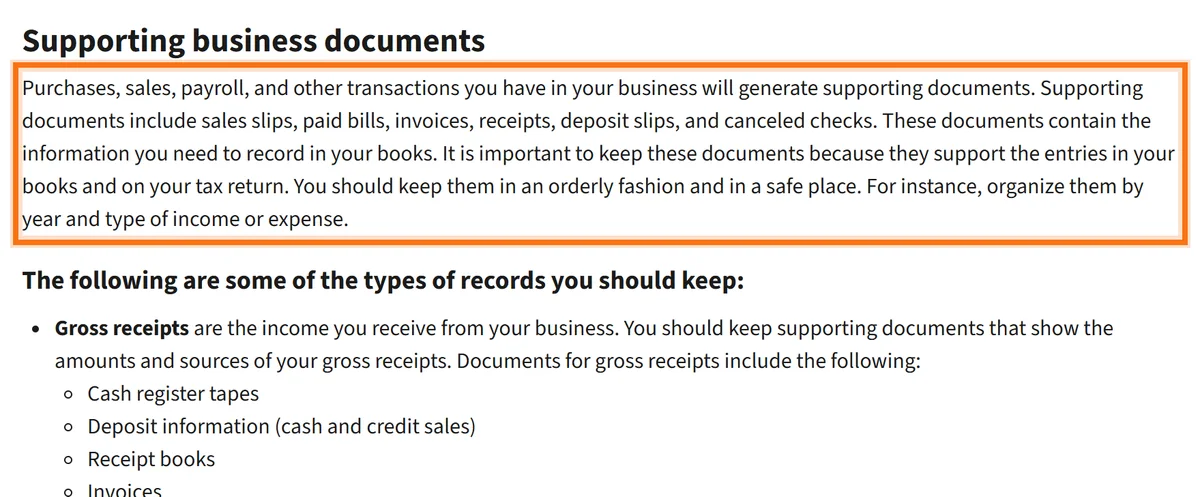
The IRS generally expects records to be kept for 3 years after you file, and employment tax records for at least 4 years. Texas has no state personal income tax, but federal estimated tax applies to business profit, most LLCs and corporations file a Texas franchise tax report each May, and businesses selling taxable items file Texas sales tax returns. Collect a Form W-9 from every contractor before you pay them; for payments made in 2026, a Form 1099-NEC is required once you pay a contractor $2,000 or more in the year.
Common bookkeeping mistakes to avoid
- Mixing personal and business spending. It hides deductions and makes every report less reliable.
- Skipping small expenses. Parking, software and supplies add up; record them with the receipt.
- Not reconciling regularly. Errors compound, and a year-end catch-up costs more than twelve monthly ones.
- Recording owner draws or loan payments as expenses. Profit looks lower than it is, and the tax return starts from the wrong number.
- Letting receivables age. The older an invoice gets, the less likely it is to be paid.
When to hire a professional bookkeeper in Dallas
Doing your own books makes sense when the business is small and simple. It stops making sense when you spend evenings catching up, when payroll, contractors or several accounts enter the picture, or when you need reports you can make decisions from and nobody checks them before you do.
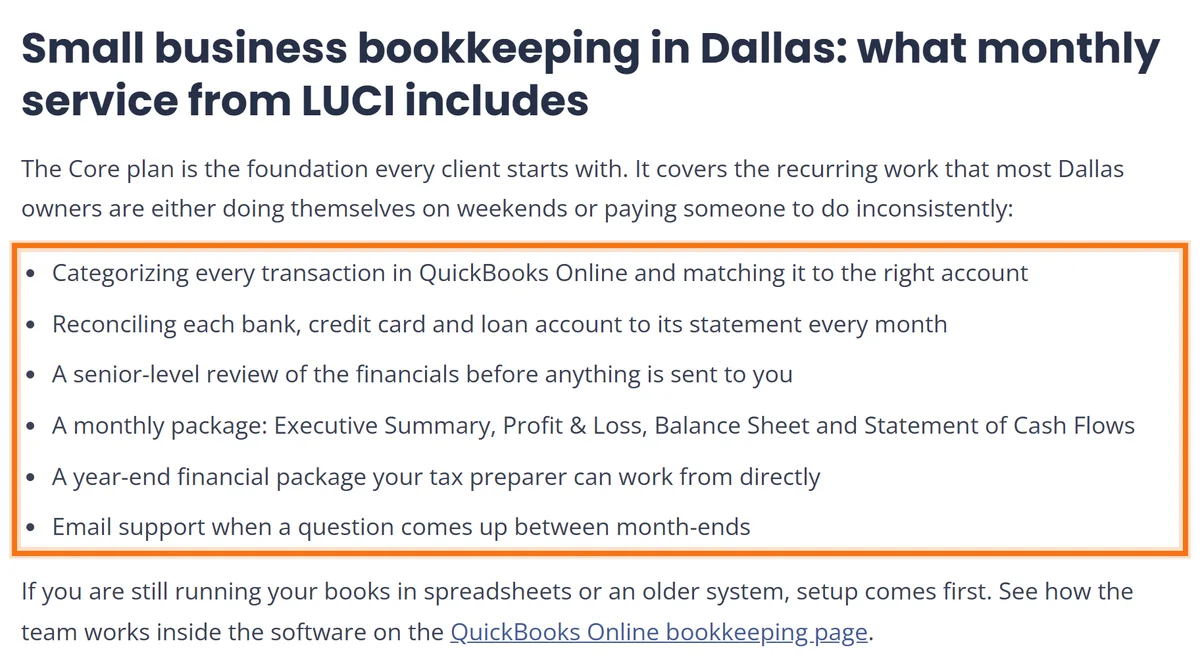
LUCI Financial Solutions is a Dallas–Fort Worth firm for established service businesses, typically with $250K or more in annual revenue. Every engagement includes monthly bookkeeping and reconciliations, a senior review of the financials, a monthly Executive Summary with the three statements, and a year-end package for your tax preparer. Newer businesses can start with Business Formation & Financial Setup, from $1,500. See bookkeeping services in Dallas or our guide to bookkeeping for small businesses.
Frequently asked questions about bookkeeping basics
What is bookkeeping in simple terms?
Bookkeeping is recording every dollar that comes into and goes out of your business, with a document behind each entry, and organizing those records so you can produce financial statements. It is the daily and monthly work; accounting and tax preparation build on it.
What are the basic bookkeeping tasks for a small business?
Recording and categorizing transactions, sending invoices and tracking who owes you, paying and tracking bills, reconciling every bank and credit card account each month, running payroll if you have employees, and producing a Profit & Loss, Balance Sheet and Statement of Cash Flows.
Should a small business use cash or accrual bookkeeping?
Cash basis records income when money arrives and expenses when they are paid, which is simpler. Accrual records income when earned and expenses when incurred, which shows profit more accurately for businesses that invoice or carry bills. Many small businesses can choose; ask your CPA which method fits your tax situation.
How long should I keep business records?
The IRS generally expects records to be kept for 3 years after you file the return they support, and employment tax records for at least 4 years. Some records, such as those for property and equipment, need to be kept longer.
Can I do my own bookkeeping?
Yes, many owners do when the business is small: one bank account, one card, a few dozen transactions a month. It becomes harder once you add payroll, several accounts, contractors or a need for reports you can act on. That is usually the point to bring in a professional.
Does LUCI Financial Solutions work with new businesses in Dallas?
LUCI works mainly with established service businesses, typically with $250K or more in annual revenue. For new businesses it offers Business Formation & Financial Setup, starting at $1,500, which covers formation, EIN registration, QuickBooks and payroll setup.
Books you can trust, every month
Reconciled accounts, a senior review and statements that explain your business. Schedule a consultation or call 214-233-5454.