

Short answer: Bookkeeping for a small business means recording every dollar in and out, reconciling each account to its statement every month, and turning that into a Profit & Loss, Balance Sheet and Statement of Cash Flows you can act on. For a Dallas small business, accurate books are what make taxes, loans and everyday decisions straightforward, and the monthly rhythm in this guide is how you keep them accurate.
Key takeaways
- Accurate means reconciled: every bank, card and loan account matched to its statement each month.
- Keep business and personal money in separate accounts from day one.
- Light bookkeeping (data entry only) is not the same as reviewed monthly financial statements.
- Keep the receipts, invoices and statements that support each entry; the IRS expects them.
- Your tax return is only as good as the books behind it.
What accurate bookkeeping for a small business actually means
Bookkeeping is the daily and monthly work of recording a business’s financial transactions: sales, payments received, bills, payroll, loan payments, owner draws. Accurate bookkeeping adds two things many owners skip. First, every account is reconciled, so the books agree with the bank to the penny. Second, someone reviews the categories, so the Profit & Loss reflects what really happened.
The output is three reports. The Profit & Loss shows whether you made money. The Balance Sheet shows what the business owns and owes. The Statement of Cash Flows shows why the bank balance moved even when profit did not. Our guide to understanding financial statements explains how the three connect.
Why bookkeeping matters for Dallas small businesses
- Decisions: pricing, hiring and spending decisions need last month’s real numbers, not a guess from the bank balance.
- Taxes: deductions need records behind them, and a year-end package keeps your tax preparer’s fee down.
- Cash: a profitable business can still run short of cash if receivables are slow; current books show it early.
- Loans and buyers: banks and buyers ask for monthly statements and want them reviewed and on time.
- Texas filings: the franchise tax report and sales tax returns are built from your revenue numbers.
None of this requires a big accounting department. It requires a routine that happens every week and every month, whoever does it.
Small business bookkeeping tasks: what to do and how often
| Task | How often | Why it matters |
|---|---|---|
| Record and categorize transactions | Weekly | Small items pile up fast; a weekly pass keeps the books current and errors easy to spot |
| Send invoices and follow up on unpaid ones | Weekly | Revenue you have earned but not collected is cash you cannot use |
| Record bills and payroll | Each pay cycle | Keeps expenses in the right month and payroll taxes tied to the books |
| Reconcile every bank, credit card and loan account | Monthly | Proves the books match reality and catches missing, duplicate or fraudulent entries |
| Review the Profit & Loss, Balance Sheet and Cash Flows | Monthly | Turns records into decisions: margins, spending trends, cash runway |
| Collect a W-9 from each new contractor | At the first payment | Needed for year-end 1099s and avoids backup withholding problems |
| File sales tax returns, if you sell taxable items | As assigned by the Texas Comptroller | Late returns bring penalties and interest |
| Prepare the year-end package for your tax preparer | Yearly | Your return is built from it; a clean package saves time and fees |
How to read this table: the weekly rows keep the books current, the monthly rows make them accurate, and the yearly rows depend on both. If you can only add one habit, add the monthly reconciliation: books that are reconciled every month rarely surprise anyone at tax time.
Light bookkeeping vs. full monthly bookkeeping
Owners searching for help often see the term light bookkeeping. It usually means data entry: transactions recorded and categorized, perhaps invoices sent. That can be enough for a side business. An established company usually needs more, because unreviewed data entry is where most bookkeeping errors hide.
| Task | Light bookkeeping | Full monthly bookkeeping |
|---|---|---|
| Record and categorize transactions | Yes | Yes |
| Reconcile every bank, card and loan account monthly | Often not | Yes |
| Second-person review before you see the numbers | No | Yes, at firms that build it in |
| Monthly Profit & Loss, Balance Sheet and Cash Flows | Rarely | Yes |
| Year-end package for your tax preparer | No | Yes |
What this means for you: if your bookkeeper only enters transactions, you are the reviewer, whether you meant to be or not. If you do not have time to check the reconciliations and reports each month, choose a service that includes them.
The records the IRS expects you to keep
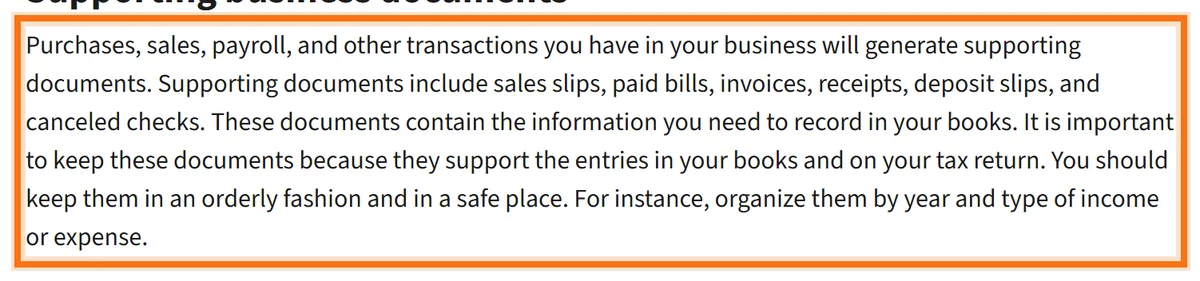
Every entry in your books should be backed by a document: a sales slip, an invoice, a receipt, a deposit slip, a canceled check or a bank statement. The IRS calls these supporting documents, and they are what you show if a deduction is ever questioned.
How long to keep them depends on the record. The IRS’s general rule is three years from the date you filed the return, at least four years for employment tax records, and longer in specific situations. Our QuickBooks cleanup checklist covers the IRS record-retention guidance.
Common bookkeeping mistakes small businesses make
- Mixing personal and business money. One personal charge on the business card is easy to fix; a year of them is not. Use separate accounts and record owner draws and contributions as such.
- Skipping reconciliations. Bank feeds import transactions, but they also duplicate and miss them. Only a reconciliation catches that.
- Leaving items in “uncategorized” or “ask my accountant.” Those balances end up as guesses on your tax return.
- Recording loan payments as expenses. Only the interest is an expense; the principal reduces the loan balance.
- Not keeping receipts. A bank line that says “Amazon” does not prove a business purpose.
- Catching up once a year. Books rebuilt in March cannot help you decide anything in June.
Software and tools for small business bookkeeping
Most small businesses keep their books in cloud software such as QuickBooks Online or Xero, with bank and credit card feeds connected so transactions arrive automatically. Software speeds up the recording, but it does not decide whether a transaction is categorized correctly or whether an account reconciles. Pair it with a monthly routine and, ideally, a second set of eyes. For a comparison of platforms, see our guide to cloud accounting software for small businesses.
Doing it yourself or hiring a bookkeeper
Doing your own books makes sense while transactions are few and simple. The signs that it is time for help are practical: the books are more than a month behind, you cannot say whether last month was profitable, your tax preparer sends a long list of questions every spring, or the hours you spend on bookkeeping are worth more spent on clients.
When you compare providers, ask four questions: who actually does the work, who reviews it, when do reports arrive each month, and is the fee fixed. Our guide on how to choose a Dallas bookkeeper goes through the full list.
How LUCI Financial Solutions keeps small business books accurate
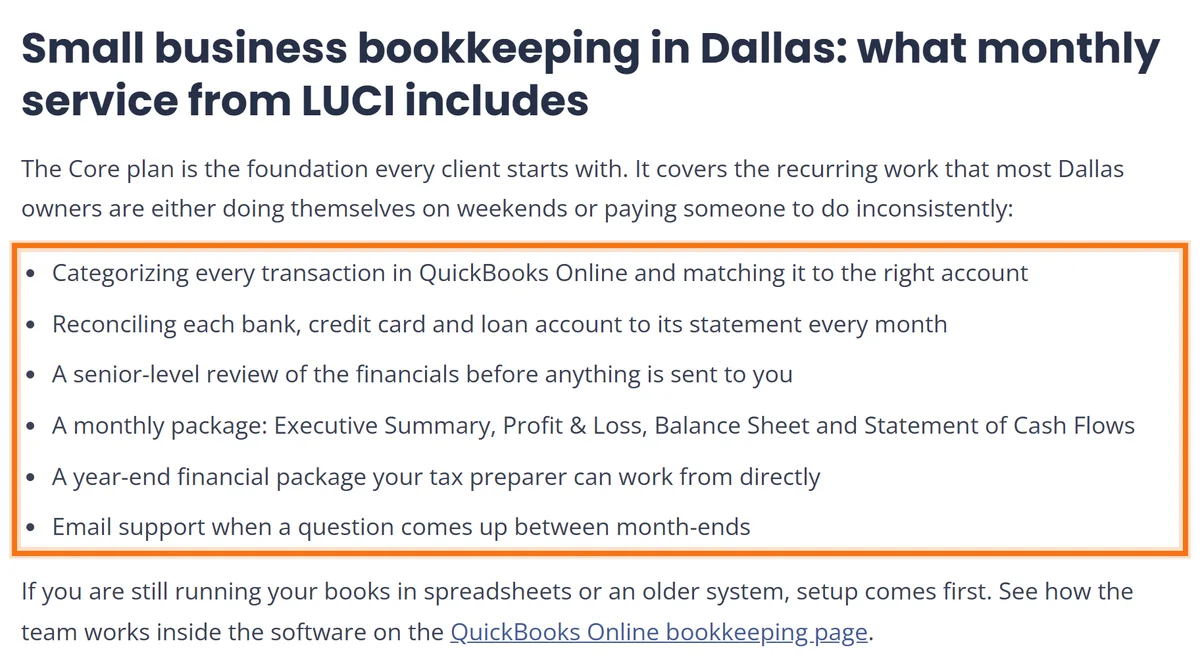
LUCI is a woman-owned bookkeeping and financial operations firm based in Dallas–Fort Worth, working with established service businesses, typically those earning $250K or more a year. Every client starts with the Core plan, and the work is the same every month: transactions categorized in QuickBooks Online, every account reconciled, a senior-level review, and a monthly package delivered on schedule.
Onboarding usually takes two to four weeks; if the books are months behind, a separate cleanup comes first. After an initial three months, service continues month to month. See bookkeeping services in Dallas for the plans, or bookkeeping cleanup and catch-up if you need to start there.
Frequently asked questions about small business bookkeeping
What does bookkeeping for a small business include?
Recording and categorizing every transaction, sending and tracking invoices, recording bills and payroll, reconciling every bank, credit card and loan account to its statement each month, and producing a Profit & Loss, Balance Sheet and Statement of Cash Flows. At year-end it also means a package your tax preparer can work from.
What is light bookkeeping?
Light bookkeeping usually means basic data entry: recording and categorizing transactions, and sometimes sending invoices or paying bills. It typically leaves out monthly reconciliations, a review of the numbers and financial statements, so it suits very small or very simple businesses better than an established company.
How does bookkeeping affect tax preparation for a small business?
Your tax return is built from your books. Reconciled, categorized books let your tax preparer work from a year-end package instead of rebuilding the year, which saves time and fees and gives you records that support every deduction if the IRS asks.
How long should a small business keep its records?
The IRS says to keep records that support your return generally for three years from filing, employment tax records for at least four years, and longer in some situations, such as unreported income or bad debt deductions. Records on property you own are kept until the period for the year you sell it has passed.
What should I look for in a bookkeeping service for my small business?
A second person who reviews the work, monthly reports on a set schedule, a fixed fee rather than hourly billing, experience with your type of business and a clean year-end handoff to your tax preparer. Ask who will actually do your books and how quickly questions are answered.
When should a small business hire a bookkeeper?
When the books fall more than a month behind, when you cannot tell from your reports whether you made money last month, or when the time you spend on bookkeeping costs more than paying someone to do it. Lenders, investors and buyers will also expect reviewed monthly statements.
Books you can trust every month
Monthly bookkeeping, reconciliations and reviewed financial statements for Dallas–Fort Worth small businesses. See our bookkeeping services in Dallas.