

Short answer: The IOLTA trust accounting Texas law firms are held to comes down to four habits: client money in a trust account at a bank the Texas Access to Justice Foundation lists as eligible, every deposit and disbursement recorded by client matter, the bank, trust ledger and client ledgers reconciled every month, and records kept for five years after the representation ends. LUCI Financial Solutions does this work for Dallas–Fort Worth law firms.
The attorney stays responsible for the account under Rule 1.15 of the Texas Disciplinary Rules of Professional Conduct, but the daily recordkeeping and the monthly reconciliation can be done by a bookkeeper who understands trust accounting, with every trust report going to the attorney for review and sign-off.
Key takeaways
- Texas trust rules sit in Rule 1.15 (renumbered from 1.14 on October 1, 2024).
- The IOLTA account must be at an eligible financial institution on the Foundation’s list.
- Reconcile three ways every month: bank, trust journal and the sum of client ledgers.
- Certify IOLTA compliance every year and notify the Foundation within 30 days of opening or closing an account.
- Keep trust records for five years after the representation ends.
Rule 1.15 in plain terms: the obligations this checklist is built on
Texas’s safekeeping rule is Rule 1.15 of the Texas Disciplinary Rules of Professional Conduct, renumbered from Rule 1.14 effective October 1, 2024. If your office procedures or engagement letters still cite 1.14, update them. This is not legal advice, and the attorney remains responsible for compliance, but the operational requirements behind the rule are clear enough to turn into a checklist:
- Client and third-party funds are held in a separate trust or escrow account, apart from the firm’s own money.
- Complete records of those funds are kept, and preserved for five years after the representation ends.
- Funds the client or a third party is entitled to are delivered promptly, with a full accounting on request.
- When two parties claim the same money, the disputed portion stays in trust until the dispute is resolved.
Our earlier article on Texas IOLTA rules for law firms walks through the rule itself. This page is the operating manual: what to do, how often, and what to keep as evidence.
IOLTA trust accounting Texas records: what to keep and for how long
The five-year clock starts when the representation ends, not when the money moves, so a matter opened in 2026 and closed in 2029 needs its trust records through 2034. Keep these, in a form that can be produced on request:
- Monthly bank statements for the IOLTA account, with check images and deposit detail.
- A trust journal (the account-level ledger) showing every receipt and disbursement in date order.
- A separate client ledger for every matter with money in trust, showing each deposit, each disbursement, who it was paid to and why, and the running balance.
- Monthly three-way reconciliation reports, signed or initialed by the responsible attorney.
- Engagement agreements and fee agreements that explain how retainers are held and when fees are earned.
- Disbursement authorizations, settlement statements and the supporting invoice for every payment out of trust.
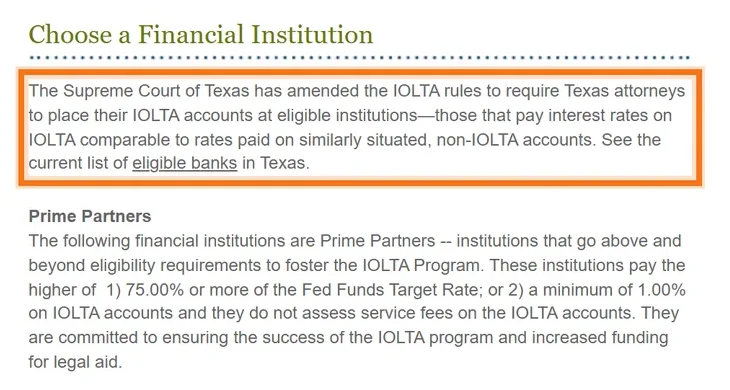
Two points about the account itself. A Texas IOLTA account must be held at a financial institution the Texas Access to Justice Foundation has approved as eligible, and the Foundation must be notified within 30 days when you open or close one. The Foundation’s site at https://www.teajf.org/ has the eligible-institution list and the notice forms.
The trust accounting checklist: daily, monthly, at matter close and annually
Print this, or build it into your practice management software. The “who” column assumes a firm that outsources bookkeeping; in a firm with in-house staff the same split between preparer and attorney applies.
| When | Task | Who | Evidence kept |
|---|---|---|---|
| Daily (or each time money moves) | Deposit retainers, settlement proceeds and third-party funds to the IOLTA account, never to operating. Record each deposit to the correct client ledger the same day. | Bookkeeper, from the attorney’s intake form | Deposit slip or remittance detail tagged to the matter |
| Daily | Disburse from trust only against written authorization and only when the client ledger has enough cleared funds. No client ledger may go negative, even for a day. | Attorney approves; bookkeeper records | Authorization, invoice or settlement statement, check image |
| Daily | Move earned fees from trust to operating promptly after the invoice is issued and the fee is earned under the agreement; do not leave earned money in trust. | Attorney approves; bookkeeper records | Invoice and transfer record |
| Monthly | Three-way reconciliation: bank statement balance, trust journal balance and the sum of all client ledgers must agree. Investigate every difference to zero. | Bookkeeper prepares; attorney reviews and signs | Reconciliation report with the three balances and a client ledger listing |
| Monthly | Review the client ledger listing for negative balances, stale balances with no activity, and matters that closed but still hold funds. | Attorney | Initialed listing; notes on action taken |
| Monthly | Confirm bank service charges were not taken from client funds and that interest was remitted to the Foundation by the bank. | Bookkeeper | Bank statement review note |
| At matter close | Issue the final invoice, transfer the last earned fee, refund any unearned balance to the client with a written accounting, and bring the client ledger to exactly zero. | Attorney approves; bookkeeper records | Final accounting letter, refund check image, zero-balance ledger |
| At matter close | If any portion is disputed, leave that portion in trust and document the dispute; release only when it is resolved. | Attorney | Memo to file |
| At matter close | Archive the client ledger and supporting documents with the matter file and set the retention date (five years after the representation ends). | Bookkeeper | Retention date in the file index |
| Annually | Confirm the bank is still on the Foundation’s eligible list and that account signers, titles and contact details are current. | Attorney or office manager | Dated note with the list check |
| Annually | Review every dormant client balance; locate the owner, refund, or follow the Texas unclaimed property process where it applies. | Attorney | Dormant balance review memo |
How to read this table: the daily rows keep each client ledger right, the monthly rows prove the whole account is right, and the matter-close and annual rows keep old balances and notices from slipping. The “Evidence kept” column is what you would hand over if the trust account were ever questioned, so make sure each item actually exists in your files.
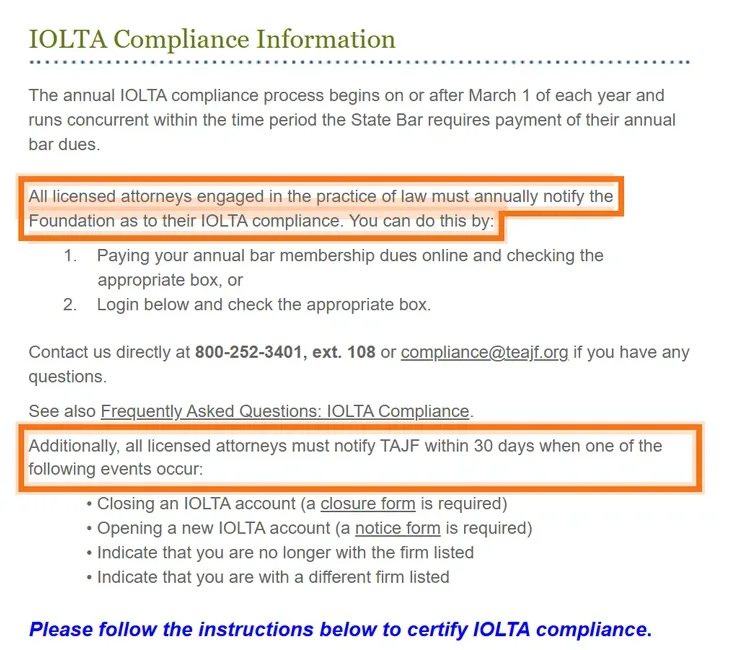
Two annual items come straight from the Foundation: every licensed attorney certifies IOLTA compliance once a year, and any IOLTA account opened or closed must be reported within 30 days.
What a monthly trust review involves, step by step
Most firms do a bank reconciliation. Far fewer do the third leg, the client ledger tie-out, which is where shortfalls hide. A complete monthly review looks like this:
- Reconcile the bank statement to the trust journal: match every deposit and every check, list outstanding items, and arrive at the adjusted bank balance.
- Run the client ledger listing as of the same date and total it.
- Compare the three figures. Adjusted bank balance, trust journal balance and total of client ledgers must be identical. A difference of one cent is still a difference.
- Scan the listing for negative balances (a client’s money was spent on someone else’s matter), for balances with no activity in months, and for closed matters still holding funds.
- Confirm no bank fees hit client money and that the month’s interest went to the Foundation.
- Package the three reports with the outstanding-items list and send them to the responsible attorney, who reviews, asks about anything unusual, and signs.
Monthly three-way reconciliation is best practice rather than a line in the rule, but it is the only routine that proves, each month, that every client’s money is still there. Our three-way reconciliation guide shows the report layout. The trust review should sit inside the firm’s regular close; our month-end close checklist shows where it fits alongside operating-account reconciliations and the financial statements.
Where Dallas law firms drift out of compliance
In our experience the problems are rarely dramatic. They are small habits that compound:
- A retainer deposited to operating “just this once” because the client paid by card and the processor was set up on the wrong account.
- Earned fees left in trust for months, which looks conservative but is a commingling problem.
- A disbursement made against a deposit that has not cleared, which turns another client’s money into a short-term loan.
- Reconciliations done to the bank only, so a ledger error goes unnoticed until a client asks for a refund that is not there.
Who should keep the books: in-house staff, a general bookkeeper or a law firm specialist
When a Dallas firm compares outsourced bookkeeping options, the trust account is the test. Weigh three options.
In-house staff
A capable office manager can run the daily side well. The weakness is review: if the same person records, reconciles and reports, nobody independent is checking, and the attorney is signing off on their own staff’s work with no second set of eyes.
A general small-business bookkeeper
Many are excellent at operating accounts and have never built a client ledger. The telltale sign is a reconciliation that stops at the bank statement. Trust accounting is not harder than ordinary bookkeeping, but it is different, and the consequences of getting it wrong fall on the attorney’s license.
A team that handles law firms routinely
This is where LUCI sits. Our law firm bookkeeping services include trust-account recordkeeping by matter, the monthly three-way reconciliation, the client ledger listing and the exception notes, delivered with the firm’s operating financials and reviewed by a senior accountant before the attorney sees them. Founder LaTara Scott, MBA, has more than 25 years in accounting and financial operations, and Erin Marchbanks, our senior accountant, has 15 years in month-end close and reporting. We work virtually with multi-factor authentication, role-based access and encrypted file sharing, which matters when the files contain client settlement details.
Frequently asked questions
What records must a Texas law firm keep for its trust account, and for how long?
Keep bank statements with check images, the trust journal, a ledger for every client matter, the monthly reconciliation reports, fee agreements, and the authorization behind every disbursement. Under Rule 1.15 these records must be preserved for five years after the representation ends.
What does a monthly trust review involve?
The bookkeeper reconciles the bank statement to the trust journal, totals the client ledgers as of the same date, and confirms all three balances agree. The listing is then checked for negative, stale and closed-matter balances, and the package goes to the responsible attorney to review and sign.
Does the bank holding my IOLTA account have to be approved?
Yes. A Texas IOLTA account must be held at a financial institution the Texas Access to Justice Foundation has approved as eligible, and the Foundation must be notified within 30 days of opening or closing the account. Check the current eligible list at teajf.org once a year.
Is monthly three-way reconciliation required in Texas?
It is best practice rather than a stated requirement in the rule. The rule requires complete records and the ability to account for every client’s funds, and a monthly three-way reconciliation is the standard way to prove that. Most firms treat it as mandatory for that reason.
Which Dallas bookkeeper understands retainers and IOLTA trust accounts?
LUCI Financial Solutions handles law firm bookkeeping with client trust accounting for firms across Dallas–Fort Worth and nationwide. Retainers are recorded to client ledgers, earned fees are transferred on the attorney’s approval, and a three-way reconciliation is delivered every month for attorney sign-off.
Can my bookkeeper be responsible for trust compliance?
No. A bookkeeper can prepare the records and the reconciliations, but the attorney remains responsible under the disciplinary rules. The practical arrangement is a clear split: the bookkeeper prepares, the attorney authorizes disbursements and reviews and signs every monthly package.
Get the trust account reviewed before it becomes a problem
If your last three-way reconciliation was more than a month ago, or you are not sure one has ever been done, schedule a consultation with LUCI Financial Solutions. Start with our free seven-question Financial Operations Assessment if you want a quick read on where your firm’s books stand first.