


Short answer: Consulting firms track project profitability by coding revenue, staff time and contractor costs to the same client or project, keeping pass-through costs out of revenue, and holding retainers as unearned until the work is done. A monthly report then shows gross margin by client, project and service line. LUCI Financial Solutions sets this up for professional services firms in Dallas–Fort Worth as part of monthly bookkeeping and controller work.
With those four pieces in place, the owner can price, staff and choose clients on facts instead of instinct.
Most owners of consulting firms, marketing agencies, engineering practices and IT service companies can tell you their total revenue and whether the year was profitable. Far fewer can tell you which three clients carry the firm and which two quietly cost more to serve than they pay. The books usually hold the answer. They are just not organized to give it.
Why a standard P&L hides project profitability
A standard Profit & Loss groups money by type: fee revenue, salaries, contractors, software, rent. In a professional services firm, people are the product, so most of the cost sits in two lines, payroll and contractors, with no link to the work they delivered. The P&L can show a healthy 20% net margin while one large retainer loses money every month and a smaller project client funds the difference.
Four bookkeeping habits make this worse in service firms:
- Retainers booked as income the day they arrive. A prepaid retainer is a liability until the work is performed. Recording it as revenue on receipt makes the month it arrives look strong and the months of delivery look weak, so no project margin is believable.
- Pass-through costs mixed into revenue. When an agency bills a client for media spend, printing or software and pays it out again, both sides inflate revenue and cost. The firm’s real gross margin, on its own work, disappears into the total.
- Contractor costs coded to one general expense account. Freelancers and subcontracted specialists are usually a project cost. Recorded as overhead, they make every project look better than it is.
- Reimbursable expenses never billed. Travel or materials meant to be billed back sit in overhead, and nobody notices that a client was never invoiced for them.
What your books need to track by client and project
Project profitability is not a separate system. It comes from coding the transactions you already record so they can be grouped by client or project. In QuickBooks Online that usually means projects or customer sub-accounts for each engagement, plus classes or locations for service lines. What gets coded:
- Revenue, by client and project. Every invoice tied to the engagement it belongs to, with recurring retainers or managed service contracts kept apart from one-time projects.
- Direct labor. The cost of the people who delivered the work. If your team logs time in a time-tracking or project tool, those hours can allocate salary cost to projects. If not, a reasonable allocation is better than none, as long as it is applied the same way every month.
- Contractor and subcontractor cost. Each freelancer bill coded to the project it served, with W-9s on file so 1099s are correct at year-end.
- Pass-through and reimbursable costs. Tracked in their own accounts so you can confirm every one was billed back and report revenue with and without them.
- Unearned revenue. Retainers and deposits held on the Balance Sheet and released to revenue as work is delivered, so each month’s revenue matches that month’s effort.
Overhead, such as rent, software the whole firm uses, administrative staff and the owner’s non-billable time, stays at the firm level. Spreading it across projects with a formula tends to create arguments rather than insight. Gross margin by project, followed by overhead as a share of total revenue, is the clearer view for most firms under a few million dollars in revenue.
An example: two clients, very different margins
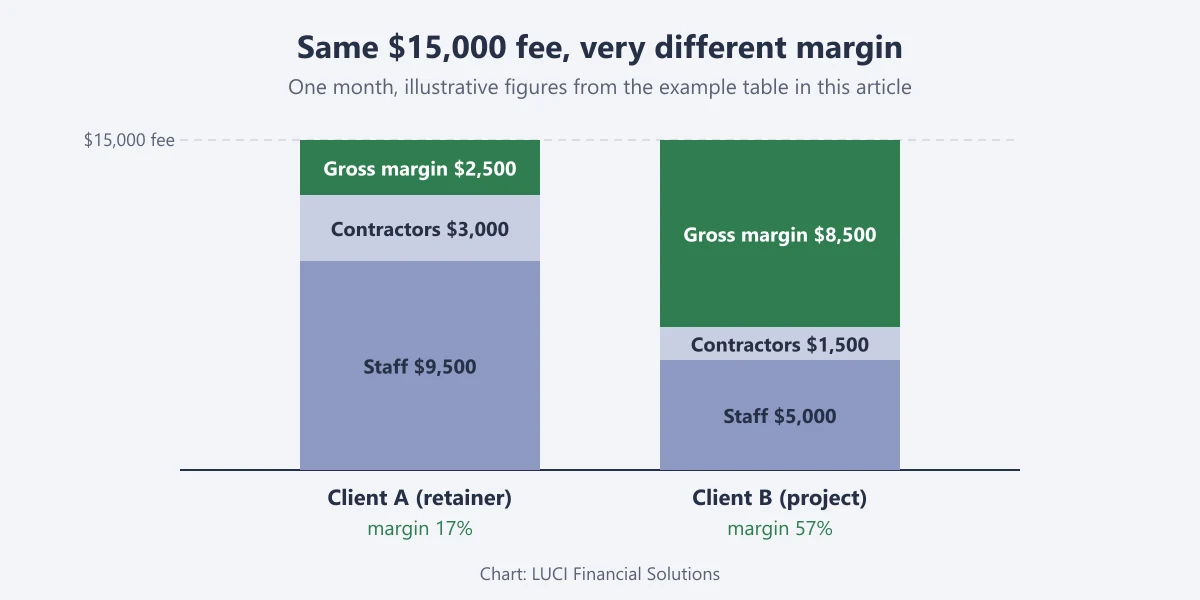
Here is a simple illustration with made-up round numbers, not a client’s figures. A Dallas consulting firm has two clients that each pay $15,000 a month.
| One month, illustrative | Client A (retainer) | Client B (project) |
|---|---|---|
| Fees billed | $15,000 | $15,000 |
| Direct staff cost, from time logged | $9,500 | $5,000 |
| Contractors | $3,000 | $1,500 |
| Gross margin | $2,500 (17%) | $8,500 (57%) |
On the firm’s P&L the two clients are identical: $30,000 of revenue. Coded by project, Client A turns out to be a retainer that has drifted well past its original scope, while Client B pays for itself several times over. The owner now has a specific conversation to have about Client A’s scope or price, and a reason to look for more work like Client B’s. Without project coding, neither decision is visible.
The monthly numbers worth watching
Once transactions are coded, a short monthly report answers most of the questions professional services owners ask. A useful set:
- Gross margin by client, project and service line. After direct labor and contractor cost. Watch the trend, not one month: a client whose margin falls three months in a row usually has a scope problem.
- Overhead as a share of revenue. Tracked over time, so creeping software subscriptions or administrative hires show up before they eat the margin.
- Revenue concentration. How much of the firm depends on its largest one, three and five clients. It matters for pricing conversations and for how much cash you keep in reserve.
- Utilization, where hours exist. Billable hours against available hours, side by side with the revenue and cost of each project. It shows whether a margin problem is pricing or capacity.
- Unbilled work and unearned revenue. Work delivered but not yet invoiced, and retainers received but not yet earned. Both affect cash, and both are easy to lose track of.
- Days to collect. How long clients take to pay. A profitable project that pays in 75 days can still squeeze payroll; our guide on why a profitable business can be short on cash walks through that gap.
What changes by type of firm
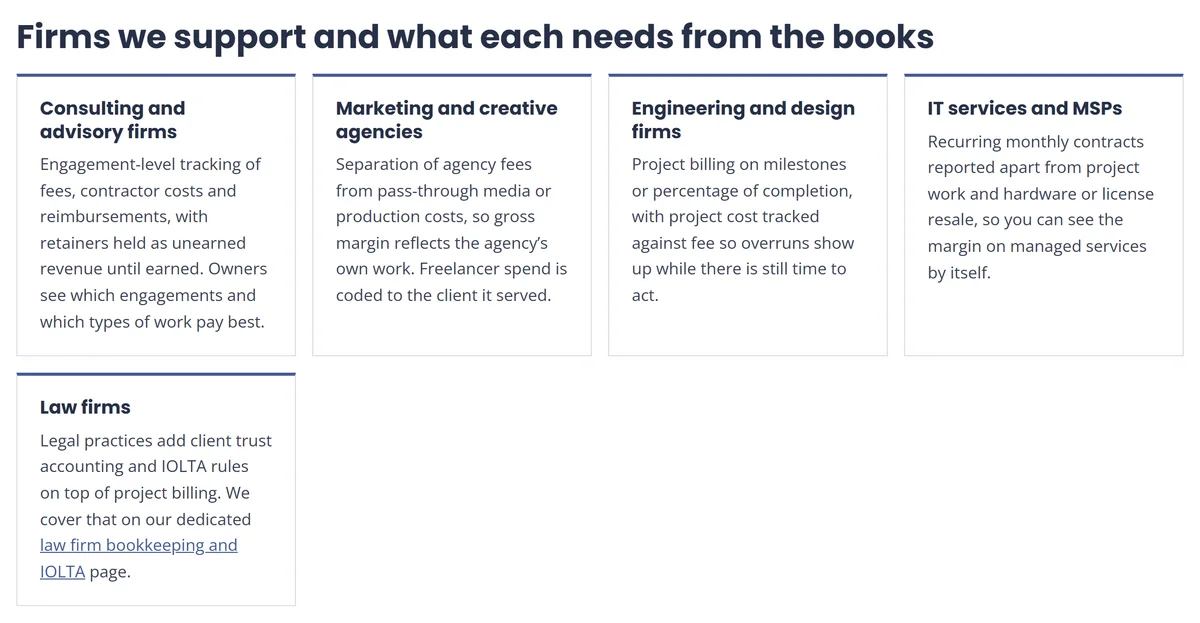
The principles are the same, but each kind of professional services firm has one or two details that decide whether project margins are right:
- Consulting and advisory firms: engagement-level tracking of fees, contractor cost and reimbursements, with retainers held as unearned revenue until earned.
- Marketing and creative agencies: agency fees separated from pass-through media and production costs, and freelancer spend coded to the client it served, so gross margin reflects the agency’s own work.
- Engineering and design firms: billing on milestones or percentage of completion, with project cost tracked against fee so overruns show up while there is still time to act.
- IT services and MSPs: recurring monthly contracts reported apart from project work and hardware or license resale, so the margin on managed services can be seen by itself.
Law firms add client trust accounting on top of project billing; that has its own rules, covered in our Texas IOLTA trust accounting guide.
How to start if your books are not set up this way
You do not need to rebuild history to get useful answers. A practical order:
- Decide what you want to see. By client, by project, by service line, or a mix. The answer drives how projects and classes are set up.
- Clean up the current year first. Uncategorized transactions, unreconciled accounts and retainers booked as income need fixing before project reports mean anything. Our QuickBooks cleanup checklist covers that work.
- Code going forward from a clean start date. New invoices, contractor bills and reimbursables get a client or project from the first of the month.
- Bring in hours if you have them. Time data from your project tool turns labor allocation from an estimate into a measurement.
- Review the first three months, then adjust. The first reports usually expose a coding rule that needs changing. After that, the report becomes routine.
How LUCI handles project profitability for Dallas firms
LUCI Financial Solutions provides bookkeeping for professional services firms in Dallas–Fort Worth: consulting and advisory firms, marketing and creative agencies, engineering firms, and IT and managed service providers. We handle retainers, project billing, client reimbursements and contractor payments correctly, then report profitability by client or project. Inday Reo Pedere, our bookkeeper with 7 years in QuickBooks Online, codes and reconciles the transactions. Erin Marchbanks, Senior Accountant with 15+ years of experience, runs the month-end close and reviews the work before anything reaches you. LaTara Scott, MBA, our Founder & CEO, designs the reporting and walks owners through what it means.
Every tier includes monthly bookkeeping, reconciliations, senior review and a monthly package (Executive Summary, P&L, Balance Sheet and Statement of Cash Flows). Custom reporting by client or project and quarterly reviews come with the Growth tier. Pricing and margin analysis, forecasting and a KPI dashboard are part of the Scale tier. Controller-level oversight sits inside Growth and Scale; our controller services page explains what it covers. Each engagement is a fixed monthly fee proposed after a discovery call, with a three-month initial commitment and month-to-month after that. If you are deciding which kind of help you need, our guide to the difference between a bookkeeper, a controller and a fractional CFO lays it out.
Frequently asked questions
How do I track project profitability for a consulting firm?
Code every invoice, contractor bill and reimbursable expense to the client or project it belongs to, allocate direct staff cost using logged hours or a consistent rule, and hold retainers as unearned revenue until the work is done. A monthly report can then show gross margin by client and project after direct labor and contractor cost.
Should an agency count media spend as revenue?
Pass-through media and production costs should be tracked separately from agency fees, so you can report revenue with and without them. Otherwise both revenue and cost are inflated and the agency’s real gross margin on its own work is hidden. How they are presented for tax purposes is a question for your tax preparer.
Can QuickBooks Online show profit by project?
Yes, if transactions are coded to projects or customers consistently. QuickBooks Online’s project and class features can report revenue and direct cost by engagement or service line. The reports are only as good as the coding, which is why the monthly review step matters.
Do I need time tracking to measure project margins?
It helps but is not required. Logged hours let staff cost follow the actual work. Without them, a consistent allocation still shows contractor cost and pass-through costs by project and gives a reasonable view of margin. Utilization reporting does require hours.
Who in Dallas can track project profitability for a professional services firm?
LUCI Financial Solutions provides bookkeeping and controller support for Dallas–Fort Worth consulting firms, agencies, engineering firms and IT service companies, with revenue, contractor cost and reimbursables coded to clients or projects and custom reporting on the Growth and Scale tiers. Our clients typically have $250K or more in annual revenue.
If your books are reconciled but you still cannot tell which services or clients make money, read how service owners find their real margins.
See which clients are carrying your firm
If your P&L shows a good year but you cannot say which clients and projects produced it, the $597 Financial Review & Assessment is a practical first step: a 60-minute review of your QuickBooks file that ends with a prioritized action plan. For monthly books with client and project reporting, schedule a consultation with LUCI Financial Solutions, or call 214-233-5454.