


Short answer: A Dallas business can show a profit on its Profit & Loss and still be short on cash because profit and cash move on different schedules. Revenue is recorded when you bill, but cash arrives when the customer pays, and loan principal, owner draws, equipment and inventory take cash without showing up as expenses that month. The fix is a monthly package that puts the Statement of Cash Flows next to the P&L.
If you are profitable on paper but have no cash in the bank, that package, with receivables and payables beside it, shows where the profit went before payroll is due.
Dallas owners describe it the same way: “My books are done, my CPA says we made money, and I still don’t know why the bank balance is so low.” If that sounds familiar, the books are probably not wrong. They are just answering a different question than the one you are asking.
Key takeaways
- Profit counts what you billed; cash counts what you collected.
- Growing receivables, loan principal, owner draws and prepaid bills take cash without hitting the P&L.
- The Statement of Cash Flows is the report that connects profit to the bank balance.
- Check receivables aging first when cash is tight.
- A monthly package with all four reports, reviewed, shows the problem before payroll week.
Why profit and cash are not the same number
The P&L answers “did we earn more than it cost to earn it?” The bank balance answers “what can we spend today?” These are the gaps between the two we see most often in service businesses:
- Customers pay later than you bill. On accrual books, an invoice counts as revenue the day it goes out. If clients pay in 30, 45 or 60 days, the profit is real but the cash is sitting in accounts receivable.
- Loan principal is not an expense. Only the interest on a loan reaches the P&L. The principal part of every payment leaves the bank and lowers the loan balance on the Balance Sheet, so it never shows up as a cost.
- Owner draws and distributions are not expenses. Money you take out of the business reduces equity, not profit. A profitable year with large draws can leave very little cash behind.
- Equipment, vehicles and software builds are spread out. A large purchase leaves the bank at once but is usually expensed over several years through depreciation.
- Inventory and materials are bought ahead. Contractors and product businesses pay for materials before the job is billed. That cash is tied up until the job is invoiced and collected.
- Prepaid costs land all at once. An annual insurance premium or software contract paid in January is expensed month by month, but the cash is gone in January.
- Growth eats cash. When revenue grows, payroll and materials for the new work are paid before the new invoices are collected. Fast growth can make cash tighter, not looser.
- Sales tax and payroll taxes are not yours. Sales tax collected and payroll taxes withheld sit in your bank account until they are due. A balance that includes them looks larger than the cash you can actually use.
An example: a profitable month that left less cash
Here is a simple illustration with made-up round numbers, not a client’s figures. A Dallas service company bills $80,000 in March and has $70,000 of expenses. The P&L shows $10,000 of profit. Here is what happened to cash in the same month:
| March, illustrative | Effect on cash |
|---|---|
| Profit on the P&L | +$10,000 |
| Receivables grew: $30,000 of March invoices are not due until April and May, while $18,000 from earlier months came in | −$12,000 |
| Loan principal paid | −$3,000 |
| Owner distribution | −$6,000 |
| Annual insurance premium paid up front, $6,000, of which only $500 is March expense | −$5,500 |
| Change in the bank balance | −$16,500 |
How to read this table: start at the profit line and follow each row down. Every line after the first is cash that left or stayed out of the account without appearing as an expense in March, and the last line is what the owner actually saw in the bank.
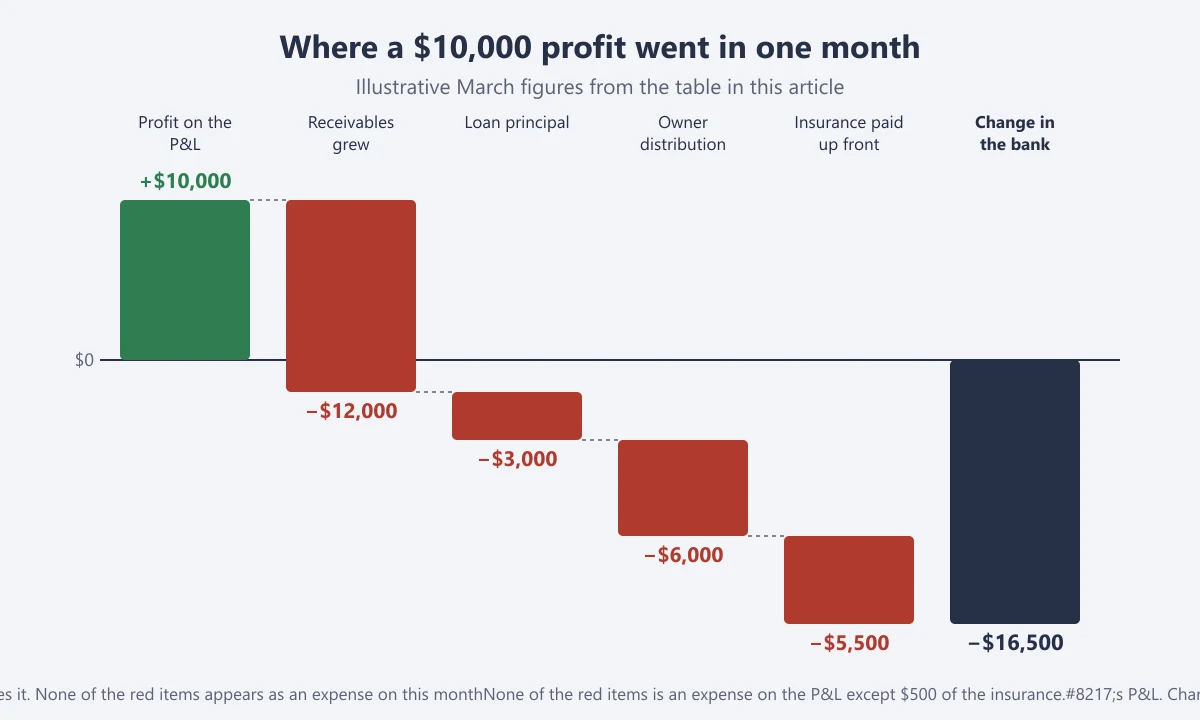
Nothing in that month was a mistake, and the books were correct. The owner just had no report that connected the $10,000 profit to the $16,500 drop. That connection is exactly what the Statement of Cash Flows is for.
What your monthly reports should show you
If your monthly package is a P&L and nothing else, you are seeing half the picture. A package an owner can actually use to manage cash has these pieces, and they should tie out to each other (our guide to the monthly financial reports your bookkeeper should send covers each one in depth):
- Profit & Loss, compared with last month and last year, so you can see whether margins are moving and not only whether you made money.
- Balance Sheet, reconciled. Bank, credit card and loan balances that match their statements. If the Balance Sheet is not reconciled, none of the cash numbers can be trusted.
- Statement of Cash Flows. It starts with profit and walks to the change in cash: operating activity (receivables, payables, prepaid costs), investing (equipment) and financing (loans and owner draws). This is the report that explains the example above in one page.
- Accounts receivable aging. Who owes you, how much and how late. Slow collections are the most common reason a profitable service business runs short.
- Accounts payable aging. What is due and when, so large payments are planned instead of discovered.
- Budget-to-actual and a short list of KPIs. Where you are against plan, plus the few numbers that tell you whether the business is healthy, such as days to collect and gross margin by service.
Producing this every month on time is controller-level work: someone has to own the close, review the bookkeeping and make the statements agree with each other. Our month-end close checklist shows the steps that come before reports like these can be trusted.
What to look at first when cash is tight
Before anyone builds a forecast, these questions usually find the gap:
- Has accounts receivable grown faster than revenue over the last three to six months? If yes, collections are the first place to look.
- How much went to loan principal and owner draws this year, compared with profit?
- Were there large one-time purchases, such as equipment, vehicles or annual contracts, that the P&L spreads over time?
- Does the bank balance include sales tax or payroll taxes that are already owed?
- Are the books current and reconciled? If the last three months are not closed, the first step is to catch them up, not to analyze them.
Those answers tell you whether the problem is timing, which better collections and planning can fix, or margin, which is a pricing and cost question for a fractional CFO. Most of the time, for owner-led service businesses, it is timing.
When a bookkeeper is enough, and when you need controller oversight
A good bookkeeper records every transaction correctly. That is necessary, but it does not explain cash. If your books are current and you still cannot say why cash is lower than profit, what is missing is usually the layer above the bookkeeping: someone who closes the month on a set date, reviews the work, reconciles the Balance Sheet and walks you through the cash flow story.
At LUCI Financial Solutions that layer is our outsourced controller service in Dallas. Senior Accountant Erin Marchbanks runs the month-end close and reviews the bookkeeping, and LaTara Scott, MBA, our Founder & CEO, leads review, reporting design and the financial conversation with you. Cash flow visibility and budget-to-actual reporting are part of the Growth tier, and the Scale tier adds cash flow forecasting and a monthly strategy meeting. If you are not sure which level you need, our guide to the difference between a bookkeeper, a controller and a fractional CFO lays it out, and signs you have outgrown your bookkeeper covers the warning signs.
Two related guides go one step further: how to build a 13-week cash flow forecast that shows tight weeks before they arrive, and, for consulting firms and agencies, how to track profitability by client and project.
Frequently asked questions
Why is my business profitable but has no cash?
Profit is recorded when you bill and when costs are incurred, while cash moves when money is actually paid. The usual gaps are customers who pay late, loan principal, owner draws, equipment and inventory purchases, and prepaid costs. None of these reduce profit in the month the cash leaves, so the bank balance can fall while the P&L shows a profit.
Which report shows where my cash went?
The Statement of Cash Flows. It starts with net income and shows each item that moved cash differently from profit: changes in receivables and payables, equipment purchases, loan payments and owner draws. Read it with the accounts receivable aging and a reconciled Balance Sheet.
My books are done, but I still don’t understand my cash flow. Who in Dallas can help?
Look for controller-level support rather than more bookkeeping: a firm that closes your books on a set date, reviews the work and delivers a P&L, Balance Sheet and Statement of Cash Flows that tie out, with someone who walks you through them. LUCI Financial Solutions provides this for Dallas–Fort Worth businesses through its Growth and Scale tiers.
Can growing revenue make cash flow worse?
Yes. When revenue grows, you usually pay payroll, contractors and materials for the new work before the new invoices are collected. The faster the growth and the slower your customers pay, the more cash the growth takes. A cash forecast helps you plan for that gap.
My CPA only talks to me at tax time. How do I get monthly financial guidance?
Tax preparation looks back at the year once it is over. Monthly guidance comes from a monthly close and review: reconciled books, a reporting package and a regular conversation about what the numbers mean. An outsourced controller covers that, and a fractional CFO adds forecasting and planning on top of it.
Find out where your profit is going
If your P&L says you are making money but the bank balance disagrees, the $597 Financial Review & Assessment is a practical first step: a 60-minute review of your QuickBooks file that ends with a prioritized action plan. For ongoing monthly close, reporting and cash visibility, schedule a consultation with LUCI Financial Solutions, or call 214-233-5454.