


Short answer: You should include bookkeepers in business strategy because every strategic decision, from pricing and hiring to a second location, starts from numbers they produce. A bookkeeper who reconciles and reviews the books each month gives a Dallas business owner reliable margins, cash and trends to plan from; without that, strategy rests on guesses. The deeper analysis then comes from a controller or fractional CFO working from the same books.
Key takeaways
- Strategy is only as good as the numbers under it, and the bookkeeper produces those numbers.
- Reconciled, reviewed monthly books come first; analysis built on unreviewed books misleads.
- Three reports carry most decisions: Profit & Loss, Balance Sheet and Statement of Cash Flows.
- Bookkeepers record and flag; controllers and fractional CFOs analyze and plan.
- A short monthly review of what changed is the simplest way to bring the books into planning.
What a bookkeeper contributes to business strategy
Bookkeeping records every financial transaction: sales, payments received, bills, payroll, loan payments and owner draws. On its own that is history. It becomes strategy when the records are accurate enough to rely on and someone looks at them in time to act. A good bookkeeper contributes to both:
- Recording and categorizing transactions so revenue and costs land in accounts that mean something, by service line or location if you need that view.
- Managing receivables and payables so you know who owes you, what you owe, and when.
- Reconciling every bank, credit card and loan account each month, so the books agree with the bank.
- Preparing monthly financial statements on a set schedule, while the month is still fresh.
- Flagging what changed: a cost that jumped, a customer paying later than usual, a margin that slipped.

What a bookkeeper should not do is guess. Items left in “uncategorized,” skipped reconciliations and books caught up once a year produce reports that look precise and are not. Our guide to bookkeeping for small businesses covers the monthly routine that makes the numbers trustworthy.
Bookkeeper business analysis: the numbers behind each decision
Most owners do not need more reports. They need the right number from the right report when a decision comes up. The table below matches common decisions with where the answer lives in your books.
| Decision | The number you need | Where it comes from |
|---|---|---|
| Raise prices or drop a service | Gross margin by service or client | Profit & Loss with revenue and direct costs coded by service |
| Hire another employee | Monthly profit after the new cost, and cash on hand | Profit & Loss and Statement of Cash Flows |
| Take on a loan or line of credit | Debt, payments and cash generated each month | Balance Sheet and Statement of Cash Flows |
| Chase slow-paying customers | Who owes what, and for how long | Accounts receivable aging |
| Cut costs | Which expense lines grew faster than revenue | Profit & Loss compared month to month |
| Plan a slow season | Cash low points in past years | Statement of Cash Flows and a cash forecast |
How to read this table: start from the decision in front of you and check that the report in the last column exists in your books, every month, and is reconciled. If it does not, that is the first thing to ask your bookkeeper for. Our guide to understanding financial statements explains how the three main reports connect.
Cash flow: where strategy meets the bank balance
A plan can be profitable on paper and still fail for lack of cash. Profit counts what you billed; cash counts what you collected, minus loan principal, owner draws and purchases that are not expenses yet. That is why the Statement of Cash Flows belongs in every monthly package, not only the Profit & Loss. If your business shows a profit but the account keeps running low, our article on why a profitable business can be short on cash walks through a worked example.
For growing companies, the next step is a short-term forecast. A 13-week cash flow forecast uses the reconciled books as its starting point and shows, week by week, when cash will get tight.
Budgets, forecasts and the cost-benefit question
Budgets turn last year’s actual numbers into next year’s plan, and budget-to-actual reports show each month where you are ahead or behind. Both depend on clean history: a budget built on miscategorized books plans the wrong things.
Smaller decisions need even less. The U.S. Small Business Administration describes a simple cost-benefit analysis: add up the benefits of a decision in dollars over a set period, subtract the costs, and see what is left.
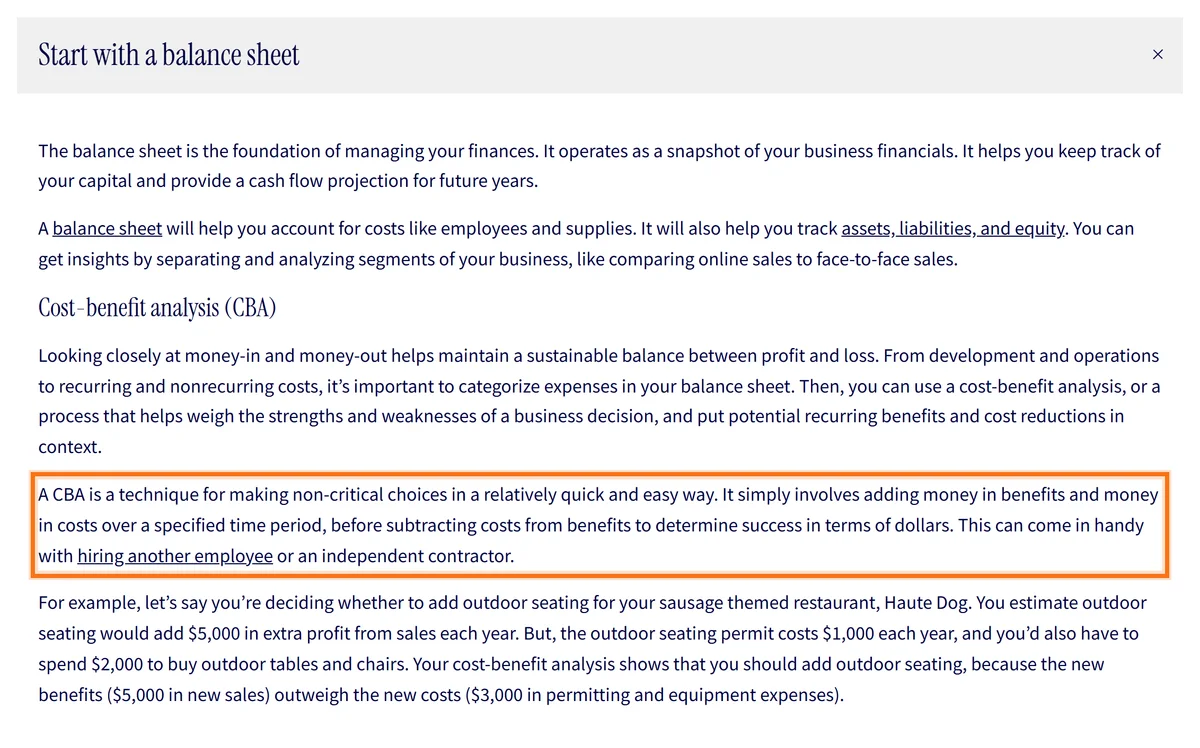
The arithmetic is easy. The inputs, such as what a new hire really costs with payroll taxes or what a service line actually earns, come from your books, which is why the bookkeeper belongs in the conversation.
Cost management and internal controls
Bookkeepers see every bill, so they are often the first to notice a subscription nobody uses, a vendor whose prices crept up, or a duplicate payment. A monthly expense review by category, compared with the prior month and the same month last year, catches most of it.
Controls matter as much as costs. The person who adds vendors should not also pay them and reconcile the account; bank and card access should be limited to the people who need it; and someone other than the preparer should review the monthly close. Our checklist of internal controls for small businesses lists the basic ones.
Where the bookkeeper’s role ends: controller and fractional CFO
Including your bookkeeper in strategy does not mean asking the bookkeeper to set it. The work usually splits into three layers:
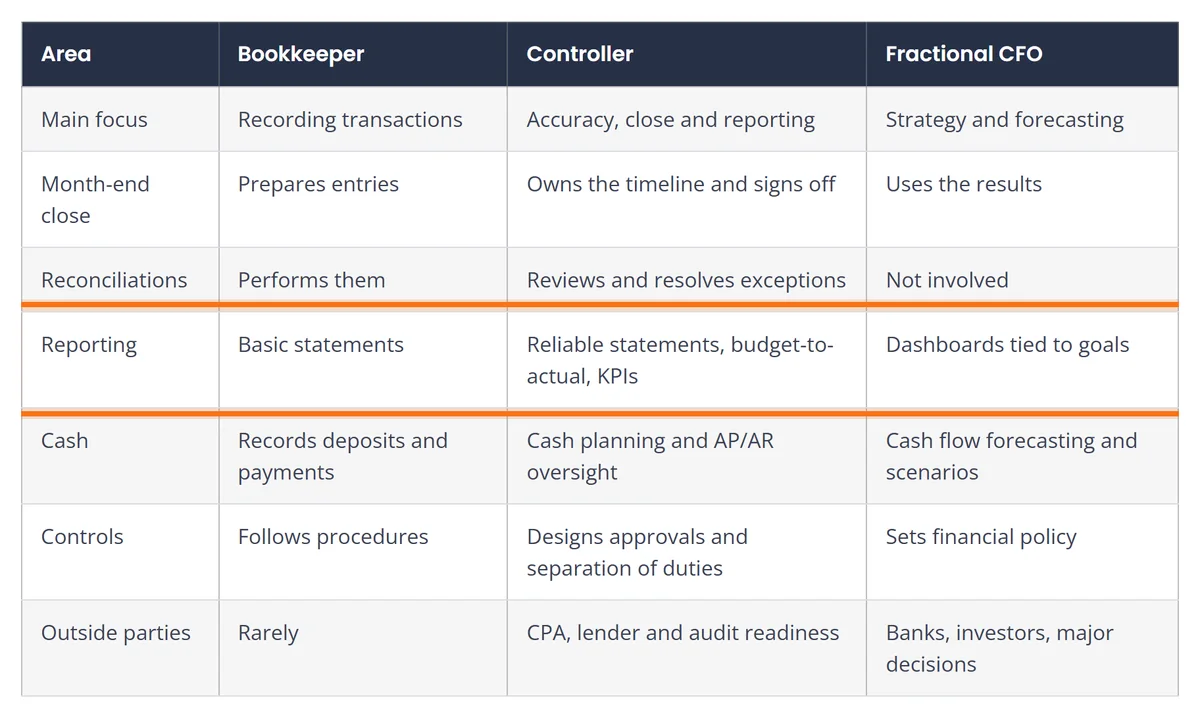
A bookkeeper records the transactions and performs the reconciliations. A controller owns the close, makes the statements reliable and adds budget-to-actual and KPI reporting. A fractional CFO uses those numbers for forecasting, pricing and growth decisions. Our comparison of bookkeeper vs. controller vs. fractional CFO explains when a business needs each one.
How to bring your bookkeeper into planning
- Agree on a close date. Know which day the month’s reviewed statements arrive, and keep it.
- Ask for a short summary. Three or four lines on what changed and why, alongside the reports.
- Code the books for your decisions. If you price by service or manage by location, set up the accounts or classes to match.
- Hold a monthly 30-minute review. Go through the summary, the receivables list and the cash position.
- Bring upcoming decisions to the review. A hire, a big purchase or a price change is easier to test against the numbers before it happens.
How LUCI Financial Solutions supports strategy for Dallas businesses
LUCI is a Dallas–Fort Worth bookkeeping and financial operations firm for established service businesses, typically those earning $250K or more a year. Every client starts with the Core plan: transactions categorized in QuickBooks Online, every account reconciled, a senior-level review, and a monthly package with an Executive Summary, Profit & Loss, Balance Sheet and Statement of Cash Flows.
The strategy layer is built on top. The Growth tier adds quarterly review meetings, custom and trend reporting, cash flow visibility, budget-to-actual and recommendations. The Scale (CFO Advisory) tier adds monthly strategy meetings, forecasting and scenario planning, margin analysis, a KPI dashboard and coordination with your CPA. Every plan is a fixed monthly fee set in a written proposal. See bookkeeping services in Dallas or fractional CFO services in Dallas.
Frequently asked questions about bookkeepers and business strategy
Why should you include bookkeepers in business strategy?
Because every strategic decision starts from numbers they produce: margins, cash, costs and trends. A bookkeeper who reconciles and reviews the books each month gives you figures you can plan from, and can tell you early when something in them does not look right.
What is bookkeeper business analysis?
It is the step from recording transactions to explaining them: comparing months, spotting rising costs or slow-paying customers, and showing margins by service or client. Basic analysis can come from a bookkeeper; budget-to-actual, KPIs and forecasts usually come from a controller or fractional CFO working from the same books.
Which financial reports matter most for planning?
The Profit & Loss for margins and costs, the Balance Sheet for what the business owns and owes, and the Statement of Cash Flows for why the bank balance moved. Add a receivables aging report if customers pay on terms.
Can a bookkeeper act as a financial advisor?
A bookkeeper keeps the records accurate and can point out what changed and why. Decisions on pricing, hiring, financing or expansion are better made with a controller or fractional CFO, and tax questions belong with your CPA.
How often should I review the numbers with my bookkeeper?
Monthly, after the books are closed and reviewed. A short monthly conversation about what changed is enough for most small businesses; growing companies add quarterly reviews or monthly strategy meetings.
Does LUCI Financial Solutions help Dallas businesses with planning?
Yes. LUCI keeps the books every month with a senior review, and its Growth and Scale tiers add quarterly reviews, budget-to-actual and trend reporting, cash flow forecasting, KPI dashboards and monthly strategy meetings for established Dallas–Fort Worth businesses.
Numbers you can plan from
Reconciled, reviewed monthly books and the reporting to plan with, for Dallas–Fort Worth businesses. See our bookkeeping services in Dallas.